How Much Should You Budget for Direct Mail?
Set the right budget for direct mail with real cost ranges, ROI formulas, and targeting insights to plan campaigns that actually generate leads and revenue

Aaron Boone
ceo
·12 min read
·Apr 30, 2026


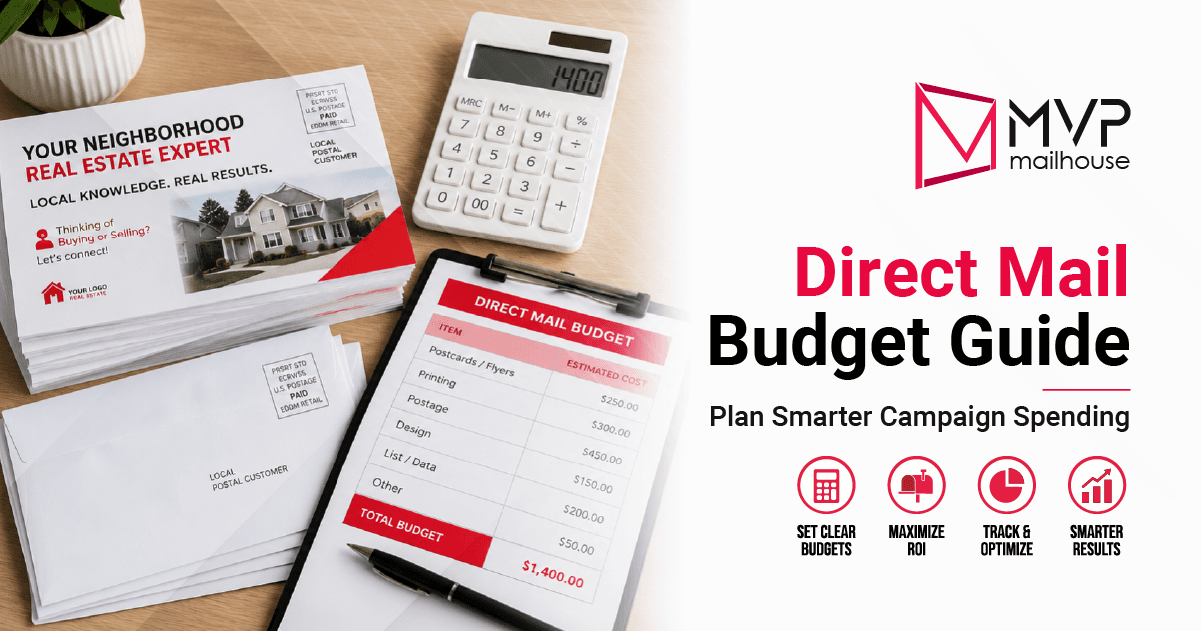
How much should you budget for direct mail if you actually want results, not just “send and hope” marketing? It’s a fair question. According to the Data & Marketing Association, direct mail response rates average 4.4% for prospect lists and 9% for house lists, far outperforming many digital channels. That kind of performance can drive serious ROI but only if your budget is structured correctly.
Direct mail continues to outperform digital channels, with an average response rate of 4.4% compared to just 0.12% for email marketing, according to the ANA/DMA Response Rate Report.
This guide breaks down what a realistic direct mail budget looks like, why costs vary so widely, and how to align your spend with measurable outcomes like leads, patients, or sales.
What Is a Realistic Direct Mail Budget?
A direct mail budget isn’t a single number, it’s a system. In practice, most businesses spend anywhere from $0.50 to $1.50 per piece, depending on format, targeting, and scale. That means:
- 5,000-piece campaign → $2,500 to $7,500
- 10,000-piece campaign → $5,000 to $15,000
Those ranges aren’t arbitrary. They reflect real campaign structures we see across industries like dental, home services, and local retail.
But here’s where most businesses get it wrong: they budget based on what they want to spend, not what it takes to generate results.
A dental clinic, for example, aiming for 50 new patients shouldn’t start with “we have $3,000.” Instead, they should reverse-engineer:
- Average patient value: $1,200
- Target ROI: 3x
- Required revenue: $60,000
- Acceptable acquisition cost per patient: ~$400
From there, the budget becomes strategic, not arbitrary.
If you want a deeper breakdown of cost structures, this guide on direct mail cost explains how these ranges are built.
Why Direct Mail Costs Vary So Much
Two campaigns can both mail 10,000 pieces and one costs $6,000 while the other hits $14,000. The difference comes down to a handful of variables that directly impact performance.
1. Format and Design Drive First Impressions
The format you choose has a measurable impact on both cost and response rates.
- Standard postcards: $0.50–$0.80 per piece
- Oversized postcards: $0.70–$1.20 per piece
- Letters with envelopes: $0.90–$1.50+ per piece
Larger formats cost more but they consistently outperform smaller ones in visibility and engagement. The USPS has reported that oversized mail pieces can increase response rates due to improved readability and prominence.
Across campaigns, oversized postcards tend to deliver stronger ROI for local businesses because they dominate the mailbox. If you’re unsure what size fits your campaign, this breakdown of postcard sizes for direct mail marketing is a useful reference.
The key takeaway: cheaper formats reduce upfront costs, but often increase your cost per acquisition.
2. Mailing List Quality Impacts Everything
Your mailing list is not just a cost, it’s a multiplier.
- Saturation (EDDM-style): lower cost, broader reach
- Targeted lists: higher cost, significantly better conversion
Targeted lists typically range from $0.05 to $0.30 per record, depending on filters like income, home value, or buying behavior.
In practice, campaigns targeting high-intent audiences (e.g., homeowners with specific income levels) often generate 2–3x higher response rates than broad campaigns.
We’ve seen dental practices mail 8,000 highly targeted households and outperform competitors mailing 25,000 untargeted homes. The difference wasn’t budget, it was precision.
If you’re evaluating list strategy, this guide on what a mailing list is in direct mail explains why targeting drives ROI.
3. Printing and Production Affect Perceived Value
Printing is where branding becomes tangible. And it directly influences trust.
- Basic print (standard stock, simple design): lower cost
- Premium print (thick stock, coatings, variable data): higher cost
The data supports this. A study by Temple University’s Center for Neural Decision Making found that physical media like direct mail requires 21% less cognitive effort to process compared to digital ads meaning higher-quality print can enhance recall and engagement.
Across industries, we’ve observed that premium-feeling mail often improves conversion rates enough to offset the increased cost.
If you want to understand how production impacts pricing, this resource on direct mail printing breaks down the components.
4. Postage Is the Largest Cost Driver
Postage usually accounts for 40% to 60% of your total direct mail budget.
Typical ranges:
- USPS Marketing Mail: ~$0.30–$0.50 per piece
- First-Class Mail: ~$0.60–$0.80 per piece
Bulk discounts can reduce costs significantly but they require planning, volume, and proper sorting.
The important nuance: cheaper postage often means slower delivery. That matters if your campaign is time-sensitive, like a seasonal dental promotion or retail sale.
For a detailed breakdown of mailing expenses, including postcard-specific costs, see this guide on how much it costs to mail a postcard.
The Hidden Cost Most Businesses Miss
There’s one cost that doesn’t show up on invoices but quietly destroys ROI: underfunding.
A campaign mailed once to 3,000 homes might cost $2,000. But without repetition, response rates often fall below 1%. That’s not a channel problem, it’s a budget strategy problem.
In practice, consistent campaigns (e.g., mailing every 4–6 weeks) dramatically outperform one-off sends. The reason is simple: repetition builds familiarity, and familiarity drives action.
Businesses that treat direct mail as a system, not a one-time expense consistently see better results.
How to Calculate the Right Budget for Your Direct Mail Campaign
A strong direct mail budget doesn’t start with guesswork, it starts with outcomes. If your goal is predictable growth (more patients, more booked jobs, more revenue), your budget needs to be reverse-engineered from those targets.
Across campaigns, the businesses that win with direct mail don’t ask, “What can we afford?” They ask, “What does it take to hit our numbers?”
Let’s walk through a practical framework.
Start With Revenue Goals, Not Mailing Costs
Most campaigns fail before they start because the budget is disconnected from business goals.
Instead, define:
- Monthly or campaign revenue target
- Average customer value
- Desired return on investment (ROI)
For example, a dental practice might look like this:
- Average patient value: $1,500
- Target new patients: 40
- Revenue goal: $60,000
- Target ROI: 3x
That means:
- Maximum marketing spend: ~$20,000
- Acceptable cost per acquisition: ~$500
Now your cost of a direct mail campaign becomes a calculated investment, not a blind expense.
In practice, this clarity changes everything. Campaigns become scalable, and decisions (like increasing volume or upgrading format) are based on ROI, not fear of spending.
If you want to go deeper into this math, this guide on how to calculate ROI from your direct mail campaign breaks it down step by step.
Use Response Rates to Estimate Volume and Budget
Once you know your target outcomes, the next step is estimating how many mail pieces you need.
Industry data shows:
- Prospect list response rate: ~4.4%
- House list response rate: ~9%
But here’s the reality, most local campaigns land closer to 1%–3% response rates depending on targeting and offer strength.
Let’s say:
- You want 40 new customers
- You estimate a 2% response rate
- You expect 50% of responders to convert
That means:
- You need 80 responses
- You need to mail ~4,000 pieces
Now apply average direct mail pricing:
- At $0.75 per piece → $3,000 budget
- At $1.00 per piece → $4,000 budget
That’s a grounded, data-backed estimate.
Across campaigns, we’ve found that businesses who plan using conservative response rates (1%–2%) avoid disappointment and outperform expectations when campaigns hit higher.
Factor in Campaign Frequency (This Is Where ROI Compounds)
One of the biggest mistakes in direct mail budgeting is treating it as a one-time effort.
The data tells a different story: repeated exposure significantly improves conversion rates. According to the USPS, consumers often need multiple brand touches (5–12 impressions) before taking action.
So instead of budgeting for one drop, plan for:
- 3-month campaign (minimum)
- 6–12 touchpoints over time
For example:
- Monthly mail to 5,000 homes
- Cost per drop: $4,000
- 3-month budget: $12,000
This is where consistency pays off.
In practice, we’ve watched home service businesses go from a 0.8% response rate on a single drop to over 2.5% by the third mailing to the same audience. Same list. Same offer. Different frequencies.
The takeaway: your direct mail budget should account for repetition, not just reach.
Align Your Budget With Key Performance Indicators (KPIs)
A budget without tracking is just spending. To make direct mail predictable, you need clear KPIs tied to your investment.
At minimum, track:
- Cost per lead (CPL)
- Cost per acquisition (CPA)
- Response rate
- Conversion rate
- ROI
For example:
- $5,000 campaign
- 100 leads generated → CPL = $50
- 30 customers acquired → CPA = ~$167
Now you can scale confidently.
Across industries, businesses that actively track and optimize these numbers improve ROI by 20%–40% over time, simply by refining targeting, creative, and timing.
If you’re unsure which metrics matter most, this guide on direct mail KPIs explains how to measure performance effectively.
Adjust Budget Based on Industry Benchmarks
Not all industries behave the same, and your mailing costs should reflect that.
Here’s how budgets typically differ:
Dental Practices
- Higher lifetime value → can afford higher CPA
- Typical budget: $5,000–$20,000/month
- Strong ROI when targeting new movers or high-income households
Home Services (HVAC, Roofing, Plumbing)
- Seasonal spikes → budget fluctuates
- Typical campaign: $3,000–$15,000 per drop
- High urgency offers drive response
Retail and Local Businesses
- Lower transaction value → tighter margins
- Typical budget: $2,000–$8,000
- Success depends heavily on offer and design
In practice, we’ve seen dental clinics comfortably scale campaigns because one new patient can justify the cost of acquiring several.
Meanwhile, retail businesses need sharper targeting and offers to make the numbers work.
The insight: your budget isn’t just about cost, it’s about economics.
Build Flexibility Into Your Direct Mail Budget
Even the best-planned campaigns need room to adapt.
Smart budgeting includes:
- Testing different formats (postcard vs letter)
- Trying new audiences
- Adjusting offers based on response
A common approach:
- Allocate 70% of budget to proven strategy
- Use 30% for testing and optimization
Across campaigns, this balance allows businesses to improve performance without risking the entire investment.
And over time, those small tests compound into major efficiency gains.
How to Optimize and Scale Your Direct Mail Budget
Once you’ve set a realistic budget for direct mail, the next step is making that budget work harder. This is where campaigns either plateau or compound.
The difference isn’t spend. It’s optimization.
Focus on ROI, Not Just Cost Per Piece
It’s tempting to reduce direct mail cost by choosing cheaper formats, lower postage tiers, or broader targeting. But lower cost per piece doesn’t guarantee better performance.
In practice, the opposite is often true.
A campaign that costs $0.60 per piece but generates a 0.8% response rate is less profitable than one costing $0.95 per piece with a 2.5% response rate.
Let’s break that down:
- 5,000 pieces at $0.60 → $3,000 spend → 40 responses (0.8%)
- 5,000 pieces at $0.95 → $4,750 spend → 125 responses (2.5%)
Even with higher upfront mailing costs, the second campaign produces over 3x the leads.
Across campaigns, the data shows that ROI, not cost, is the metric that determines scalability.
If you want to improve returns, this guide on how to improve your direct mail ROI outlines practical strategies that consistently increase performance.
Improve Targeting to Reduce Waste
One of the fastest ways to optimize your direct mail budget is eliminating wasted impressions.
Every irrelevant household you mail to increases your cost per acquisition.
Refined targeting using filters like income, homeownership, or behavioral data can reduce waste dramatically. According to McKinsey, personalization can increase marketing ROI by 10–30% (McKinsey & Company).
In real campaigns, tighter targeting often leads to:
- Higher response rates
- Lower cost per lead
- More predictable outcomes
We’ve seen service businesses cut their mailing volume by 40% while maintaining the same number of leads, simply by improving audience selection.
If you’re evaluating list costs and targeting depth, this breakdown of mailing list pricing provides useful context.
Strengthen Offers and Creative (This Drives Conversion)
You can’t out-budget a weak offer.
No matter how optimized your direct mail pricing is, poor messaging will drag down results.
Strong campaigns typically include:
- A clear, compelling offer (e.g., “Free exam + X-rays” for dental)
- Urgency (limited-time incentives)
- A strong call to action
According to a study by Canada Post, direct mail requires 39% less cognitive effort to process than digital ads, meaning your message has a better chance of being remembered but only if it’s clear and compelling.
Across industries, improving the offer alone can double response rates without increasing budget.
Use Data to Continuously Refine Campaigns
Optimization isn’t a one-time effort. It’s a system. The most effective direct mail strategies evolve based on real performance data.
Track:
- Which lists perform best
- Which formats generate higher response
- Which offers convert
Then adjust.
For example:
- If oversized postcards outperform letters, shift budget there
- If one demographic responds 2x more, double down on that segment
Over time, these small improvements compound into significant gains.
If you’re unsure how to measure effectiveness, this article on how effective direct mail marketing is provides benchmarks and expectations.
Know When to Scale Your Budget
Scaling isn’t about spending more, it’s about spending with confidence.
You’re ready to increase your direct mail budget when:
- Your cost per acquisition is stable and profitable
- Response rates are consistent across multiple drops
- Your operations can handle increased demand
At that point, increasing volume becomes a growth lever. Across campaigns, businesses that reach this stage often scale from:
- 5,000 pieces → 15,000+ pieces per drop
- Monthly spend → multi-market expansion
We’ve seen dental groups expand into multiple zip codes after proving ROI in a single area, turning direct mail into a predictable patient acquisition channel.
Conclusion: Budgeting for Direct Mail Is About Predictability, Not Guesswork
So, how much should you budget for direct mail?
The answer isn’t a fixed number, it’s a framework.
A successful direct mail budget:
- Starts with revenue and ROI goals
- Accounts for real-world direct mail costs like printing, lists, and postage
- Factors in frequency and consistency
- Evolves through testing and optimization
When done correctly, direct mail becomes one of the most predictable marketing channels available. It’s not about sending more, it’s about sending smarter.
The businesses that win with direct mail don’t treat it as an expense. They treat it as a growth engine.
If you’re ready to build a campaign that delivers consistent leads, measurable ROI, and scalable growth, explore our direct mail pricing options and see exactly how your investment translates into results.
Because the goal isn’t just to send mail, it’s to create a system that drives predictable customer acquisition, month after month.
Tags
Industry Insights
Frequently Asked Questions
Related blog



Ready For Your Success Story?
Get 500 Free Handout cards shipped right to your doorstep!