Direct Mail Printing: Everything You Need to Know
Direct mail printing still drives strong response rates when done right. Learn costs, personalization, formats, targeting, and campaign strategy.

Michael Stephen Hohl
marketing consultant
·19 min read
·Jun 25, 2025


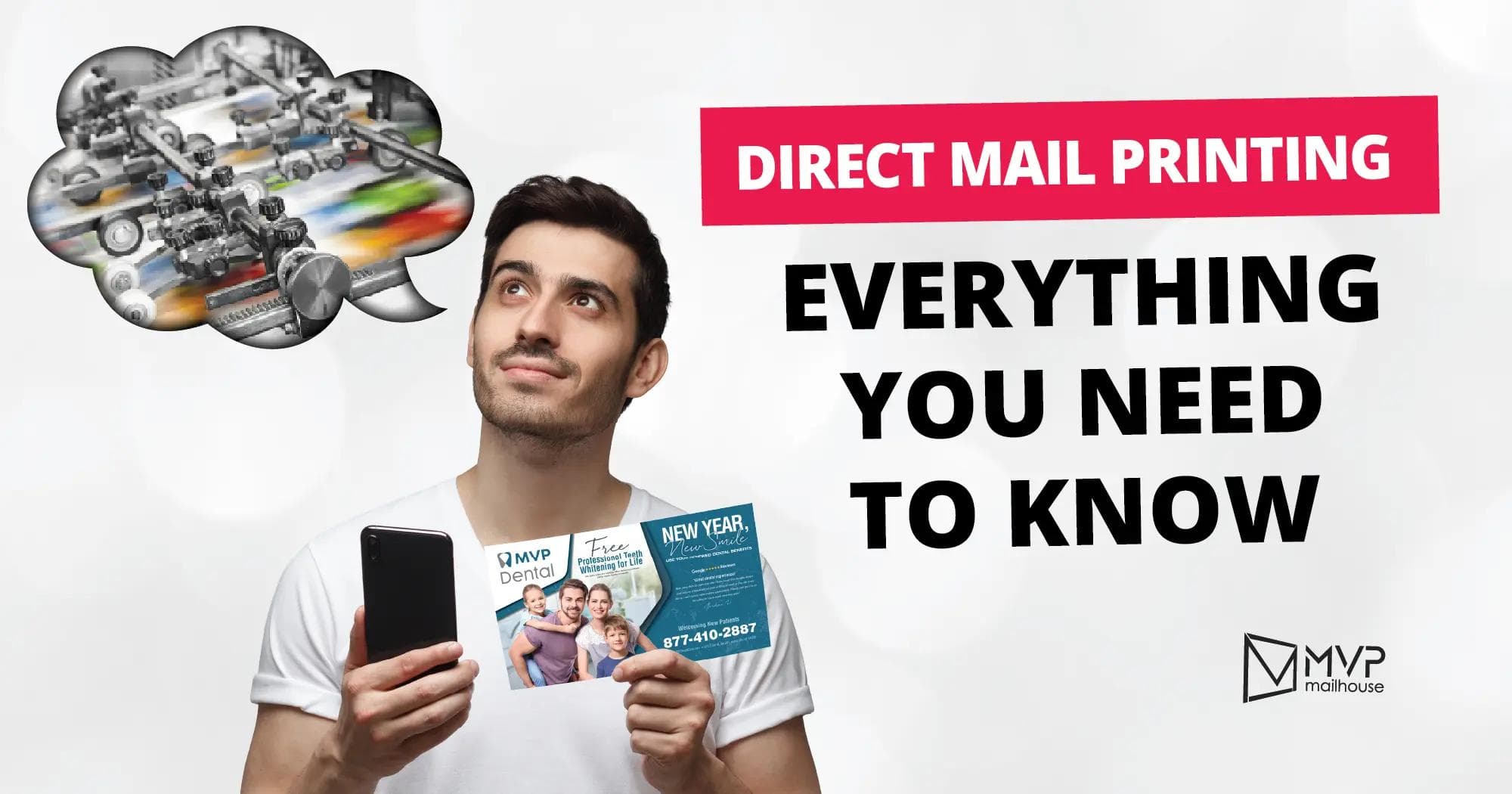
Direct mail printing is far from outdated. In fact, response rates for direct mail continue to outperform many digital channels, with the Data & Marketing Association reporting house lists averaging a 9% response rate compared to email’s average click rate below 2%. That gap explains why healthcare groups, local businesses, franchises, and service companies still invest heavily in physical mail.
But results rarely come from simply printing postcards and dropping them in the mail.
The real performance difference comes from how the mail is printed, personalized, formatted, and delivered. A poorly executed campaign wastes postage. A strategically printed campaign can consistently drive appointments, calls, and measurable revenue for months.
This guide breaks down what direct mail printing actually is, how direct mail printing works, what affects performance, how much direct mail printing costs, and what businesses should know before launching a campaign.
What Is Direct Mail Printing?
Direct mail printing is the process of producing physical marketing materials specifically designed to be mailed to targeted recipients. These materials can include postcards, brochures, letters, catalogs, flyers, newsletters, and promotional offers.
Unlike general commercial printing, direct mail printing is tied directly to marketing performance. The print itself influences response rates, readability, deliverability, and conversion outcomes.
A successful direct mail campaign combines several moving parts:
- Print production
- Mailing list management
- Variable data personalization
- USPS preparation
- Design optimization
- Tracking and attribution
That combination is why direct mail printing services have become more sophisticated over the past decade. Modern campaigns are heavily data-driven rather than “spray and pray.”
In practice, businesses that treat direct mail as a measurable acquisition channel usually outperform companies using generic saturation mail.
For example, dental offices frequently use targeted postcard campaigns to promote new patient specials. Across campaigns we’ve analyzed, hyper-targeted geographic mailings often outperform broad local mail by a substantial margin because the messaging aligns more closely with household demographics and insurance data.
Why Direct Mail Printing Still Works in 2026
Digital fatigue is real.
Consumers receive hundreds of emails daily, yet physical mailboxes remain relatively uncluttered. According to the United States Postal Service, 98% of consumers bring in their mail the same day it’s delivered, and direct mail receives significantly longer attention spans than digital ads.
According to the 2024 ANA/DMA Response Rate Report, direct mail campaigns generate an average prospect response rate of 4.9%, significantly outperforming many digital advertising channels. The report also found that highly targeted oversized postcards can achieve response rates between 5% and 9%, especially in industries like healthcare, home services, and local business marketing.
That matters because attention drives action.
Printed mail creates several advantages digital channels struggle to replicate:
Physical Presence Creates Higher Recall
A postcard sits on a kitchen counter. A letter remains on a desk. That repeated exposure increases memory retention.
Neuromarketing studies published by Canada Post found direct mail requires 21% less cognitive effort to process than digital media while producing stronger brand recall.
We consistently notice this with local service businesses. Even when prospects do not respond immediately, they often keep postcards for weeks before booking.
Email disappears in seconds. Mail stays visible.
Direct Mail Builds Local Trust Faster
Physical marketing still signals legitimacy.
For industries like dental, home services, legal, or healthcare, consumers tend to trust professionally printed mail more than random social ads. Poor print quality, however, has the opposite effect.
Cheap stock, blurry images, or flimsy postcards can quietly damage credibility.
That’s one reason paper selection matters more than most businesses realize. Choosing the right finish and thickness affects perceived value immediately. Businesses comparing materials often benefit from understanding the best paper for postcards in direct mail printing before finalizing production.
Targeting Has Improved Dramatically
One major misconception is that direct mail lacks precision.
Modern direct mail printing services can target based on:
- Household income
- Homeownership
- Age demographics
- Purchase behavior
- Insurance type
- Geographic radius
- Presence of children
- Move-in date
- Business ownership
That level of targeting allows campaigns to behave much more like paid social advertising, except with lower competition for attention.
The data shows targeted direct mail can improve response rates by 2–5x compared to untargeted saturation campaigns.
How Direct Mail Printing Works
Businesses often underestimate how technical direct mail production can become behind the scenes.
The printing itself is only one stage.
Here’s how a typical direct mail printing workflow operates from start to finish.
1. Audience Selection
Everything begins with the mailing list.
If the audience is wrong, even exceptional creative fails.
Most professional direct mail printing services either help build mailing lists internally or integrate with third-party data providers. Businesses define targeting criteria based on geography, demographics, purchasing behavior, or customer history.
In healthcare marketing, for instance, practices frequently target:
- New movers
- Families with children
- Households with PPO insurance
- Higher-income ZIP codes
We’ve repeatedly seen mailing accuracy influence ROI more than flashy design.
2. Design and Layout
The design phase directly affects response behavior.
Strong direct mail design balances:
- Readability
- Offer clarity
- Visual hierarchy
- CTA placement
- Brand trust
- USPS compliance
Small adjustments can create major performance swings.
For example, campaigns with oversized headlines and one clear offer routinely outperform cluttered postcard layouts filled with competing messages.
Businesses looking to improve conversion rates should understand how design impacts direct mail response rates, particularly when competing in crowded local markets.
3. Variable Data Printing and Personalization
Personalization has transformed direct mail performance.
Variable data printing allows each printed piece to dynamically change text, offers, names, images, or messaging based on recipient data.
Examples include:
- Personalized first names
- Neighborhood-specific messaging
- Unique offers
- Dynamic maps
- Individual QR codes
According to InfoTrends research, personalized direct mail campaigns can improve response rates by more than 40%.
This is especially effective in healthcare and local service marketing where relevance matters heavily.
Businesses unfamiliar with personalization strategies should review how variable data printing works in direct mail marketing before scaling campaigns.
Printing Technology Has Changed More Than Most Businesses Realize
Modern direct mail printing no longer operates like traditional offset-only print shops.
Today’s campaigns often combine:
- Digital printing
- Automated personalization
- Intelligent barcoding
- Real-time tracking
- USPS automation
- Trigger-based workflows
This evolution has significantly reduced turnaround times.
A decade ago, campaigns could take weeks to launch. Today, many custom direct mail printing campaigns can move from approval to mailbox delivery in under 10 business days.
Speed matters because timing affects campaign performance.
For example, new mover campaigns work best when households receive mail within the first 30–60 days after relocating. Delayed delivery weakens intent and lowers response rates.
Across local acquisition campaigns, we’ve found that businesses treating direct mail like a rapid-response channel rather than a quarterly branding exercise usually see stronger ROI consistency.
The Hidden Difference Between Good and Bad Direct Mail Printing
Most businesses focus heavily on design but overlook production quality.
That’s a mistake.
Print execution directly impacts deliverability, engagement, and trust.
The strongest-performing campaigns usually share several production characteristics:
- Consistent color calibration
- High-resolution imagery
- Proper cardstock thickness
- USPS-compliant formatting
- Clean trimming
- Durable coating finishes
- Accurate address hygiene
Poor print quality creates subconscious distrust.
Consumers may not articulate why a postcard feels “cheap,” but they react to it anyway.
We regularly see businesses improve campaign performance simply by upgrading print stock and simplifying design clutter without changing the actual offer.
Postcard dimensions also influence response behavior. Larger formats often improve visibility, though oversizing without strategy can unnecessarily increase postage costs. Businesses evaluating format options should review this guide to postcard sizes for direct mail marketing before selecting final specs.
Custom Direct Mail Printing Gives Businesses a Competitive Advantage
Generic mail rarely performs well anymore.
Consumers instantly recognize templated marketing. The businesses generating the strongest ROI today are using custom direct mail printing strategies tailored to audience behavior, local competition, and customer intent.
Customization extends far beyond simply adding a first name.
High-performing campaigns often customize:
- Messaging by ZIP code
- Offers by household demographics
- Images by audience segment
- Seasonal promotions
- Service recommendations
- QR code landing pages
- Appointment incentives
In practice, personalization works because it reduces psychological friction. The recipient feels like the message was intended specifically for them rather than blasted to thousands of households.
One overlooked tactic we’ve seen perform extremely well involves neighborhood-specific references. For example, dental practices referencing local schools, communities, or nearby landmarks consistently create stronger familiarity and response engagement.
That relevance compounds when combined with thoughtful print design and strategic timing.
Direct Mail Printing Costs: What Businesses Actually Pay
One of the most common questions businesses ask is: “How much does direct mail printing cost?”
The answer depends on several variables:
- Mail format
- Paper stock
- Quantity
- Personalization
- Postage
- Design complexity
- Mailing list quality
- Automation level
For postcards, total direct mail printing costs often range between $0.35 and $0.85 per piece including postage.
But focusing only on unit cost is usually the wrong approach.
The better question is cost per acquisition.
A cheaper campaign with weak targeting often becomes far more expensive than a higher-quality campaign generating stronger response rates.
We’ve watched businesses attempt to reduce costs by using thinner cardstock or broad untargeted lists, only to see response rates collapse. Saving a few cents per piece can destroy ROI if the campaign fails to generate meaningful conversions.
The Biggest Cost Drivers in Direct Mail Printing
Print Quantity
Larger print runs typically reduce per-unit pricing because setup costs spread across more pieces.
However, larger volume does not always equal better ROI.
Smaller, highly targeted campaigns frequently outperform massive untargeted mail drops.
Paper and Finishes
Premium paper increases costs but can significantly improve perception and response.
Gloss coatings, UV finishes, and thicker cardstock create a more substantial feel in the recipient’s hands.
Businesses evaluating paper options often underestimate how much tactile quality affects conversion behavior. Understanding what type of paper is used for postcards helps businesses avoid production choices that weaken campaign credibility.
Postage
Postage is usually the largest single expense.
The USPS offers different mailing rates based on:
- Mail class
- Piece dimensions
- Automation compatibility
- Presorting
- Saturation eligibility
Postcard size directly affects postage pricing. Oversized pieces may improve visibility but increase mailing costs substantially if not carefully planned.
Businesses calculating budgets should understand how much it costs to mail a postcard before selecting formats.
Personalization and Variable Data
Advanced personalization increases production complexity but often improves ROI enough to justify the added cost.
The data shows personalized direct mail campaigns consistently outperform static campaigns in response and conversion metrics.
Across customer acquisition campaigns, we often see personalization reduce cost per lead over time because higher engagement offsets production expenses.
Offset vs Digital Printing: Which Is Better for Direct Mail?
Businesses comparing direct mail printing services eventually encounter the offset vs digital printing debate.
Both have strengths.
Offset Printing
Offset printing is traditionally used for high-volume campaigns.
Advantages include:
- Lower costs at massive volume
- Extremely consistent color quality
- Premium image reproduction
However, offset becomes less efficient for highly personalized campaigns because each variation requires additional setup.
Digital Printing
Digital printing dominates modern custom direct mail printing because it supports:
- Variable data personalization
- Faster turnaround times
- Lower minimum quantities
- Easier version testing
For most local and mid-sized businesses, digital printing is usually the more flexible and practical solution.
We’ve seen this especially in healthcare marketing where offers, provider information, and audience segments change frequently.
Businesses trying to choose between operational models should also evaluate the tradeoffs in in-house printing vs outsourced printing for direct mail before investing in equipment or staffing.
Why Direct Mail Design Impacts Printing Performance
Even excellent printing cannot save weak creative.
Design directly affects whether recipients:
- Read the mail
- Understand the offer
- Trust the business
- Take action
According to research from Lob and Comperemedia, nearly 60% of consumers are more likely to engage with visually appealing direct mail.
Yet many businesses still overload postcards with excessive information.
The highest-performing campaigns are usually visually disciplined.
In practice, strong direct mail design often follows several principles:
- One primary offer
- One clear CTA
- Strong headline hierarchy
- High contrast readability
- Minimal clutter
- Intentional whitespace
- Mobile-friendly QR experiences
The mistake many businesses make is treating direct mail like a brochure rather than a conversion tool.
High-performing postcards are designed for scanning behavior, not deep reading.
QR Codes and Mobile Integration Are Changing Response Behavior
Modern direct mail printing increasingly bridges offline and digital experiences.
QR codes now play a major role in campaign tracking and attribution.
When implemented correctly, QR integrations can:
- Track engagement
- Improve appointment scheduling
- Personalize landing pages
- Attribute ROI more accurately
- Reduce friction in mobile conversion paths
We’ve consistently noticed QR code usage improving among younger demographics who prefer instant digital interaction rather than phone calls.
However, QR codes only work when paired with compelling offers and fast-loading landing pages.
Poor digital experiences kill otherwise strong direct mail campaigns.
The Most Effective Direct Mail Formats Today
Different formats perform differently depending on campaign goals.
Postcards
Postcards remain the most common direct mail format because they are:
- Affordable
- Fast to read
- Highly visible
- USPS-efficient
They work especially well for:
- Dental marketing
- Local promotions
- Appointment reminders
- New mover campaigns
- Seasonal offers
In healthcare campaigns, oversized postcards frequently outperform standard sizes because they dominate the mailbox visually.
Businesses exploring healthcare-specific campaigns should understand the best postcard sizes for dental direct mail success before production.
Letters in Envelopes
Letters typically generate stronger engagement for higher-trust or higher-value services.
Examples include:
- Financial services
- Legal firms
- Specialty healthcare
- Insurance offers
Enveloped mail creates curiosity and often feels more personal.
However, production costs and postage are higher.
Self-Mailers and Folded Pieces
Self-mailers allow businesses to communicate more information without envelope costs.
They work well for:
- Multi-service promotions
- Educational campaigns
- Retail offers
- Product catalogs
The downside is increased design complexity.
Improper folding or layout structure can confuse readers quickly.
How Long Direct Mail Campaigns Take to Produce
Businesses often underestimate campaign timelines.
Typical direct mail printing timelines range from 7–21 business days depending on complexity.
Here’s a realistic breakdown (Stage: Estimated Timeline):
- Strategy and targeting: 1–3 days
- Design development: 2–5 days
- Proofing and approvals: 1–3 days
- Printing production: 2–7 days
- USPS preparation: 1–3 days
- Mail delivery: 3–10 days
Rush campaigns are possible but usually increase costs.
Across campaigns, businesses that plan campaigns at least 3–4 weeks ahead tend to avoid costly production mistakes and achieve better timing coordination.
The Businesses Seeing the Best Results From Direct Mail Printing
Direct mail works especially well in industries where trust, geography, and lifetime customer value matter.
Some of the strongest-performing sectors include:
- Dental practices
- Orthodontics
- Home services
- Med spas
- Insurance agencies
- Real estate
- Legal services
- Franchises
These industries benefit because customer value often justifies acquisition costs.
For example, a dental office acquiring one long-term family patient through direct mail may generate thousands in lifetime revenue.
That changes the economics completely.
Businesses that succeed usually approach direct mail systematically rather than as a one-time experiment. Campaign consistency matters more than most marketers realize.
One postcard rarely changes a business. Repeated brand visibility often does.
Common Direct Mail Printing Mistakes That Hurt ROI
Many businesses assume direct mail failed when the real issue was execution.
The gap between profitable and unprofitable campaigns is often surprisingly small. A weak mailing list, poor timing, cluttered design, or cheap production quality can quietly reduce performance before the mail even reaches the recipient.
Here are some of the most common mistakes we consistently see across campaigns.
Treating Direct Mail Like a One-Time Campaign
One of the biggest misconceptions is expecting immediate, massive returns from a single drop.
Direct mail performs best through repetition and consistency.
According to the Rule of 7 marketing principle, consumers often need multiple exposures before taking action. Direct mail works similarly. Repeated visibility increases familiarity, trust, and recall over time.
Across local service campaigns, businesses mailing consistently for 6–12 months usually outperform businesses that stop after one attempt because the compounding brand recognition effect becomes substantial.
In practice, direct mail often behaves more like a long-term acquisition engine than a short-term sales spike.
Weak Offers Kill Good Design
Beautiful mailers do not automatically generate conversions.
Consumers respond to compelling offers, urgency, and relevance.
Strong direct mail offers typically include:
- Clear value propositions
- Time-sensitive incentives
- Easy response paths
- Minimal friction
- Specific outcomes
The highest-performing healthcare campaigns frequently emphasize outcomes instead of features.
For example:
- “Get Your First Dental Cleaning for $99”
- “Free Whitening for New Patients”
- “Same-Day Emergency Appointments Available”
That specificity consistently outperforms vague branding language.
Ignoring Tracking and Attribution
Businesses that fail to track campaign performance usually struggle to improve ROI.
Modern direct mail printing campaigns should track:
- Calls
- QR scans
- Landing page visits
- Appointment bookings
- Coupon redemption
- Cost per acquisition
- Lifetime customer value
The data matters because optimization compounds over time.
We’ve seen businesses reduce acquisition costs dramatically after identifying which ZIP codes, postcard formats, or offers consistently outperformed others.
Without tracking, direct mail becomes guesswork.
How to Choose the Right Direct Mail Printing Services
Not all direct mail printing services operate at the same level.
Some companies simply print materials. Others manage the full campaign ecosystem including targeting, strategy, personalization, mailing logistics, and performance optimization.
The difference matters.
A printing partner should ideally understand both production and marketing performance, not just machinery.
Questions Businesses Should Ask Before Hiring a Direct Mail Printer
Do They Handle USPS Compliance Internally?
Mail formatting errors can delay campaigns and increase postage costs.
Experienced providers ensure mail pieces meet automation standards and postal requirements before production begins.
Can They Support Variable Data Printing?
Personalization is no longer optional in competitive markets.
Businesses should confirm the provider can manage advanced custom direct mail printing capabilities including dynamic personalization and segmented messaging.
What Is Their Average Turnaround Time?
Speed affects campaign timing and seasonal relevance.
Reliable providers should clearly communicate:
- Production timelines
- Proofing timelines
- Mailing windows
- USPS delivery expectations
Do They Offer Campaign Tracking?
The strongest direct mail printing services now integrate tracking technology directly into campaigns.
This may include:
- Call tracking
- QR tracking
- Personalized URLs
- Delivery tracking
- Attribution dashboards
Businesses focused on long-term growth should prioritize providers who understand campaign analytics rather than just print fulfillment.
Why Direct Mail and Digital Marketing Work Better Together
The highest-performing campaigns rarely rely on one channel alone.
Direct mail becomes significantly more effective when paired with digital marketing.
This multi-channel approach reinforces brand recognition and improves conversion timing.
For example:
- A consumer sees a postcard
- Later notices a retargeting ad
- Searches the business online
- Reads reviews
- Finally books an appointment
That sequence is increasingly common.
According to MarketingSherpa research, integrated direct mail and digital campaigns can improve response rates by up to 63% compared to single-channel campaigns.
In practice, direct mail often acts as the trust-building touchpoint while digital channels provide convenience and reinforcement.
The businesses generating the strongest ROI typically coordinate:
- Direct mail
- Google Ads
- Meta ads
- SEO
- Email marketing
- SMS follow-ups
That ecosystem creates repeated visibility across multiple environments.
How to Launch a Successful Direct Mail Printing Campaign
The most effective campaigns usually follow a structured process instead of rushing into production.
Businesses planning campaigns should focus on:
- Defining acquisition goals
- Selecting the right audience
- Building a strong offer
- Designing for conversion
- Choosing effective formats
- Personalizing messaging
- Tracking results consistently
- Repeating and optimizing
Businesses looking for a deeper campaign framework should review how to run a successful direct mail campaign before launching production.
Campaign execution matters more than most businesses expect.
Small operational improvements compound quickly in direct mail because postage represents such a large investment. Better targeting, stronger offers, and smarter print production can dramatically improve profitability over time.
Conclusion
Direct mail printing remains one of the most effective customer acquisition channels available when executed strategically.
Despite the rise of digital advertising, physical mail continues to command attention, build trust, and generate measurable response rates across industries like healthcare, home services, real estate, and local business marketing.
But successful campaigns involve much more than printing postcards.
The strongest-performing direct mail campaigns combine:
- Precise audience targeting
- High-quality print production
- Strategic personalization
- Clear offers
- Strong design
- Accurate tracking
- Consistent campaign execution
Businesses that approach direct mail scientifically rather than casually tend to see the best long-term results.
In practice, direct mail works best when businesses commit to optimization over time instead of expecting instant success from a single campaign. The data, targeting, creative, and production quality all work together to influence ROI.
The companies seeing predictable growth today are not simply “sending mail.” They are building repeatable acquisition systems around direct mail printing.
Done correctly, direct mail can become a scalable source of consistent leads, stronger local visibility, and long-term customer growth that compounds month after month.
Tags
Industry Insights
Frequently Asked Questions
Related blog



Ready For Your Success Story?
Get 500 Free Handout cards shipped right to your doorstep!