Direct Mail vs Social Media Marketing: Which Wins for You?
Direct mail vs social media marketing: compare ROI, response rates, and funnel impact to see which channel actually drives real conversions and growth

Michael Stephen Hohl
marketing consultant
·14 min read
·Apr 23, 2026


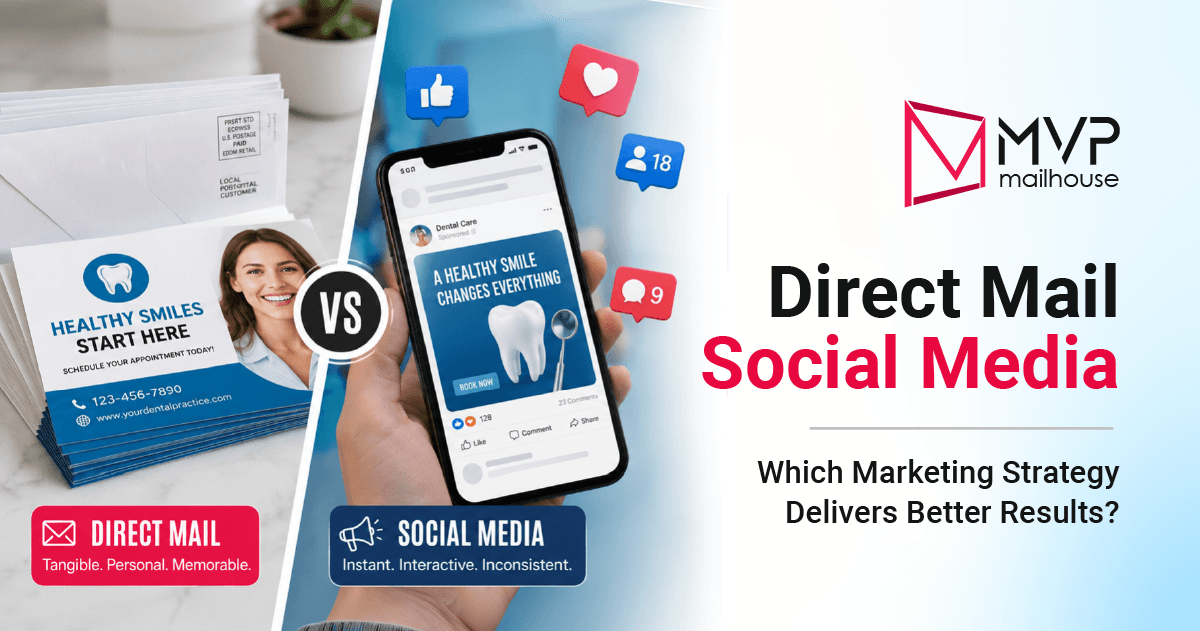
Direct mail vs social media marketing isn’t just a tactical debate, it’s a strategic decision that shapes how you acquire, convert, and retain customers. Here’s the reality: direct mail response rates can reach 4.4% for prospect lists, compared to email’s average of 0.12% (Data & Marketing Association). That gap alone raises an important question, are you investing in the channels that actually convert?
This article breaks down not just what each channel does, but where each one wins across the marketing funnel, what kind of ROI you can realistically expect, and how to choose the right mix for your business especially if you’re in high-value, service-based industries like dentistry.
What Is Direct Mail vs Social Media Marketing?
At a glance, the comparison seems simple. In practice, it’s anything but.
Direct mail marketing is a physical, targeted outreach channel: postcards, letters, dimensional mail, sent to specific households or businesses. It’s interruption-based, tactile, and often hyper-local.
Social media marketing, on the other hand, operates in a crowded, algorithm-driven environment. It’s digital, scalable, and primarily attention-based relying on engagement signals like likes, shares, and comments.
The distinction that matters most? Intent vs attention.
- Direct mail reaches people based on who they are (demographics, location, income).
- Social media reaches people based on what they do (interests, behavior, engagement patterns).
That difference shapes everything from response rates to ROI timelines.
Direct Mail Marketing Benefits (And Why It Still Outperforms)
Despite being labeled “traditional,” direct mail consistently delivers some of the highest ROI in marketing. The reason is simple: it cuts through digital noise.
1. Higher Response Rates and Conversion Intent
The data shows that direct mail response rates outperform most digital channels. While social media engagement rates often hover below 1%, direct mail campaigns routinely generate 2–5% response rates depending on targeting quality (DMA).
In practice, we’ve seen dental campaigns generate:
- 3–6% response rates within 30–60 days
- Cost per acquisition (CPA) 20–40% lower than paid social
- Immediate appointment bookings within the first week of delivery
That’s not just engagement, that’s action.
If you want a deeper breakdown of performance benchmarks, this guide on what is a good response rate for direct mail marketing puts those numbers into context.
2. Strong ROI with Predictable Timelines
Direct mail ROI isn’t speculative, it’s measurable and often predictable. Campaigns typically follow a clear timeline:
- Week 1–2: Mail delivery and initial responses
- Week 3–6: Peak conversions and appointment scheduling
- Month 2–3: Full ROI visibility
Across campaigns, direct mail ROI often ranges from 5:1 to 9:1, particularly in industries with high customer lifetime value.
If you’re unsure how to quantify this, here’s a practical walkthrough on how to calculate ROI from your direct mail campaign.
3. Less Competition, More Attention
Social media feeds are saturated. Your ad is competing with hundreds of posts, reels, and ads, every minute.
Direct mail lands in a quieter space: the mailbox.
- 90% of direct mail gets opened
- 70% of consumers say mail feels more personal than digital ads
This creates a rare advantage: undivided attention.
We’ve observed that even simple postcard campaigns outperform highly produced digital creatives when targeting is precise. Why? Because the message isn’t fighting for visibility, it owns it.
4. Ideal for Local and High-Intent Services (Especially Dentists)
For local businesses, especially dental practices, direct mail aligns perfectly with how patients choose providers:
- Proximity matters
- Trust matters
- Timing matters
A well-timed mailer like a new patient offer or insurance reminder can drive immediate bookings.
If you’re in this space, this breakdown on why direct mail beats digital ads for dental offices shows exactly how practices are leveraging it for consistent patient growth.
Social Media Marketing Benefits (And Where It Actually Wins)
Social media isn’t ineffective, it’s just often misused. Its strength lies earlier in the funnel, not at the point of conversion.
1. Scalable Reach and Brand Awareness
Social platforms give you access to massive audiences at relatively low upfront cost.
- Facebook and Instagram ads can reach thousands for a few dollars per day
- Organic content builds ongoing visibility without direct spend
This makes social media highly effective for:
- Brand awareness
- Audience education
- Community building
However, awareness doesn’t always translate to action.
Across campaigns, click-through rates (CTR) for social ads typically range from 0.9% to 1.6%, with conversion rates often below 2%. That’s a steep drop-off compared to direct mail’s response-driven model.
2. Real-Time Optimization and Data Feedback
One undeniable advantage of social media is speed.
You can:
- Launch campaigns instantly
- Adjust targeting in real time
- Test creatives and messaging quickly
This makes it ideal for experimentation and rapid iteration.
In practice, businesses use social media to:
- Identify winning offers
- Test messaging before scaling into direct mail
- Retarget website visitors
It’s not the closer, it’s the optimizer.
3. Lower Entry Cost (But Higher Long-Term Spend)
At first glance, social media seems cheaper. You can start with a small budget and scale gradually.
But here’s the trade-off:
- Cost per lead increases as competition rises
- Algorithm changes can disrupt performance overnight
- Continuous spend is required to maintain visibility
Over time, many businesses find that social media ROI becomes less predictable, especially in competitive markets like healthcare or local services.
Direct Mail vs Social Media Marketing: The Core Difference
If you strip everything down, the comparison comes down to this:
- Direct mail converts demand.
- Social media creates demand.
That distinction matters more than any feature or metric.
Businesses that rely solely on social media often struggle with inconsistent lead flow. Those that rely only on direct mail may miss out on long-term brand building.
The smartest strategy isn’t choosing one, it’s knowing when each one should lead.
Direct Mail vs Social Media Across the Marketing Funnel
Most comparisons stop at surface-level pros and cons. That’s where they fall short. The real question isn’t which is better overall, it’s which channel performs best at each stage of the funnel.
When you map both channels against awareness, consideration, and conversion, the differences become obvious and actionable.
Awareness Stage: Social Media Leads, But Attention Is Fragile
At the top of the funnel, social media dominates.
Platforms like Facebook, Instagram, and TikTok are built for discovery. You can introduce your brand to thousands of potential customers quickly and at a relatively low cost.
Typical awareness metrics:
- Cost per 1,000 impressions (CPM): $5–$15
- Engagement rate: 0.5%–1.5%
- Video view rates: 10%–30% depending on creative
In practice, this is where social media shines:
- Showcasing your brand personality
- Educating prospects about services
- Building familiarity before purchase
But there’s a catch, attention is rented, not owned.
Algorithms decide who sees your content. Engagement fluctuates. And most users aren’t actively looking to buy, they’re scrolling.
Across campaigns, we’ve found that while awareness metrics look strong on paper, they rarely translate into immediate revenue without a second touchpoint.
Consideration Stage: Both Channels Compete (But in Different Ways)
This is where the comparison gets more nuanced. Social media uses retargeting, testimonials, and educational content to nurture prospects. It’s effective when someone already knows your brand.
Direct mail, however, introduces a different dynamic: physical reinforcement.
When a prospect sees your brand online and receives a tangible mail piece, trust accelerates.
We’ve observed that campaigns combining both channels often see:
- 20–30% higher conversion rates compared to single-channel efforts
- Increased brand recall within 2–4 weeks
- Lower cost per lead due to improved response efficiency
In other words, direct mail strengthens what social media starts.
For dental practices, this is especially powerful. A potential patient might see your ad online, ignore it, then receive a mailer with a compelling offer and finally take action.
If you want a broader view of how channels stack up in this space, this guide on direct mail vs Google Ads: which marketing method works highlights similar funnel dynamics.
Conversion Stage: Direct Mail Wins, Consistently
When it comes to actual conversions: appointments booked, consultations scheduled, revenue generated, direct mail consistently outperforms social media.
Here’s why:
- Higher Intent Targeting: Direct mail is sent to carefully selected households based on demographics, income, and location. You’re reaching people who are more likely to need your service.
- Clear, Action-Oriented Offers: Mail campaigns are built around one goal: response. Whether it’s a new patient special or limited-time discount, the message is direct and focused.
- Reduced Friction: There’s no scrolling, no competing ads, no distractions. The call to action is front and center.
Typical conversion benchmarks:
- Direct mail conversion rate: 3–6%
- Social media conversion rate: 1–2% (often lower without retargeting)
In practice, this gap is even wider in industries like dentistry, where decisions are local and trust-driven.
For a deeper look at performance expectations, this article on how effective is direct mail marketing breaks down real campaign outcomes.
Direct Mail ROI vs Social Media ROI: What the Numbers Actually Say
ROI is where most businesses make their final decision and where misconceptions are common.
Direct Mail ROI: Higher Upfront Cost, Stronger Return
Direct mail requires an initial investment: printing, postage, design but delivers measurable returns.
Typical campaign metrics:
- Cost per mail piece: $0.50–$1.00
- Response rate: 2–5%
- Conversion rate: 70–80% of responders
- ROI: 5:1 to 9:1
Across campaigns, we’ve seen dental practices generate:
- 50–150 new patients per campaign
- $20,000–$60,000 in production within 60–90 days
- Long-term patient value exceeding initial ROI by 3–5x
The key advantage? Predictability.
Once you dial in your targeting and offer, results become repeatable.
If you’re looking to improve performance, this resource on how to improve your direct mail ROI outlines practical optimization strategies.
Social Media ROI: Lower Barrier, Less Predictable Outcomes
Social media ROI is more variable and often misunderstood.
Typical metrics:
- Cost per click (CPC): $0.50–$3.00
- Cost per lead (CPL): $10–$50+ depending on industry
- Conversion rate: 1–3%
While initial costs are lower, long-term spend adds up:
- Continuous ad spend is required
- Performance depends on algorithm changes
- Audience fatigue increases costs over time
In practice, many businesses experience:
- Rising cost per lead after 60–90 days
- Declining engagement without creative refresh
- Inconsistent lead quality
This doesn’t mean social media is ineffective, it means it’s less reliable as a primary conversion channel.
Direct Mail Response Rate vs Social Media Engagement: Why They’re Not Equal
One of the biggest mistakes businesses make is comparing response rates to engagement metrics as if they’re equivalent.
A 2024 industry report found that direct mail response rates range from “2.7% to 4.4%”, while social media averages just “0.08%”, showing how physical mail consistently drives stronger real-world action.
They’re not.
- A “like” or “share” on social media is passive
- A phone call or appointment from direct mail is active
That distinction matters.
For example:
- A social post with 1,000 likes may generate zero customers
- A direct mail campaign with a 3% response rate could generate dozens of paying clients
In practice, we’ve found that engagement inflates perceived performance, while response rates reflect actual business outcomes.
If your goal is revenue, not vanity metrics, direct mail has a clear advantage.
Is Direct Mail Better Than Social Media Marketing?
The short answer: for conversions, yes. For awareness, no.
But the better answer is more strategic.
- Use social media to build visibility and test messaging
- Use direct mail to capture demand and drive action
Businesses that treat this as an either/or decision often underperform. The ones that win understand how each channel fits into a larger system.
The Omnichannel Playbook: How to Combine Direct Mail and Social Media for Maximum ROI
The highest-performing campaigns don’t choose between direct mail vs social media marketing, they sequence them deliberately.
When both channels are aligned, you’re no longer relying on a single touchpoint. You’re building familiarity, reinforcing trust, and creating multiple opportunities for conversion.
Here’s a practical framework you can actually execute.
Step 1: Use Social Media to Test and Validate Offers
Before scaling any campaign, start with social.
Run low-budget campaigns to test:
- Offers (e.g., “$99 New Patient Special” vs “Free Whitening with Exam”)
- Messaging angles (pain-focused vs benefit-driven)
- Creative formats (video vs static)
Within 2–4 weeks, you’ll know what resonates based on:
- Click-through rates (CTR)
- Cost per lead (CPL)
- Engagement trends
This stage isn’t about ROI, it’s about data gathering.
In practice, campaigns that skip this step often waste thousands on direct mail with unproven messaging.
Step 2: Scale Winning Campaigns with Direct Mail
Once you identify a winning offer, shift your focus to direct mail. This is where you scale predictably.
Build your campaign around:
- Targeted mailing lists (demographics + geography)
- A single, clear offer
- Strong call-to-action (CTA)
Typical execution timeline:
- Week 1: Finalize design and targeting
- Week 2: Print and mail
- Week 3–6: Response and conversion window
Across campaigns, this approach consistently delivers:
- Lower cost per acquisition
- Higher conversion rates
- Faster revenue generation
If you’re in a service-based industry, especially dental, this is often the turning point where marketing becomes revenue-driven instead of experimental.
For a deeper look at what works in this space, explore top dental marketing strategies that actually work.
Step 3: Reinforce with Retargeting and Follow-Ups
After your mail hits homes, layer in social media retargeting.
This creates a powerful one-two effect:
- The mail builds awareness and trust
- Social media reinforces the message
We’ve observed that prospects exposed to both channels:
- Convert faster (often within days instead of weeks)
- Show higher lifetime value
- Require fewer touchpoints to take action
Execution tactics:
- Retarget website visitors from your mail campaign landing page
- Run reminder ads tied to your offer deadline
- Use testimonials to reduce hesitation
This stage turns interest into commitment.
Step 4: Optimize Based on Real Revenue Data
Most businesses optimize based on clicks. High-performing businesses optimize based on revenue per campaign.
Track:
- Cost per acquisition (CPA)
- Patient or customer lifetime value (LTV)
- ROI per channel
In practice, direct mail provides clearer attribution:
- You know how many pieces were sent
- You know how many responses came in
- You can tie results directly to revenue
Social media data, while abundant, often requires interpretation. The advantage of combining both? You get insight + certainty.
Direct Mail vs Social Media for Dentists: A Clear Winner (With a Caveat)
In the dental industry, the results are hard to ignore. Direct mail consistently outperforms social media when it comes to:
- New patient acquisition
- Appointment bookings
- Immediate ROI
Why?
Because dental decisions are:
- Local
- Trust-based
- Often triggered by timely need
A well-targeted mailer hits all three.
That said, practices relying solely on direct mail can miss out on long-term brand visibility. Social media fills that gap by:
- Keeping your practice top-of-mind
- Showcasing patient experiences
- Building credibility over time
If your goal is sustained growth, not just short-term wins, you need both.
For a deeper dive into patient acquisition strategies, this guide on how to attract high-quality dental patients to your practice outlines proven approaches.
Pros and Cons: Direct Mail vs Social Media Marketing
Let’s make the trade-offs clear.
Direct Mail
Pros:
- High response and conversion rates
- Predictable ROI
- Strong local targeting
- Less competition for attention
Cons:
- Higher upfront cost
- Slower to launch compared to digital
- Requires strong list quality
Social Media
Pros:
- Scalable reach
- Low initial cost
- Real-time optimization
- Strong for awareness and engagement
Cons:
- Lower conversion rates
- Algorithm dependency
- Rising long-term costs
- Inconsistent lead quality
Final Verdict: Which Wins?
If the question is “is direct mail better than social media marketing?”, the answer depends on what you’re measuring.
- For awareness → Social media wins
- For engagement → Social media appears to win (but often misleading)
- For conversions and ROI → Direct mail wins, consistently
But the businesses seeing the strongest growth don’t treat this as a competition. They treat it as a system:
- Social media builds attention
- Direct mail converts that attention into revenue
Conclusion: The Smarter Strategy Isn’t Choosing, It’s Sequencing
Direct mail vs social media marketing isn’t about picking a winner. It’s about understanding roles.
- Direct mail delivers predictable, high-intent conversions.
- Social media creates visibility and ongoing engagement.
When used together, they close the gap between attention and action.
Across campaigns, the pattern is clear:
- Businesses relying only on social media struggle with inconsistent results
- Businesses relying only on direct mail miss opportunities to build brand equity
- Businesses combining both see faster growth, lower acquisition costs, and more predictable revenue
If your goal is consistent, scalable customer acquisition, not just sporadic leads, you need a strategy that integrates both channels with intention.
Ready to Build a Predictable Patient Growth Engine?
If you want a system that doesn’t just generate leads but consistently brings in high-value patients month after month, it starts with the right channel strategy.
Direct mail, when executed correctly, becomes your most reliable acquisition engine. Paired with social media, it becomes even more powerful.
If you’re serious about predictable growth, measurable ROI, and attracting the right customers, not just more clicks, now is the time to build a campaign that actually performs.
Tags
Industry Insights
Frequently Asked Questions
Related blog



Ready For Your Success Story?
Get 500 Free Handout cards shipped right to your doorstep!