What Is A Direct Mailing List And Why It Matters
What is a direct mailing list? Learn why targeted lists drive 4.4% response rates, cut waste, and book more patients. Build smarter mail campaigns today.

Emily Duke
marketing manager
·8 min read
·Apr 14, 2025


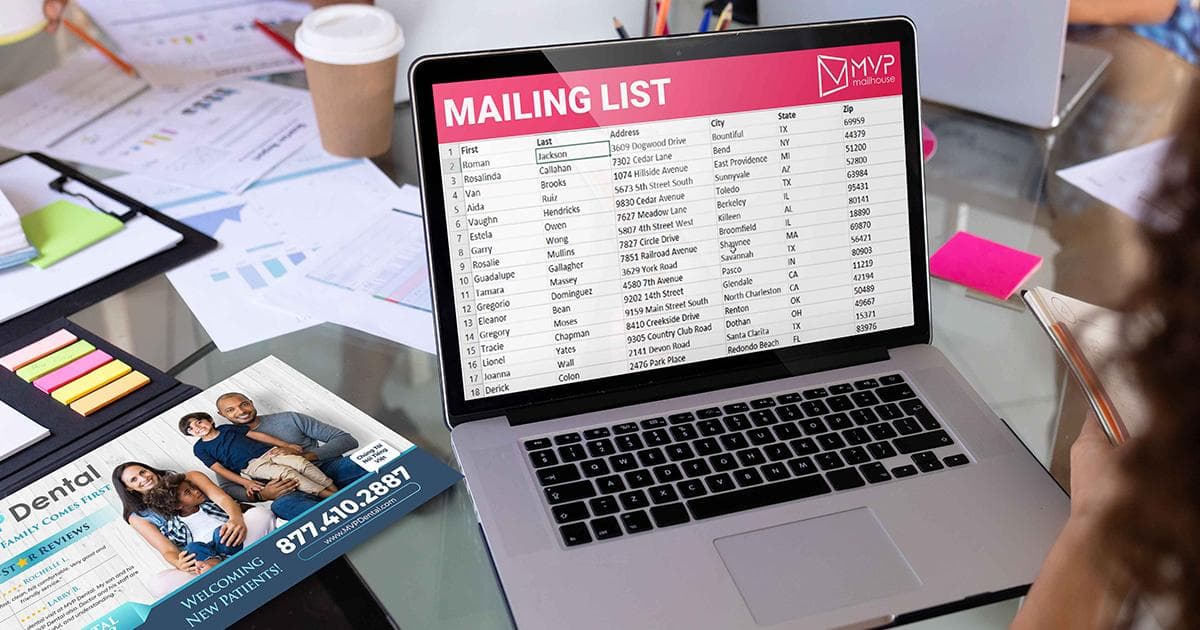
What is a direct mailing list and why do so many businesses still rely on it when digital ads dominate the conversation? Here’s a telling stat to frame the discussion: direct mail consistently outperforms email in response rates, especially when campaigns are well targeted. That alone should raise an eyebrow.
According to recent industry data, direct mail achieves an average response rate of around 4.4%, compared to just 0.12% for email marketing, showing that physical mail consistently earns markedly higher engagement than digital channels.
We will break down what a direct mailing list actually is, why it matters in modern direct mail marketing, and how it becomes a measurable growth lever not just a stack of addresses. If you’ve ever wondered why some mail campaigns quietly drive revenue while others disappear into recycling bins, it usually comes down to the list.
What a Direct Mailing List Really Is (and What It Isn’t)
At its simplest, a direct mailing list is a curated collection of physical mailing addresses used for direct mail marketing campaigns. But that definition is incomplete and honestly, misleading because it implies all mailing lists are equal. They’re not.
A true direct mailing list is built around intent and relevance, not volume.
Instead of “everyone in a ZIP code,” modern direct mailing lists are often segmented by factors such as:
- Location and delivery route
- Household income or homeownership
- Business type or industry
- Buying signals, life events, or professional specialization
A mailing list isn’t just where you send mail. It’s who you’re choosing to have a physical conversation with.
For example, a dental practice running a new-patient campaign doesn’t need every household in a city. It needs families within a service radius, ideally those new to the area or without a current provider. That distinction: broad vs. relevant is where direct mail succeeds or fails.
If you want to see how lists are structured from the ground up, this guide on how to create a mailing list for direct mail breaks down the process in practical terms.
Why a Mailing List Is the Most Important Part of Direct Mail
Design gets attention. Offers get debated. Postage gets scrutinized. But the mailing list does the heavy lifting.
A well-built list determines:
- Who sees your message
- Whether the offer feels timely or irrelevant
- How efficient your cost per response will be
In direct mail marketing, the list is the strategy. Everything else supports it.
This is especially true with targeted mailing lists, where you’re deliberately narrowing the audience to increase relevance. Fewer pieces mailed, higher engagement, better ROI. It’s counterintuitive for businesses used to chasing scale, but it works.
Take dental marketing as a real-world example. Practices that mail “Every Door” style campaigns often see modest results. Practices that mail targeted households, new movers, families with children, or high-density residential zones consistently generate more patient calls from fewer mailers. Same postcard. Same offer. Different list. Different outcome.
If you want to understand how smarter segmentation improves campaign performance, this guide on direct mail targeting explains how relevance is engineered, not guessed.
Why Direct Mailing Lists Still Matter in a Digital-First World
It’s easy to assume mailing lists are outdated because inboxes, feeds, and search results feel more immediate. But physical mail operates under a different set of rules and that’s precisely why it still works.
A mailing list gives you:
- Guaranteed placement (no algorithm throttling)
- Longer attention windows (mail sits, it doesn’t vanish)
- Local trust signals, especially for service-based businesses
In industries like healthcare, home services, and local retail, trust and proximity matter more than clicks. A targeted mailing list lets you show up physically, in the right homes, with a message that feels intentional, not random.
And unlike digital audiences that reset every day, a mailing list compounds in value. The more you understand who responds, who converts, and who stays, the smarter your future campaigns become.
How Targeted Mailing Lists Work (and Why They Outperform)
Not all mailing lists are created equal. The real divide isn’t between digital and physical, it’s between generic lists and targeted mailing lists.
A targeted mailing list is built by filtering audiences based on attributes that actually influence buying behavior. Instead of asking, “How many people can we reach?” the smarter question becomes, “Who is most likely to respond right now?”
That shift in thinking is where performance changes.
Targeted lists work because they reduce friction. The message feels relevant before the envelope is even opened. When someone receives a mailer that aligns with their location, needs, or life stage, the offer doesn’t feel like advertising, it feels timely.
In practice, targeting often includes layers such as:
- Geography: radius targeting, carrier routes, or ZIP-level density
- Demographics: age range, household composition, income bands
- Behavioral signals: new movers, recent purchases, business formation
- Industry or profession: especially effective in B2B and healthcare
Dental marketing is a clear example. A postcard offering a new-patient special performs very differently when sent to renters who move frequently versus homeowners with families. Practices that use targeted mailing lists consistently see stronger response rates because they’re aligning the list with the lifetime value of a patient, not just filling chairs short-term.
This is why niche targeting matters so much in healthcare. If you want a deeper look at how precision targeting drives better patient acquisition, this breakdown of the benefits of targeted mailing lists for dental marketing shows exactly why relevance wins.
How Much Does a Direct Mail List Cost?
One of the most common and most misunderstood questions is: How much does a direct mail list cost?
The short answer: it depends on how specific you want to be.
Direct mailing list costs are typically influenced by:
- Size of the list
- Level of targeting and filtering
- Data freshness and update frequency
- Whether the list is rented, licensed, or custom-built
Highly targeted lists cost more per record but almost always cost less per response. That distinction matters. Paying less upfront for a broad list often leads to higher printing, postage, and waste without the results to justify it.
For example, mailing 10,000 untargeted households might feel economical. Mailing 3,000 well-qualified households often produces more calls, more conversions, and clearer performance data. In direct mail marketing, efficiency beats volume nearly every time.
If you want a transparent breakdown of pricing models and what businesses should realistically expect to pay, this guide on how much mailing lists cost walks through the numbers without the fluff.
Why List Quality Determines ROI More Than Creative
It’s tempting to obsess over design, copy, or print finishes. Those elements matter but only after the list is right.
A strong mailing list does three things:
- Improves response rates by matching message to audience
- Lowers cost per acquisition by reducing wasted mail
- Creates usable data for future optimization
Weak lists hide problems. Strong lists reveal them.
When targeting is tight, you can actually test offers, formats, and messaging with confidence. If performance drops, you know it’s creative or timing, not audience mismatch. That clarity is impossible with a bloated, unfocused mailing list.
In other words, your mailing list isn’t just a delivery mechanism. It’s the foundation that determines whether direct mail marketing behaves like a guessing game or a predictable growth channel.
How Mailing Lists Connect to Measurement and Long-Term Results
A direct mailing list doesn’t stop mattering once the mail drops, it continues to matter after responses come in. This is where many businesses miss the full value of direct mail marketing.
When your list is intentional and well-defined, performance becomes measurable instead of vague. You can track which segments respond, which offers convert, and which audiences are worth reinvesting in. Over time, your mailing list becomes a data asset, not just a one-time expense.
The most effective campaigns evaluate results using clear metrics such as response rate, cost per lead, and customer acquisition cost. These insights allow businesses to refine future lists, tighten targeting, and scale what works while cutting what doesn’t. If you want to understand how professionals evaluate success beyond surface-level responses, this breakdown of direct mail KPIs shows how performance is actually measured.
This feedback loop is what separates random mailers from repeatable growth systems. The better the list, the cleaner the data. The cleaner the data, the smarter every campaign that follows.
Conclusion: Why Direct Mailing Lists Still Drive Results
So, what is a direct mailing list, really?
It’s not just a set of addresses. It’s a strategic filter that determines who you reach, how relevant your message feels, and whether your direct mail marketing generates results or waste.
To recap:
- A direct mailing list defines who your campaign is for
- Targeted mailing lists consistently outperform broad, generic lists
- List quality impacts cost, response rates, and long-term ROI
- Strong lists make direct mail measurable, scalable, and predictable
Whether you’re a local dental practice trying to attract new patients or a multi-location business looking to improve acquisition efficiency, your mailing list is the single most important decision you’ll make in a direct mail campaign.
If you want help building smarter mailing lists, improving targeting, or running data-driven direct mail campaigns, visit our website to learn more or schedule a demo to see how the right list can turn direct mail into a reliable growth channel.
Tags
Industry Insights
Frequently Asked Questions
Related blog



Ready For Your Success Story?
Get 500 Free Handout cards shipped right to your doorstep!