Best Paper For Postcards: Direct Mail Printing
The best paper for postcards boosts response rates: 110–130 lb cover improves durability, trust, and ROI. Learn what to print and schedule a demo today.

MVP Marketing
marketing manager
·7 min read
·Jun 13, 2025


When brands invest in direct mail, paper choice quietly determines whether the postcard feels disposable or worth reading. In fact, studies consistently show that tactile marketing materials are remembered longer than digital ads, which makes the best paper for postcards more than a production detail. It’s a strategic lever.
So what paper actually performs best in direct mail printing? And why does it matter beyond cost?
We will break down the foundations: how postcard paper works, what “quality” really means in a mailbox, and how the right stock influences response before a single word is read.
Why Paper Choice Matters More Than Design Alone
Most marketers obsess over copy, offers, and imagery. Fewer think about how the postcard feels when someone pulls it from their mail stack. That’s a mistake.
Paper weight, thickness, and finish directly affect:
- Perceived credibility – flimsy cards are subconsciously dismissed as junk
- Durability – postcards travel through automated USPS equipment
- Engagement time – heavier stock is more likely to be handled, flipped, and read
- Mailing efficiency – weight impacts postage tiers and total campaign cost
In direct mail printing, paper is the first impression. Before the headline lands, the stock has already communicated value.
If you’re newer to physical mail strategy, it’s worth grounding this discussion in how the channel works overall. Our guide on Direct Mail Printing: Everything You Need to Know walks through the end-to-end process and why production decisions compound over scale.
Understanding Postcard Paper Weight (Without the Confusion)
One of the most common questions in direct mail printing is: what is the ideal paper weight for postcards? The confusion comes from how paper is measured.
In the U.S., postcard stock is typically defined using:
- Cover weight (lb) – the weight of 500 sheets before cutting
- Point thickness (pt) – the actual physical thickness of the card
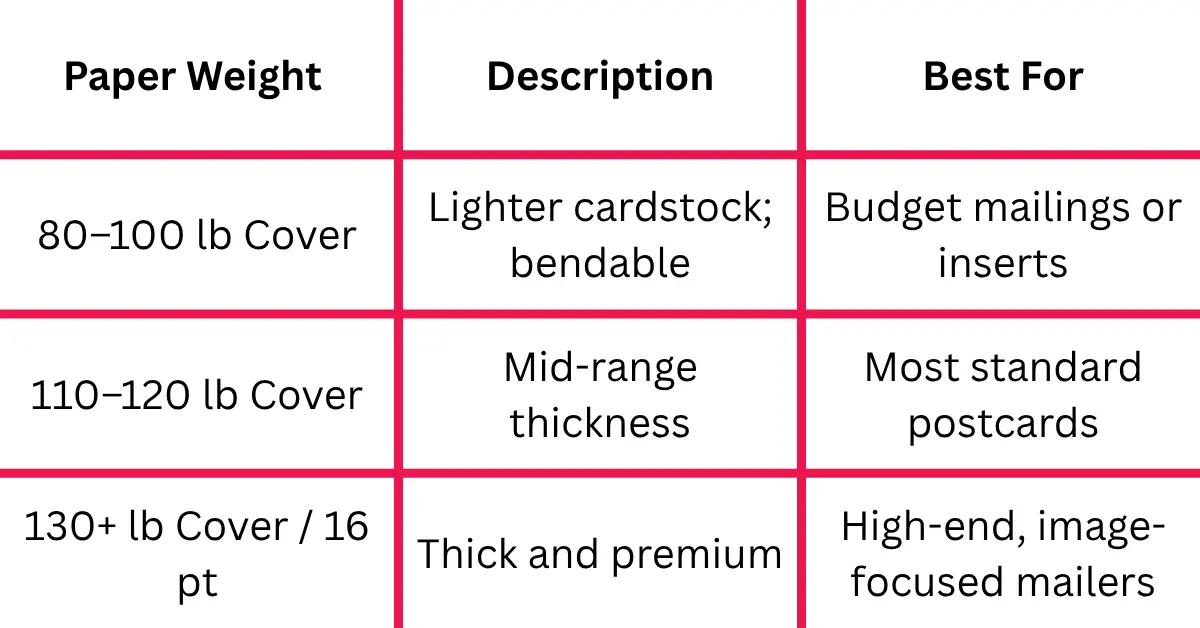
To make this tangible, here’s a quick visual reference comparing postcard paper weights and their best use cases in direct mail:
For postcards, these measurements usually map like this:
- 80–100 lb cover → lighter, flexible, budget-friendly
- 110–120 lb cover → balanced, sturdy, professional
- 130+ lb cover / 16 pt → thick, premium, high visual impact
The takeaway isn’t that thicker is always better. It’s that paper should match intent:
- Awareness and reminders → lighter stock can work
- Acquisition and promotions → mid-weight performs best
- High-value offers → premium stock reinforces trust
Most successful direct mail postcards land squarely in the middle. 110–120 lb cover (or roughly 14–16 pt) provides enough rigidity to survive mailing and enough heft to feel intentional without pushing postage or print costs unnecessarily high.
If you want a deeper breakdown of how postcard paper is classified and used in practice, we cover that in detail in What Type of Paper Is Used for Postcards.
The Real Cost of Choosing the Wrong Paper
Going too light saves pennies per piece but risks being ignored. Going too heavy can inflate postage and shrink ROI. The best paper for postcards sits at the intersection of perception, performance, and postal efficiency.
This is also where printing decisions matter. Whether you’re running production internally or partnering with a direct mail printer changes what paper options are practical at scale. We explore those trade-offs in In-House Printing vs Outsourced Printing for Direct Mail.
Choosing the Right Postcard Size for Direct Mail Performance
Once paper weight is dialed in, size becomes the next major performance driver. This is where many campaigns either gain a serious edge or quietly underperform. The postcard size you choose affects visibility, USPS eligibility, printing efficiency, and how much information you can communicate without overwhelming the reader.
In direct mail printing, size isn’t about aesthetics alone. It’s about attention economics inside a crowded mailbox.
Why Postcard Size Changes Response Rates
A postcard doesn’t compete with emails or ads, it competes with other mail. Bills, catalogs, envelopes, and flyers all fight for a few seconds of attention. Size directly influences whether your piece gets noticed or blended into the stack.
Here’s how size impacts outcomes:
- Smaller cards are cost-efficient but easier to ignore
- Mid-sized cards balance visibility and postage efficiency
- Oversized cards dominate attention but increase production and mailing costs
The goal isn’t to go big by default. It’s to choose a size that supports your message, audience, and budget without creating friction.
Which Paper Sizes Are Commonly Used for Postcards?
Most direct mail postcards fall into a handful of proven formats. These sizes are popular because they align with USPS automation standards and standard printing workflows.
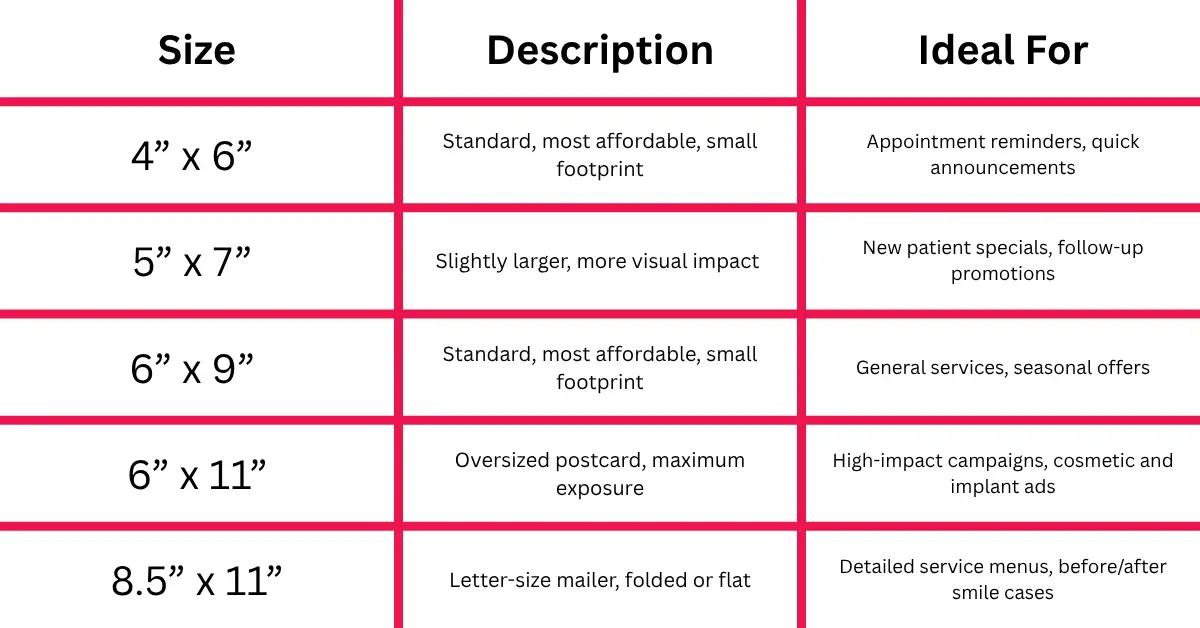
Here’s how these sizes perform in real-world campaigns:
- 4” × 6”: The smallest standard postcard. It’s affordable and works well for reminders, quick announcements, or frequency-based campaigns—but it offers limited visual impact.
- 5” × 7”: A step up in presence without a dramatic cost increase. This size allows stronger imagery and clearer hierarchy, making it effective for promotions and follow-ups.
- 6” × 9”: One of the most popular choices in direct mail printing. Large enough to command attention while still qualifying for automation rates. Often considered the “sweet spot.”
- 6” × 11”: Oversized and eye-catching. Ideal for high-impact campaigns where visibility matters more than postage efficiency.
- 8.5” × 11” (flat or folded): Technically a large-format mailer rather than a classic postcard. Best used when detailed explanations, visuals, or comparisons are necessary.
If you want a deeper breakdown of size standards and USPS considerations, our Guide to Postcard Sizes for Direct Mail Marketing walks through dimensions, mailing rules, and use cases in detail.
How Paper Size and Paper Weight Work Together
Paper size and paper weight should never be chosen in isolation. A large postcard printed on thin stock can feel flimsy and cheap. A small postcard on ultra-thick stock can feel awkward and inefficient.
Here’s how they typically pair best:
- 4” × 6” → 100–110 lb cover
- 5” × 7” → 110–120 lb cover
- 6” × 9” → 120–130 lb cover
- 6” × 11” → 14–16 pt for structural stability
As size increases, thickness matters more. Larger cards experience more bending during handling, so upgrading paper weight helps preserve quality and readability throughout delivery.
Matching Size to Strategy (Not Just Budget)
A common mistake in direct mail printing is choosing size based purely on cost per piece. That approach ignores how strategy shapes ROI.
For example:
- Short, single-offer messages often perform best on mid-sized cards
- Visual-heavy promotions benefit from larger formats
- Educational or comparison-based messaging may require expanded layouts
In industries like healthcare, home services, or professional practices, postcard size can also signal legitimacy. Bigger formats often feel more established and trustworthy especially when paired with quality paper.
We explore this idea further in Best Postcard Size for Dental Direct Mail Success, where size selection is tied directly to response behavior rather than aesthetics alone.
Bringing It All Together: How to Choose the Best Paper for Postcards
By now, one thing should be clear: choosing the best paper for postcards isn’t about chasing the thickest stock or the largest format. It’s about alignment, matching paper, size, and production decisions to the goal of your direct mail campaign.
When those elements work together, postcards don’t just get delivered. They get noticed, handled, and remembered.
Key Takeaways at a Glance
Let’s quickly recap what matters most in direct mail printing:
- Paper weight sets perception: Mid-range cardstock (typically 110–120 lb cover or 14–16 pt) delivers the best balance of durability, professionalism, and cost efficiency.
- Size drives visibility and engagement: Formats like 5” × 7” and 6” × 9” consistently perform well because they stand out without inflating postage.
- Paper weight and size must work together: Larger postcards need thicker stock to avoid bending and maintain visual integrity through the mail stream.
- Strategy beats assumptions: The “best” paper depends on message length, audience, frequency, and campaign intent, not personal preference.
- Production decisions affect outcomes: Print quality, consistency, and turnaround all influence how effective your postcard feels once it’s in someone’s hands.
Each of these factors compounds. Small upgrades in paper choice often produce outsized improvements in response.
Final Thoughts: Paper Is a Silent Salesperson
In direct mail, paper does more than hold ink. It communicates trust, effort, and legitimacy before the reader ever engages with your message. That’s why the best-performing campaigns treat paper selection as a strategic decision, not a line item to minimize.
When postcards feel substantial, they earn a few extra seconds of attention. Those seconds are often the difference between being discarded or acted on.
If you want help selecting the right paper, size, and production approach for your next campaign, we’re here to help. Visit our website to explore our direct mail solutions or schedule a demo to see how thoughtful printing choices can turn postcards into measurable results.
Tags
Design and Creativity
Frequently Asked Questions
Related blog


Ready For Your Success Story?
Get 500 Free Handout cards shipped right to your doorstep!