Top 5 Industries Benefiting from Targeted Direct Mail
Top 5 industries benefiting from targeted direct mail, see 4–9% response rates. Learn who wins and start your high-ROI campaign today.

Ashley Paige Lloyd
marketing consultant
·11 min read
·May 30, 2025


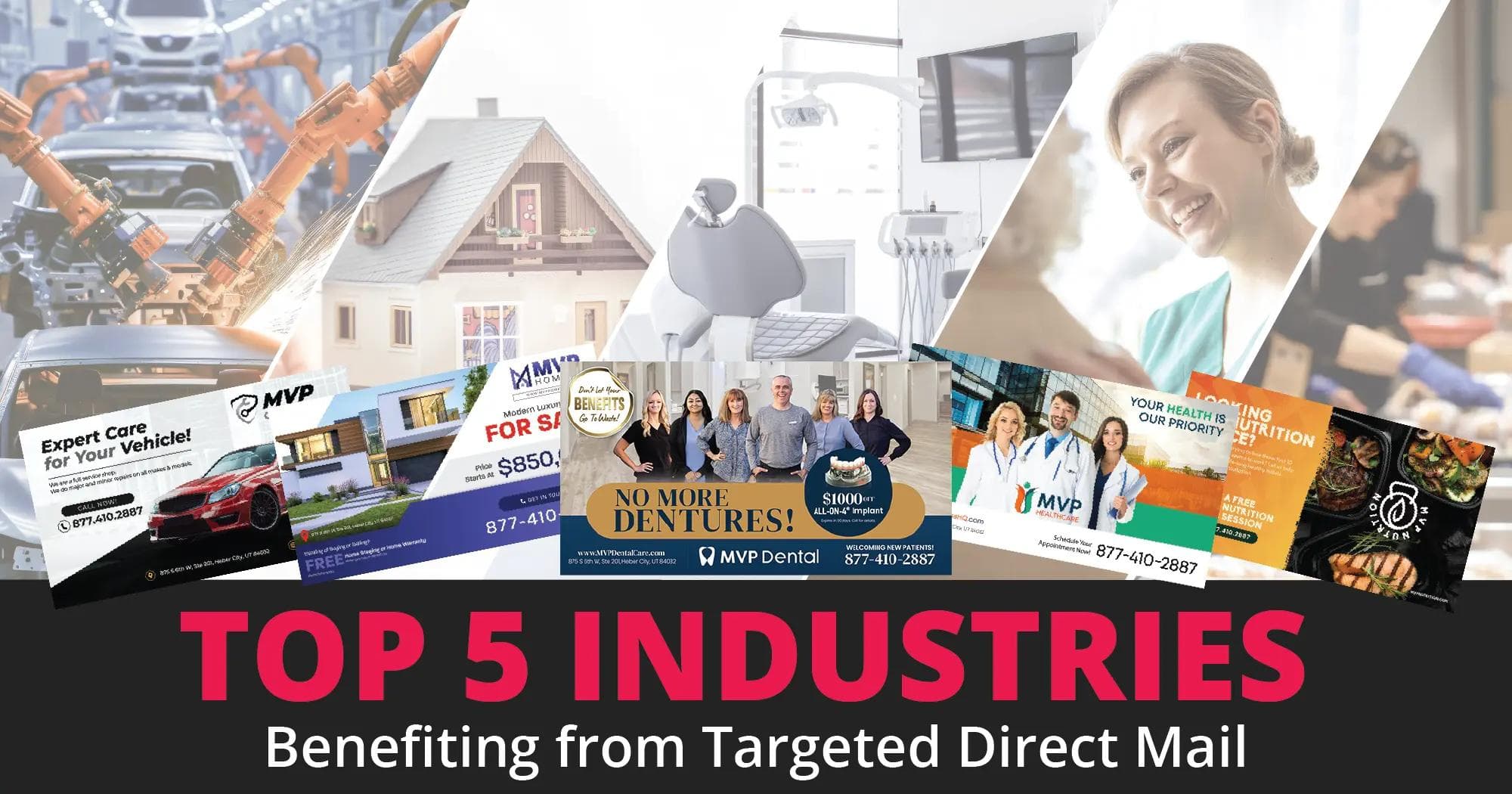
Top 5 industries benefiting from targeted direct mail, why does this still matter in 2026, when every brand is fighting for attention online?
Because attention is scarce. And physical mail still commands it.
Response rates for direct mail routinely outperform digital display ads by multiple multiples. While the average click-through rate for display hovers below 1%, well-targeted direct mail campaigns often generate response rates between 4%–9%, and even higher in niche industries. In a landscape saturated with inbox noise and algorithm fatigue, the mailbox is strangely quiet and that’s exactly why it works.
In 2025, 69% of marketers reported direct mail response rates above 3%, with 33% achieving rates of 5% or higher and 11% seeing response rates of 7% or more, showing direct mail’s continued strength over many digital channels.
This article breaks down the industries seeing the strongest ROI from targeted direct mail, why it works specifically for them, and what realistic results look like. We’ll also answer a common question we hear: Who dominates the market for targeted mailing campaigns? (Spoiler: It’s not who most people think.)
If you’re evaluating where direct mail fits in your 2026 strategy, this will give you clarity, not theory, but grounded insight from campaigns we’ve seen perform firsthand.
Why Targeted Direct Mail Still Matters in 2026
Before we dive into the top industries, it’s worth answering the bigger question: Why targeted direct mail still matters in 2026.
Marketing has become hyper-digital. But hyper-digital also means hyper-ignored.
The direct mail industry is projected to reach a market value of $73.57 billion by 2026, underlining its significant role in modern marketing strategies.
Consumers scroll past ads instinctively. Email open rates fluctuate. Paid media costs continue to climb. Meanwhile, physical mail has become less crowded. That shift alone changes performance dynamics.
But the real power isn’t in “mail.” It’s in targeted mail.
When you combine:
- Clean, segmented mailing lists
- Demographic and geographic filtering
- Behavioral data
- Offer alignment with life events
…you move from “spray and pray” to strategic, measurable acquisition.
If you’re new to the mechanics, it helps to understand the fundamentals of what is direct mail marketing and how it has evolved beyond generic postcards.
We’ve seen this happen repeatedly: businesses that treat direct mail like a data channel, not a branding relic, win. The ones that blast 20,000 untargeted pieces rarely do.
Now let’s break down the top 5 industries benefiting from targeted direct mail, starting with one that consistently outperforms expectations.
1. Dental Practices (Dental Marketing)
If we had to name one vertical that consistently dominates ROI conversations in the direct mail industry, it’s dentistry.
Why Dental Marketing Thrives with Direct Mail
Dentistry is hyper-local. Patients typically search within a 5–10 mile radius. That geographic constraint makes mail incredibly efficient.
Add to that:
- Recurring patient value (cleanings every 6 months)
- High lifetime value (cosmetic, implants, orthodontics)
- Strong response to introductory offers
- Insurance-driven patient switching
Targeted Dental direct mail campaigns frequently generate 20–40 new patients per drop in mid-sized markets when executed properly.
We’ve seen this happen in competitive suburban areas where digital ads were saturated and CPCs were climbing. One well-targeted mail drop offering a $99 new patient special outperformed months of Facebook ads in a single cycle.
For deeper insight into this vertical, our breakdown of why direct mail marketing still works in dentistry explains the psychology behind it.
What Realistic Results Look Like
For a practice mailing 5,000 highly targeted households:
- Expected response rate: 4%–6%
- Calls/leads: 200–300
- Converted patients: 20–50
- ROI timeline: 30–90 days
KPIs to track:
- Cost per acquired patient
- Lifetime value (LTV) vs campaign cost
- Retention after 6 months
In our experience, practices that layer demographic targeting, household income, family status, homeownership, see significantly higher returns than those mailing by ZIP code alone.
This is where smarter segmentation matters. If you want to understand the mechanics behind that, our guide to direct mail targeting: a guide to smarter campaigns breaks down the strategic framework.
2. Home Services (Roofing, HVAC, Plumbing, Solar)
Home services is another industry that benefits disproportionately from targeted direct mail.
Why?
Because urgency and geography intersect.
A homeowner doesn’t plan for a roof leak. They react to it. And when they do, they call the company they recognize or the one whose postcard is sitting on the counter.
Data + Timing = Market Share
The companies that dominate targeted mailing campaigns in home services aren’t just mailing randomly. They use:
- New mover lists
- High-equity homeowner data
- Property age filters
- Storm-damaged area mapping
When executed properly, response rates can range from 3%–5%, sometimes higher in disaster-affected regions.
We’ve seen roofing companies lock down entire neighborhoods after major hailstorms simply because they had mail hitting homes within days—not weeks.
This is where location-based marketing becomes a serious competitive advantage.
Expected Outcomes & Timelines
For a 10,000-home targeted drop:
- Leads: 300–500 inquiries
- Closed jobs: 20–60 projects
- Revenue impact: Often 6–7 figures depending on service size
- Timeline: 2–6 weeks post-drop
The key isn’t just volume. It’s precision.
And precision begins with list quality which we’ll dive into in the next section.
3. Healthcare & Medical Specialists (Beyond Dentistry)
While dentistry often leads the conversation, broader healthcare verticals are quietly among the top 5 industries benefiting from targeted direct mail.
Primary care clinics, urgent care centers, chiropractors, med spas, vision clinics, and specialty practices (orthopedics, cardiology, dermatology) all operate within defined geographic service areas. And patients still respond strongly to tangible offers especially when trust and credibility are factors.
Why Healthcare Responds to Targeted Direct Mail
Healthcare decisions are personal. They’re not impulse buys driven by flashy digital ads. Patients look for:
- Proximity
- Insurance compatibility
- Reputation
- Clear, risk-reducing offers
Targeted mail allows practices to introduce themselves in a controlled, authoritative way without fighting algorithms.
We’ve seen this happen with urgent care centers entering competitive markets. Instead of spending six months building organic search presence, they launched a 15,000-piece targeted mail drop focused on families with children within a 7-mile radius. Within 60 days, walk-in traffic increased measurably especially during flu season.
That kind of outcome doesn’t happen with generic saturation mail. It happens when data and messaging align.
Who Dominates the Market for Targeted Mailing Campaigns in Healthcare?
It’s not the biggest hospital systems.
It’s the groups that understand segmentation.
Practices that invest in strong lists filtered by age, income, insurance indicators, household composition consistently outperform broad “every door” campaigns. The foundation of that success always comes back to understanding what is a mailing list in direct mail and why it matters.
Realistic KPIs for Healthcare Campaigns
For a 12,000-piece targeted drop:
- Response rate: 2%–5%
- New patient appointments: 150–400
- Conversion rate (appointment to retained patient): 50%–70%
- ROI timeline: 60–120 days
Healthcare marketing isn’t about flashy short-term spikes. It’s about steady patient acquisition and lifetime retention. Direct mail supports that cadence exceptionally well.
4. Financial Services & Insurance
Financial services is one of the most misunderstood sectors in the direct mail industry.
Banks, credit unions, mortgage brokers, financial advisors, and insurance agencies rely heavily on trust and credibility. Digital ads can generate awareness but direct mail drives action.
Why Targeted Direct Mail Works for Financial Brands
Money decisions require reassurance. A physical mail piece carries psychological weight. It feels intentional. Verified. Official.
We’ve worked with mortgage lenders who saw direct mail outperform PPC during rate fluctuation periods simply because the messaging was hyper-targeted:
- Homeowners with 30-year mortgages older than 2 years
- Households with high estimated equity
- Credit-qualified demographic profiles
When rates dip, these segments respond quickly.
Insurance agencies see similar performance when targeting:
- New homeowners
- Recently married households
- High-income ZIP clusters
In these cases, response rates often range from 2%–4%, but the lifetime value per client makes the ROI substantial.
What Performance Actually Looks Like
For a 20,000-piece targeted financial campaign:
- Leads: 400–800 inquiries
- Closed accounts/policies: 5%–15% of leads
- ROI timeline: 90–180 days
- Long-term value: Multi-year recurring revenue
The difference-maker? Measurement.
Too many financial brands ask, “Is direct mail effective?” The better question is, “What is a good response rate for direct mail marketing?”
If you want benchmarks, our breakdown of what is a good response rate for direct mail marketing explains performance expectations by industry and campaign type.
In our experience, financial services firms that commit to 3–4 consistent drops (rather than a single test) see dramatically better results. Momentum matters. Trust builds over repetition.
5. E-Commerce & Retail (Yes, Even in 2026)
This one surprises people.
In an era of TikTok ads and AI-powered retargeting, why would online brands invest in direct mail?
Because digital is noisy and physical mail cuts through.
Why Retail Brands Are Returning to Mail
E-commerce brands are using targeted direct mail for:
- Cart abandonment follow-ups
- Lapsed customer reactivation
- High-value customer retention
- New mover introductions
We’ve seen DTC brands send personalized postcards to high-LTV customers who hadn’t purchased in 90 days and recover 8%–12% of that segment within a month.
That’s significant.
Unlike broad digital retargeting, direct mail feels curated. It stands out. It signals importance.
When combined with QR codes, personalized URLs, and promo codes, attribution becomes measurable and clear.
This one surprises people.
In an era of TikTok ads and AI-powered retargeting, why would online brands invest in direct mail?
Because digital is noisy—and physical mail cuts through.
Why Retail Brands Are Returning to Mail
E-commerce brands are using targeted direct mail for:
- Cart abandonment follow-ups
- Lapsed customer reactivation
- High-value customer retention
- New mover introductions
We’ve seen DTC brands send personalized postcards to high-LTV customers who hadn’t purchased in 90 days—and recover 8%–12% of that segment within a month.
That’s significant.
Unlike broad digital retargeting, direct mail feels curated. It stands out. It signals importance.
When combined with QR codes, personalized URLs, and promo codes, attribution becomes measurable and clear.
Expected Metrics for Retail Campaigns
For a segmented 8,000-customer reactivation campaign:
- Response rate: 5%–12%
- Revenue per responder: Often 2–3x campaign cost
- ROI timeline: 30–60 days
The brands seeing the best returns treat direct mail as part of a multi-channel ecosystem, not a replacement for digital, but an amplifier.
If you’re evaluating performance expectations more broadly, our analysis of how effective is direct mail marketing dives into measurable impact across sectors.
What Separates Average Campaigns from Dominant Ones
By now, the pattern is clear. The top 5 industries benefiting from targeted direct mail, dentistry, healthcare, home services, financial services, and retail, don’t succeed because they “tried mail.” They succeed because they execute it strategically.
Here’s what we’ve seen consistently separate average campaigns from market-dominating ones:
1. Data Comes First, Design Comes Second
Most underperforming campaigns start with creative. The high-performing ones start with audience segmentation.
Before a single postcard is designed, top brands define:
- Who exactly are we targeting?
- Why would this household care right now?
- What life event, behavior, or demographic makes this relevant?
If the list is weak, the campaign is weak. It’s that simple.
2. Offer Clarity Beats Cleverness
A confusing offer kills response rates. A clear, compelling one lifts them dramatically.
For example:
- “$99 New Patient Special” outperforms “Comprehensive Oral Wellness Experience.”
- “Free Roof Inspection After Hail” beats “Exterior Evaluation Services.”
We’ve seen 20–30% response rate swings just from simplifying the offer and headline.
3. Consistency Over One-Off Tests
One drop rarely defines success. Three coordinated drops over 90 days often do.
Direct mail compounds. Repetition builds trust. Recognition builds response.
In nearly every industry mentioned, brands that commit to 2–4 sequential campaigns see measurable improvement in cost per acquisition.
If ROI is the concern, understanding how to improve your direct mail ROI is critical. Optimization doesn’t happen by accident. It happens by tracking, testing, and refining.
Conclusion: Why These Industries Win with Targeted Direct Mail
Let’s bring this together.
The top 5 industries benefiting from targeted direct mail share three undeniable traits:
- They operate within defined geographic or demographic boundaries.
- They have strong lifetime customer value.
- They offer services tied to trust, urgency, or recurring need.
In 2026, digital advertising is more crowded and more expensive, than ever. Meanwhile, targeted mailboxes are quieter. That imbalance creates opportunity.
- Dental practices generate predictable patient flow.
- Home service companies lock down neighborhoods.
- Healthcare providers accelerate trust.
- Financial firms build credibility.
- Retail brands reactivate dormant buyers.
And they do it because they don’t treat direct mail as outdated. They treat it as data-driven acquisition.
We’ve seen this happen across markets of all sizes. When targeting is precise, messaging is clear, and campaigns are consistent, response rates become predictable. ROI becomes measurable. Growth becomes repeatable.
If you’re serious about building a campaign that performs, not just “testing mail”, it starts with strategy.
Visit our website to learn more about how targeted direct mail can transform your acquisition pipeline, or schedule a demo to see how we help businesses design, target, and execute campaigns that actually deliver results.
Tags
Industry Insights
Frequently Asked Questions
Related blog



Ready For Your Success Story?
Get 500 Free Handout cards shipped right to your doorstep!