How to Use Direct Mail Marketing Effectively
Learn how to use direct mail marketing effectively with smarter targeting, stronger postcard offers, better timing, and practical ways to measure campaign ROI.

Aaron Boone
ceo
·16 min read
·Nov 20, 2026



Learning how to use direct mail marketing effectively starts with understanding what makes someone respond. A postcard can reach thousands of households, but if the message reaches the wrong people or gives them no reason to act, much of that investment goes to waste.
According to Lob's 2026 State of Direct Mail Consumer Insights Report, 87% of surveyed U.S. consumers said they read direct mail the same day they receive it. That creates an opportunity for businesses, but attention alone doesn't guarantee customers.
The most effective direct mail marketing strategies focus on three things from the beginning. A clear business goal, an audience with a genuine need, and an offer worth responding to. Here's how to put those pieces together before spending money on printing and postage.
1. Set a Clear Goal for Your Direct Mail Campaign
Every successful mailing starts with a specific outcome. Sending 5,000 postcards might sound productive, but the number means little unless you know what those postcards are supposed to accomplish.
Start by deciding whether your priority is attracting new customers, generating appointments, bringing back previous buyers, or increasing sales from existing customers. Each goal requires a different message and a different way to measure success.
For example, consider a dental practice that wants to generate 20 new patient appointments within 30 days of its mailing's expected delivery.
A simple planning scenario might look like this.
- Mailing volume - 2,500 postcards
- Illustrative response rate - 2%, producing 50 inquiries
- Inquiry-to-appointment rate - 40%, producing 20 bookings
- Primary KPI - Cost per booked appointment
These numbers illustrate how to plan a goal, not a guaranteed result or an industry benchmark. Actual performance depends on the mailing list, offer, competition, and how well the practice handles inquiries.
The important part is working backward from the business result. If 50 people respond but only five schedule appointments, printing more postcards may not solve the problem. The practice might need to improve its booking process or make the offer clearer.
Before launching, calculate how much you can afford to spend to acquire a customer. Our guide on how much to budget for direct mail explains how to plan costs before committing to a mailing.
The goal is not to send more mail. It's to generate enough profitable customer actions to justify sending it.
2. Target People Who Are Most Likely to Respond
One of the biggest mistakes businesses make is assuming that reaching more households automatically produces better results.
It doesn't.
In Lob's 2025 Consumer Insights Report, 72% of surveyed consumers said they throw away mail that feels irrelevant to them. That's a strong reason to prioritize relevance over mailing volume.
Effective targeting begins with understanding who needs your service, where those people live, and what might motivate them to respond.
Instead of purchasing one large mailing list, divide your audience into smaller groups based on meaningful characteristics.
Geographic targeting works well for businesses serving specific neighborhoods, cities, or service areas. A local roofing contractor, for example, might focus on neighborhoods with older homes rather than every household across the county.
Demographic and household targeting can help match an offer to likely customer needs. A home improvement company could focus on homeowners, while a family-oriented business might prioritize households that fit its services.
Behavioral and customer targeting uses information such as purchase history, previous inquiries, or time since the last transaction. This can be particularly useful for retention and reactivation campaigns.
New mover targeting reaches households that recently relocated. These residents may be looking for new dentists, home services, restaurants, or other local providers.
For direct mail for dentists, the difference matters. A postcard welcoming new residents should introduce the practice and explain how to schedule a first appointment. A message to an existing patient should focus on a relevant reason to return, using patient information only in ways permitted by applicable privacy rules.
Real Campaign Example
Healthcare communications company Mabel provides a useful example of targeted mailing.
According to a published Mabel direct mail case study, the company used patient information to personalize doctor-branded letters for Medicare-related outreach. The campaigns reportedly achieved an average response rate of approximately 5%, compared with the 0.1% to 0.25% rates the company cited for generic payer mailings.
These are company-reported results from a specific healthcare program, not typical response rates that every business should expect.
The lesson is straightforward. A message from a recognizable provider, delivered to someone with a relevant need, has a stronger basis for engagement than a generic advertisement sent to an unrelated audience.
For a more detailed approach to selecting audiences, see our guide to smarter direct mail targeting.
3. Give Recipients a Strong Reason to Take Action
Even the right audience can ignore a postcard if the offer doesn't matter to them.
In Lob's 2026 consumer research, 66% of respondents said they liked referring back to direct mail when considering a purchase. That makes the usefulness of the message especially important.
A strong offer should connect directly to something the customer wants or needs. It doesn't always require a discount.
For example, a dental practice might promote convenient appointment availability for new patients. A landscaping business could offer a clear estimate for a seasonal service. A home services company might introduce a maintenance package with transparent pricing.
In each case, the offer should answer three practical questions.
- What is the business offering?
- Why is it relevant to this particular recipient?
- What should the recipient do next?
Avoid filling one postcard with several competing promotions. When everything is presented as important, the main message becomes harder to understand.
Instead, build the offer around one clear benefit and one intended action. If the objective is generating appointments, focus on making scheduling easy. If the goal is increasing purchases, explain the product's value and provide a straightforward way to order.
In practice, this is where a common planning problem appears. Businesses spend considerable time choosing postcard sizes, colors, and images before deciding why someone would respond.
That order should be reversed.
Define the audience and offer first. Then create the postcard around the action you want that person to take. This gives the design a clear purpose and makes the campaign easier to measure and improve.
4. Design Direct Mail That People Can Understand Quickly
A postcard doesn't need an elaborate design to generate interest. It needs to communicate the right message before the recipient loses interest.
According to Lob's 2025 State of Direct Mail Consumer Insights Report, 47% of surveyed consumers who had taken action after receiving direct mail said a unique shape or design influenced their decision.
But attractive design alone isn't enough. A postcard can look professional while making its offer difficult to find.
For better results, organize the design around three elements.
- Headline that immediately communicates the main benefit.
- Supporting message that explains the offer and why it matters.
- Clear call to action that shows recipients how to respond.
For example, a dental practice trying to attract new patients could lead with a headline such as "Looking for a Dentist Near You?" Below it, the postcard could briefly introduce the practice, highlight convenient appointment options, and include a simple booking instruction.
A photograph of the actual dental team may be more useful than a generic stock image because it helps prospective patients recognize the people they'll meet.
Keep the layout clean, use readable fonts, and leave enough space between sections. Important information shouldn't compete with decorative graphics.
A practical design test is to show the postcard to someone unfamiliar with the business for five seconds. Then ask them to explain what's being offered and how to respond. If they can't, simplify the design before printing.
Our guide on how design impacts direct mail response rates explains how layout, imagery, and readability can influence campaign performance.
5. Make It Easy for Recipients to Respond
Getting someone to read a postcard is only the first step. The next challenge is making the response simple enough that interested recipients actually follow through.
Lob's 2026 consumer research found that 79% of surveyed consumers had taken a digital action after receiving direct mail. That includes behaviors such as visiting websites, searching for businesses, or interacting with brands online.
This reinforces an important point. Direct mail should make the next action easy, whether the customer prefers calling or going online.
A strong call to action gives a specific instruction connected to the campaign's goal.
Instead of writing "Contact Us Today," a dental practice could use "Schedule Your New Patient Appointment" with a dedicated phone number or booking page.
For a home services company, "Request Your Free Roof Inspection" communicates a clearer outcome than "Learn More About Our Services."
The action should require as little effort as possible.
Include a QR code leading directly to the relevant landing page, a short website address, or a phone number that is easy to read. If the recipient scans a code for a dental appointment, don't send them to a general homepage where they need to search for booking information.
The landing page should repeat the postcard's offer and provide a simple way to complete the next step.
We've seen how easily marketing creates unnecessary friction when the postcard promotes one service but sends visitors to a page filled with unrelated options. That disconnect can weaken interest before the customer takes action.
For businesses that want to improve their messaging, our guide on how to write an effective direct mail call to action covers practical ways to make responses easier.
6. Send Direct Mail When Customers Are Most Likely to Need It
Timing can affect whether someone responds immediately, keeps a postcard for later, or ignores the offer.
In Lob's 2025 Consumer Insights Report, 67% of surveyed consumers said a personalized element of direct mail had prompted them to take action. Relevance involves more than personal details. Sending a message when the offer is useful is part of a sound targeting strategy.
For example, a landscaping company promoting spring maintenance should plan its mailing before the busiest booking period. Waiting until customers have already hired another provider reduces the opportunity.
Similarly, a dental practice introducing itself to new residents should aim to reach households while those residents are still choosing local healthcare providers.
For campaigns tied to a specific date, work backward from when customers should receive the mail.
A practical planning schedule could include the following.
- 3 to 4 weeks before the target delivery period - Finalize the audience, offer, and design.
- 2 weeks before - Approve print proofs, verify addresses, and confirm production and postage requirements.
- 1 week before - Confirm mailing acceptance and estimated delivery windows with the provider.
- After delivery - Monitor responses and ensure the team is ready to handle inquiries.
These are planning allowances, not guaranteed production or USPS delivery times. Actual turnaround depends on mailing volume, format, service class, and the provider's schedule.
Repeated mailings can be useful when the purchase decision takes time. However, sending the same postcard every week doesn't automatically improve performance.
A better approach is to test a follow-up mailing after an appropriate interval, perhaps four to six weeks for a nonurgent service, and adjust the message based on what customers have already received.
For more detailed scheduling guidance, see our article on how often to send direct mail.
7. Track Direct Mail Performance and Measure ROI
The real measure of a successful direct mail campaign isn't how many postcards reach mailboxes. It's how many recipients become paying customers and whether those customers generate enough profit to cover the investment.
According to Lob's 2026 State of Direct Mail Business Insights Report, 94% of surveyed marketing and operations leaders said direct mail delivers stronger results when integrated with other marketing channels.
This makes accurate tracking especially important. Customers may receive a postcard, search for the business online, and schedule an appointment days later. Without proper attribution, that conversion could be credited entirely to organic search or another channel.
To understand how to run a successful direct mail campaign, track performance from the initial response through the final sale.
The most useful metrics include the following.
- Response rate measures the percentage of mailed recipients who respond.
- Conversion rate shows how many inquiries become appointments or paying customers.
- Cost per acquisition identifies how much you spend to gain one customer.
- Return on investment (ROI) measures whether the financial return justifies the campaign's cost.
Use unique phone numbers, dedicated landing pages, campaign-specific promotional codes, and trackable QR codes to connect responses to individual mailings.
The USPS guide to direct mail measurement and attribution also recommends matchback analysis, which compares mailing records with subsequent customer transactions to identify conversions that may occur through other channels.
For a complete breakdown, our guide to direct mail KPIs and campaign performance explains which measurements deserve attention.
Example of Measuring Campaign Profitability
Consider a home services company that sends 3,000 postcards to selected neighborhoods.
The following figures are hypothetical and demonstrate how to evaluate a campaign.
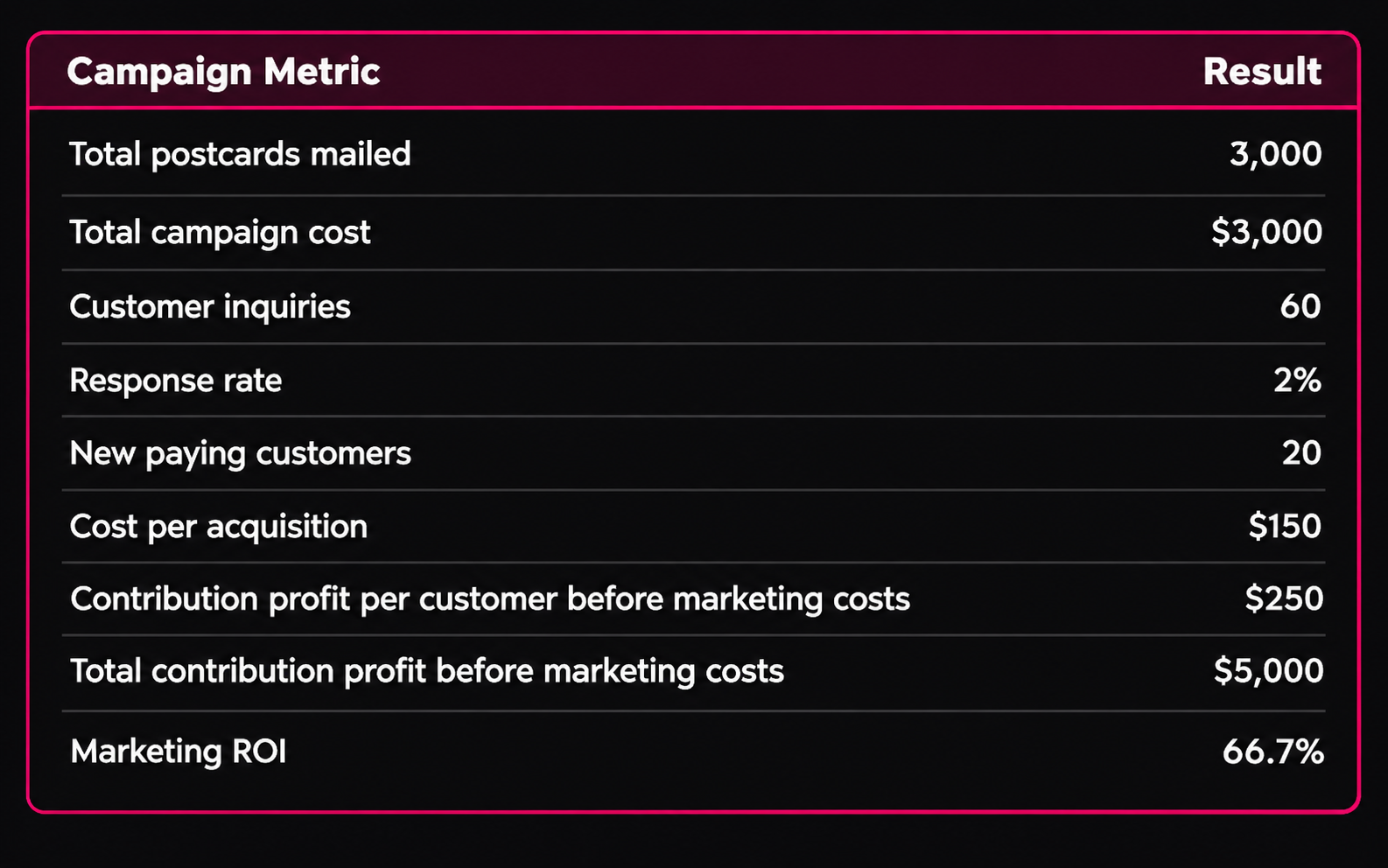
In this example, the company generates $5,000 in contribution profit before marketing expenses. After deducting the $3,000 campaign cost, it retains $2,000.
The marketing ROI is approximately 66.7%.
This calculation uses contribution profit rather than gross revenue to avoid overstating profitability. Actual campaign ROI should account for relevant service delivery costs and acquisition expenses.
Not every campaign will produce a positive return. A high response rate can still be unprofitable when too few inquiries convert into customers.
For more detailed calculations, read our guide on how to calculate ROI from your direct mail campaign.
Start reviewing responses during the first week after expected delivery. Evaluate initial performance after 30 days, then update results at 60 and 90 days if customers take longer to purchase or schedule services.
8. Test Your Campaigns and Improve What Isn't Working
One mailing rarely provides enough information to determine the best audience, offer, or message.
Businesses that treat each campaign as a learning opportunity can make more informed decisions about where to spend their next marketing dollar.
Lob's 2026 Consumer Insights Report found that 89% of surveyed U.S. consumers said relevant direct mail influenced them to take action. However, what recipients consider relevant varies by age, preferences, and personal circumstances.
That's why testing different approaches matters.
Start with one meaningful variable. You might compare two offers, two headlines, or two audience segments. Avoid changing everything at once because you won't know which adjustment influenced the results.
For example, a dental practice could test two versions of a new patient postcard.
Version A might emphasize convenient scheduling and available appointment times. Version B could focus on introducing the dental team and helping new residents find a local dentist.
Send the versions to comparable, randomly selected groups, such as 1,500 households each. Keep the timing, postcard format, and response process consistent.
Assign separate tracking codes to determine which version generates more qualified inquiries and booked appointments.
When reviewing the results, don't automatically choose the postcard with more calls. If one version produces 40 inquiries but only eight appointments, while another produces 30 inquiries and 15 appointments, the second may be more valuable despite its lower response volume.
Those figures are illustrative. Small differences also may not be statistically meaningful, so avoid declaring a winning version without enough responses.
The purpose of testing is to identify what generates valuable customers, not simply what attracts attention.
If results fall below expectations, first review the audience, offer, and response process before increasing mailing volume. Our guide on how to increase direct mail response rates explains where to look for improvements.
For additional execution guidance, review these direct mail best practices for successful campaigns.
9. Prepare Your Business Before Launching the Campaign
Even well-targeted campaigns can underperform when production schedules slip, addresses are inaccurate, or businesses aren't prepared to handle incoming inquiries.
Lob's 2026 Business Insights Report found that 87% of the 250 surveyed leaders overseeing high-volume direct mail programs considered printing, shipping, and delivery major operational blind spots. The findings show why coordination matters, although smaller businesses may face different challenges.
Before mailing, confirm that addresses are properly formatted and validated, the postcard meets postal specifications, and the printing and delivery schedule supports your campaign goals.
More importantly, make sure your team can respond when customers reach out.
A dental practice promoting new patient appointments should have a clear booking process, available appointment slots, and staff who understand the advertised offer.
A home services company should be ready to answer calls, explain its promotion, and arrange estimates without unnecessary delays.
When an interested recipient calls but can't reach anyone, the business risks losing a lead it has already paid to generate.
For businesses managing their first campaign, our step-by-step guide to sending direct mail explains the process from preparation through mailing.
Working with an experienced provider can simplify mailing list preparation, design, printing, postal requirements, and campaign tracking. However, compare providers based on their capabilities, transparency, and ability to support your goals rather than price alone.
Our article on how to choose the right direct mail service explains what to evaluate before committing.
Once the campaign launches, monitor responses, review customer acquisition costs, and document any problems. Use those findings to improve the next mailing rather than repeating the same approach without evidence.
Conclusion
Understanding how to use direct mail marketing effectively comes down to making every mailing purposeful and measurable.
Start with a clear business goal. Target people who are likely to need your services, create an offer that gives them a reason to respond, and use simple design with a direct call to action.
Timing, tracking, and follow-up matter just as much. A campaign that generates calls but fails to convert those inquiries into customers still has room for improvement.
The strongest approach is to start with a manageable campaign, measure its results, and use that information to make each future mailing more effective. Consistent customer acquisition comes from improving the entire process, not simply sending more postcards.
Turn Your Direct Mail Into a More Predictable Source of New Customers
If your business wants to generate more qualified leads, improve response tracking, and build a more consistent customer acquisition strategy, MVP Mailhouse can help you plan a more focused direct mail campaign.
From reaching the right households to creating targeted postcards and measuring responses, the goal is to make your marketing investment easier to understand and improve.
Visit our website at MVP Mailhouse to explore our direct mail marketing solutions and see how we can help you build a campaign focused on measurable business growth.
Tags
Direct Mail Strategies
Frequently Asked Questions
Related blog




Ready For Your Success Story?
Get 500 Free Handout cards shipped right to your doorstep!