How to Get More Dental Appointments
Learn how to get more dental appointments with better call handling, easier online booking, local SEO, patient reactivation, and targeted dental marketing.

Reece Lyndon Mower
director of-Strategy
·21 min read
·Nov 6, 2026


Knowing how to get more dental appointments starts with understanding why interested patients never make it onto your schedule. According to BrightLocal's 2025 Consumer Search Behavior study, 85% of consumers consider contact information and business hours important when researching local businesses. For dental practices, being easy to reach is one of the first steps toward getting patients to book.
But getting inquiries is only half the work. A practice can receive plenty of calls, website visits, and referrals while still struggling with empty appointment slots.
The solution is to improve how patients find your practice, contact your team, and schedule their visits. This guide covers practical ways to increase dental appointments, reduce missed opportunities, and build a more consistent flow of patients. You'll learn which changes to prioritize, what numbers to track, and how to measure progress over the next 30 to 90 days.
1. Find Out Why Patients Aren't Booking Appointments
Before spending more on dental practice marketing, find out where potential appointments are being lost.
At MVP Mailhouse, we've recorded, scored, and analyzed over 300,000 incoming new-patient phone calls. One important lesson from our experience is that generating patient interest and converting that interest into a scheduled appointment are two different challenges.
We've seen how a marketing campaign can generate responses, yet the practice still misses opportunities because callers don't reach the front desk or conversations end without an appointment.
Consider this hypothetical example.
A dental practice receives 100 qualified appointment inquiries in one month. Its staff connect with 60 patients and successfully book 35% of those conversations. That's 21 appointments.
Now imagine the practice improves its answer rate and booking process. Staff connect with 80 patients and schedule 45% of those conversations. The result is 36 appointments.
That's 15 additional appointments from the same number of inquiries. These are illustrative numbers, but they show why improving conversions matters as much as attracting new dental patients.
Start by measuring four things.
- Qualified patient inquiries from calls, website forms, referrals, and marketing campaigns.
- Call answer rate to identify missed opportunities.
- Appointment booking rate to measure how many qualified conversations lead to scheduled visits.
- Completed appointments to distinguish bookings from patients who actually arrive.
Review the previous 30 days of activity to establish your starting point. Then identify the biggest problem.
If inquiries are low, focus on how to get more dental patients. If inquiries are healthy but bookings are weak, work on the scheduling process before increasing your marketing budget.
This approach helps you invest where the practice has the greatest opportunity to improve.
2. Improve Front Desk Call Handling to Book More Patients
Your front desk plays a major role in dental patient acquisition. Patients may discover your practice through Google, direct mail, or referrals, but many still depend on a phone conversation before deciding to schedule.
A 2026 analysis of 9,248 dental patient calls across 28 dental practices found that 23% of calls during business hours went unanswered. This was a vendor-led study of participating practices, not a national average, but it highlights a problem worth checking in your own office.
An unanswered call may represent someone seeking an urgent appointment, looking for a new family dentist, or comparing local providers.
And even when someone answers, the conversation can still fall short.
Make Every Patient Conversation Lead to a Clear Next Step
A good front desk conversation doesn't need to sound like a sales pitch. Patients want straightforward information, reassurance, and an easy way to schedule.
For example, a patient calls about a dental cleaning and asks whether the practice accepts their insurance.
A weak response confirms the insurance information but leaves the patient to decide what happens next.
A stronger response answers the question, confirms the type of visit needed, and offers two available appointment times.
Something as simple as "We have Tuesday morning or Thursday afternoon available. Which works better for you?" makes scheduling easier without pressuring the patient.
The goal is to reduce uncertainty and help patients make a decision while they're already interested.
For more practical examples, review our call handling best practices for dental offices.
Follow Up on Missed Calls and Unscheduled Inquiries
Not every patient books during the first conversation. Some need to check their schedules, confirm insurance coverage, or discuss treatment costs.
That doesn't mean the opportunity is gone.
Assign someone to follow up with missed calls and patients who requested more information. Where appropriate, return missed calls the same business day, and keep a record of whether the conversation resulted in a booking.
We've found that examining the reasons appointments aren't scheduled is more useful than simply counting how many calls came in.
For the first two weeks, review missed calls and unsuccessful booking conversations. Look for repeated issues such as unanswered insurance questions, limited availability, or callers who never received a follow-up.
After 30 days, compare your answer rate and appointment conversion rate with your original baseline. The goal is measurable improvement, not an assumed percentage increase.
Our guide on front desk strategies for efficient call handling explains how to organize these responsibilities without overwhelming your team.
3. Make Online Appointment Scheduling Simple
Patients shouldn't have to work hard to schedule a dental appointment.
A September 2026 study by Suff Digital examined 522 U.S. dental practice websites. Online booking was evaluated on 495 of those sites, and 52.9% offered no online appointment booking option.
That creates an opportunity for practices willing to make scheduling more convenient.
Imagine a prospective patient searching for a dentist after work. They find two nearby practices offering similar services.
One website requires them to call during office hours. The other lets them request an appointment immediately or select an available time.
The second practice has removed a barrier that could otherwise delay the booking.
Give Patients More Than One Way to Schedule
Online scheduling should support your front desk, not replace it. Some patients prefer speaking with a person, especially when they have concerns about treatment or insurance. Others want to book without making a phone call.
Your dental website should make both options easy to find.
Place a clear Book an Appointment button near the top of your homepage and relevant service pages. Include a clickable phone number for mobile visitors.
Patients should also be able to find your office hours, location, accepted insurance plans, and whether you're accepting new patients.
If you offer online scheduling, clearly distinguish between a confirmed appointment and a request that still needs staff approval. Avoid showing availability that isn't actually open.
Keep appointment request forms short and use an appropriate secure system when collecting patient health information.
In practice, these details matter because patients often compare several dental offices before contacting one. The fewer obstacles they encounter, the easier it becomes to choose your practice.
Track how many website visitors start scheduling and how many complete the process. Review the results after four weeks, paying particular attention to mobile visitors and requests submitted outside office hours.
The objective isn't simply to generate more website traffic. It's to make every qualified visit more likely to become a scheduled dental appointment.
4. Improve Your Local SEO to Attract Patients Ready to Book
Most patients looking for a new dentist prefer a practice close to home or work. That's why local search visibility matters when trying to increase dental appointments.
According to BrightLocal's 2026 Local Consumer Review Survey, 97% of consumers read online reviews for local businesses, while 85% say positive reviews make them more likely to use a business.
For dental practices, this means appearing in Google search results isn't enough. Patients also need a reason to trust your practice before scheduling.
Optimize Your Google Business Profile for Appointment Searches
Your Google Business Profile should help patients quickly understand what you offer, where you're located, and how to contact your team.
Keep your business name, address, phone number, and operating hours accurate. Choose the correct primary business category and add relevant services, such as dental cleanings, emergency dentistry, implants, or cosmetic treatments, when available.
Include recent photos of your office, treatment rooms, and team. These help potential patients become familiar with the practice before their first visit.
Make sure your website and appointment links lead directly to the appropriate pages rather than forcing visitors to search for scheduling information.
For example, someone searching for "emergency dentist near me" should be able to confirm whether you provide emergency care and find a clear way to contact your office.
The fewer steps between finding your practice and requesting an appointment, the better.
Use Patient Reviews to Build Trust
Online reviews influence whether patients feel comfortable choosing an unfamiliar dental practice.
However, collecting more five-star ratings shouldn't be your only priority. Patients often read written reviews to understand how staff communicate, whether appointments run smoothly, and what the overall experience is like.
Ask patients for honest feedback after their visits. Make the process simple by providing a direct review link through an appropriate follow-up message.
Respond professionally to feedback without confirming anyone's patient status or sharing private health information. Avoid offering rewards in exchange for positive reviews.
In practice, consistent review activity helps potential patients see that your office is active and responsive.
Give your local SEO improvements 30 to 90 days for an initial assessment. Monitor Google Business Profile calls, website clicks, appointment requests, and completed bookings. Google explains how these interactions are counted in its Business Profile performance documentation.
For more ways to strengthen your practice's visibility, review our dental practice marketing ideas.
5. Use Targeted Direct Mail to Reach Potential Dental Patients
Online marketing reaches people actively searching for a dentist. But some potential patients aren't searching yet, even though they may soon need a new dental provider.
This is where direct mail marketing for dentists can be useful.
According to Lob's 2025 State of Direct Mail Consumer Insights Report, 67% of surveyed consumers said relevant timing and personalization motivate them to act on direct mail.
The lesson is straightforward. Sending postcards to the right households matters more than simply reaching the largest number of addresses.
At MVP Mailhouse, targeted dental direct mail focuses on reaching households within selected service areas. Rather than treating every address as equally valuable, practices can build campaigns around geographic coverage and audience relevance.
A postcard should give recipients a clear reason to consider the practice. Introduce the dentist, explain the services offered, and make scheduling easy.
For example, a family dentistry postcard might highlight convenient appointment availability, accepted insurance plans, and a welcoming environment for new patients.
Include a phone number or booking link so interested households can respond without extra steps.
Target New Movers Who May Need a Dentist
New mover marketing is especially relevant for dental patient acquisition because relocating often means finding new healthcare providers.
Someone who recently moved may need a family dentist, a provider that accepts their insurance, or a nearby office for routine care.
Instead of waiting for these households to search online, your practice can introduce itself through a targeted welcome postcard.
For example, a dental office could send a short series of mailers to households that recently moved into nearby neighborhoods.
The first introduces the practice and its location. A later postcard highlights useful services or appointment convenience. A final reminder provides another opportunity to schedule.
This approach keeps your practice visible while new residents are getting familiar with their community.
Our guide to new mover mailers for dental practices explains how to structure these campaigns around people who have recently relocated.
Measure Appointments Instead of Mail Volume
A large mailing doesn't automatically mean more dental appointments.
Suppose a practice sends 2,000 targeted postcards and receives 30 qualified inquiries. If 12 callers schedule and 10 attend, the campaign has generated 10 completed appointments.
Those figures are an illustrative example, not a typical or guaranteed campaign result.
The important numbers are the appointments generated and the cost of acquiring those patients.
Use a dedicated tracking number, campaign-specific booking link, or another reliable attribution method to identify responses.
Evaluate early inquiries within the first 30 days after delivery, then continue tracking appointments over 60 to 90 days. Multiple mailings may require a longer evaluation period.
The goal is consistent patient acquisition at a cost your practice can support, not simply distributing more postcards.
6. Reactivate Inactive Patients to Fill Open Appointment Slots
Getting more dental appointments doesn't always require finding new patients. Some of the easiest opportunities to investigate may already exist in your patient database.
These are patients who previously visited your practice but haven't returned for recommended care or are overdue for follow-up.
According to the CDC's 2024 report on dental care among older adults, only 63.7% of U.S. adults aged 65 and older reported visiting a dentist within the previous 12 months in 2022.
This finding doesn't tell us how many patients are inactive at a particular dental office. But it illustrates that regular dental attendance isn't universal, making patient follow-up an important part of appointment management.
Dental patient reactivation focuses on reconnecting with existing patients who may be ready to return but haven't scheduled their next visit.
Identify Patients Who Need Follow-Up
Start by reviewing your patient records and recall system.
Look for patients who missed appointments, didn't schedule recommended follow-up care, or haven't visited within the interval recommended by their dental provider.
Instead of sending the same reminder to everyone, organize outreach based on their situation.
For example, someone who missed a recent appointment may only need help rescheduling. A patient who hasn't returned for a longer period may benefit from a friendly reminder and an opportunity to discuss their current needs.
The message should be helpful rather than pushy.
A simple reminder that the practice is accepting appointments, paired with an easy scheduling option, is often more appropriate than an aggressive promotional offer.
Use approved communication methods and protect patient information in accordance with HIPAA requirements.
Our article on how to reactivate inactive dental patients provides additional guidance on reconnecting with existing patients.
Track Reactivation Results Over 30 to 60 Days
Patient reactivation should be measured separately from new patient marketing.
Start with a defined group of eligible inactive patients and track how many are successfully contacted, how many book, and how many complete an appointment.
For example, if your team contacts 100 eligible inactive patients and 18 schedule a visit, that's an 18% booking rate among the patients contacted. This is a sample calculation, not an industry benchmark.
Review the results after 30 days and continue monitoring completed appointments over the following month.
If the booking rate is low, examine the message, contact information, scheduling availability, and reasons patients decline.
A well-organized reactivation process can help fill available appointment slots while strengthening long-term patient relationships.
And because these patients already know your practice, reconnecting with them may require a different approach than introducing your services to someone entirely new.
7. Encourage Patient Referrals to Generate More Appointments
Patient referrals remain one of the most practical ways to attract new dental patients because the recommendation comes from someone the prospective patient already trusts.
According to Nielsen's 2021 Trust in Advertising Study, 88% of surveyed consumers worldwide trust recommendations from people they know more than any other advertising channel.
For dental practices, that trust matters. Patients are often more comfortable visiting an unfamiliar dentist when a friend, family member, or coworker has already had a positive experience.
But referrals shouldn't depend entirely on patients remembering to mention your practice.
Make Referrals Easy for Existing Patients
The best time to encourage a referral is after a positive patient experience.
For example, a patient who recently completed treatment and expressed satisfaction may be happy to recommend your office. A simple invitation to share your practice's contact information with someone looking for a dentist can help.
There's no need for a complicated referral program.
Make sure patients can easily share your website, phone number, or appointment booking page. Train your staff to mention referrals naturally without making patients feel obligated.
You can also strengthen referrals by maintaining a consistent patient experience. Clear communication, respectful treatment, and reliable scheduling give patients reasons to recommend your practice.
Our guide on how to get dental referrals covers additional ways to encourage recommendations.
Measure How Many Referrals Become Appointments
Ask new patients how they heard about your office and record their answers in your practice management system.
For example, if 20 referred patients contact your practice and 14 complete their first appointment, your completed appointment rate from those referrals is 70%.
This is an illustrative example rather than an industry benchmark.
Review referral inquiries and completed visits every month. If referral volume is growing but appointments aren't, investigate scheduling availability and front desk follow-up.
A successful referral strategy should generate actual patient visits, not simply more recommendations.
8. Track Which Marketing Channels Generate Dental Appointments
One of the biggest mistakes in dental practice marketing is measuring success through visibility alone.
Website traffic, ad clicks, and phone calls provide useful information. But they don't tell you how many patients actually scheduled and attended an appointment.
That's why every dental practice should connect its marketing activity to real booking outcomes.
Google Analytics documentation explains how key events help businesses measure important website actions across marketing channels. For dental practices, these can include completed appointment request forms or interactions with booking systems.
However, tracking a website action is only the starting point. An appointment request isn't necessarily a confirmed booking.
Use Call Tracking to Identify Patient Inquiries
Many patients still prefer calling a dental office before scheduling, particularly when discussing insurance coverage, treatment options, or urgent dental concerns.
Without proper tracking, it's difficult to know whether those conversations originated from Google Search, paid advertising, direct mail, or another source.
Dedicated tracking numbers can help identify which marketing campaigns generate phone inquiries.
For example, a dental practice might receive 40 calls from a postcard campaign and 25 from online advertising during the same month.
The postcard campaign generated more calls, but that doesn't automatically make it the better investment.
You need to know how many inquiries were qualified, how many became scheduled appointments, and how many patients actually attended.
Our article explaining call tracking for dental practices covers how tracking numbers can support these measurements.
Calculate Your Cost per Completed Appointment
Cost per completed appointment measures how much marketing spending is required to generate one attended visit.
The calculation is straightforward.
Cost per completed appointment = Marketing spend ÷ Completed appointments attributed to the campaign
Suppose a practice spends $1,200 on advertising and generates 12 completed new-patient appointments. Its cost per completed appointment is $100.
If another campaign costs $900 and generates 15 completed appointments, the cost is $60 per appointment.
These are sample calculations, not actual campaign results.
The second campaign has a lower acquisition cost, although patient value, treatment mix, and attribution quality still matter when comparing performance.
Use consistent tracking rules across marketing channels and avoid including patient health information in advertising analytics systems.
For a more detailed approach, read our guide on tracking which marketing channels bring new dental patients.
Review marketing performance monthly, then evaluate broader trends over 60 to 90 days.
The purpose isn't to spend less on every campaign. It's to identify where your budget produces the most valuable appointment opportunities and where improvements are needed.
9. Reduce Missed Appointments and Fill Last-Minute Cancellations
Getting patients to book is important. Making sure they attend is just as important.
Missed appointments create unused chair time, disrupt staff schedules, and reduce opportunities to treat other patients.
A 2021 study of SMS reminders in public dental services examined more than 118,000 appointments before and after reminder implementation. In the adult dental service, attendance increased from 73.5 to 77.7 per 100 appointments. Results were mixed across the services studied, showing that reminders can help but aren't equally effective for every patient group.
For dental practices, this supports a practical approach. Confirm appointments, make rescheduling easy, and respond quickly when patients cancel.
Use Appointment Reminders That Encourage Confirmation
Send reminders through the communication methods patients have agreed to use.
For example, a practice might send a reminder three days before an appointment, followed by a final confirmation the day before.
Give patients a simple way to confirm, cancel, or request a different time.
The exact timing should reflect your patient preferences and scheduling workflow.
When someone needs to cancel, encourage early notice so your team has enough time to offer the appointment to another patient.
Keep reminder messages brief and avoid unnecessary treatment details.
Maintain a Short-Notice Appointment List
Patients sometimes want an earlier appointment than the next available opening.
A short-notice list allows your team to contact these patients when a cancellation occurs.
For example, a patient waiting two weeks for a cleaning might be available the next afternoon. If another patient cancels, the front desk can offer that opening to someone on the list.
This works best when your scheduling team records which patients are flexible, the types of appointments they need, and their preferred contact methods.
Measure your appointment attendance rate and the percentage of canceled slots successfully refilled.
Suppose a practice schedules 200 appointments per month and 20 go unused. Its unused appointment rate is 10%.
If improved reminders and a short-notice list reduce unused appointments to 12, the practice gains eight completed appointment opportunities without increasing its advertising budget, assuming those eight slots are successfully filled and attended.
This example illustrates the potential impact rather than promising a particular result.
Start tracking these numbers immediately and compare results after 30 days. Small improvements in scheduling efficiency can make a meaningful difference over time.
How Long Does It Take to Get More Dental Appointments?
The timeline depends on your current patient demand, marketing activity, and appointment availability.
Some improvements can affect bookings within days, particularly when your practice starts responding to missed calls, following up with unscheduled inquiries, or filling cancellations.
Other strategies, including local SEO, direct mail, and patient acquisition campaigns, require more time to evaluate.
A practical 90-day improvement plan can help you measure progress without expecting immediate results from every activity.
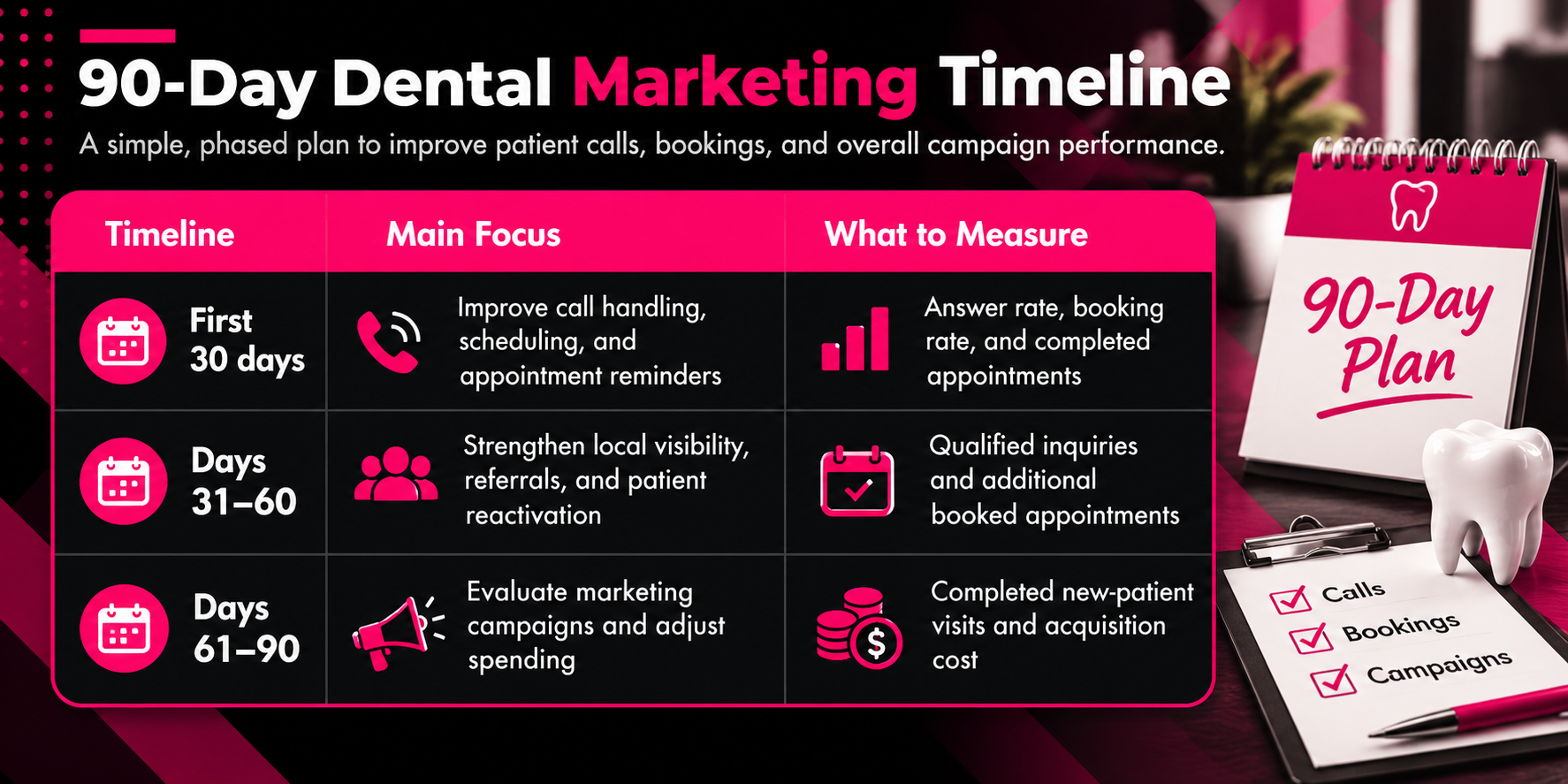
These are suggested review periods, not guaranteed timelines for increased bookings.
Focus on improving a few measurable outcomes rather than making every change at once.
For example, a practice struggling with unanswered calls should prioritize front desk performance before expanding advertising. Another practice with strong booking rates but limited inquiries may benefit more from targeted patient acquisition campaigns.
The right approach depends on where appointments are being lost.
Conclusion
Learning how to get more dental appointments isn't just about attracting more people to your website or increasing your advertising budget. It's about turning patient interest into scheduled visits and making sure those appointments happen.
Start by improving front desk call handling and making scheduling easier. Strengthen your local search presence, encourage patient referrals, and reconnect with inactive patients. Then use targeted marketing, including direct mail and new mover campaigns, to reach potential patients in your service area.
Most importantly, measure the results. Track qualified inquiries, booking rates, completed appointments, and acquisition costs so you know which improvements are working.
Consistent appointment growth comes from combining effective patient acquisition with a reliable scheduling process.
Build a More Consistent Flow of New Dental Patients
If your dental practice wants to reduce unpredictable appointment volume and reach more potential patients in your community, MVP Mailhouse can help.
Our targeted dental direct mail campaigns help practices introduce their services to households in selected neighborhoods, reach recent movers, and track responses to their marketing.
Instead of relying on broad advertising alone, you can focus on reaching relevant households and measuring how those campaigns contribute to patient acquisition.
Visit MVP Mailhouse to learn how targeted dental direct mail, new mover marketing, and call tracking can support a more predictable flow of patient inquiries and appointments.
Tags
Tips and Tutorials
Frequently Asked Questions
Related blog


Ready For Your Success Story?
Get 500 Free Handout cards shipped right to your doorstep!