Dental Practice Marketing Tips That Attract More Patients
Use these dental practice marketing tips to attract new patients, improve local SEO, increase referrals, and turn more inquiries into booked appointments.

Emily Duke
marketing manager
·26 min read
·Oct 27, 2026



Getting more patients into your dental practice takes more than running ads or posting on social media. The most effective dental practice marketing tips focus on reaching the right people, building trust, and turning patient inquiries into booked appointments.
According to BrightLocal's 2026 Local Consumer Review Survey, 97% of consumers read online reviews when researching local businesses. That matters for dental practices because patients often compare reviews, services, and convenience before deciding where to book.
But attracting attention is only half the job. A practice can have strong Google rankings, an active social media presence, and a steady flow of website visitors without seeing meaningful growth in appointments.
The difference comes down to having a clear marketing strategy and making sure every patient interaction supports it.
In this guide, we'll cover practical dental marketing strategies that help practices improve local visibility, attract qualified patients, increase appointments, and measure what actually works.
1. Build a Dental Marketing Strategy Around Your Growth Goals
One of the biggest mistakes in dental marketing is jumping into different promotional activities without defining what the practice needs.
A dental office struggling to fill hygiene appointments has different priorities from a new practice trying to build its patient base. Likewise, an established practice looking to increase implant consultations shouldn't necessarily follow the same approach as a family dentist focused on routine care.
Your marketing should reflect the type of growth you want, not just the number of people you want to reach.
Before choosing your dental marketing strategies, establish three things.
Patient acquisition goals. Determine how many new patients your practice needs each month based on appointment capacity and growth targets.
Ideal patient profile. Identify the neighborhoods, age groups, services, and patient needs that best match your practice.
Marketing budget. Set a realistic monthly budget based on your goals, existing revenue, and the cost of acquiring patients.
For example, suppose your practice wants 30 new patients per month and currently averages 20. Your immediate goal is to close that 10-patient gap.
If 40% of qualified new patient inquiries become booked appointments and 75% of those appointments are completed, you would need approximately 34 additional inquiries to generate 10 completed visits.
These are planning assumptions, not industry averages. Your actual conversion rates should come from your scheduling and patient records.
This approach gives every marketing activity a measurable purpose.
Rather than simply asking whether an advertising campaign received enough clicks, you can determine whether it helped generate the additional appointments your practice needed.
For a more detailed approach, our guide on how to create a dental marketing plan that works explains how to organize your marketing efforts around clear business goals.
Set Realistic Marketing Expectations
Not every dental marketing channel produces results at the same speed.
Paid search advertising can generate inquiries shortly after a campaign launches, while local SEO and content marketing typically require more time to build consistent visibility.
A practical starting framework looks like this.
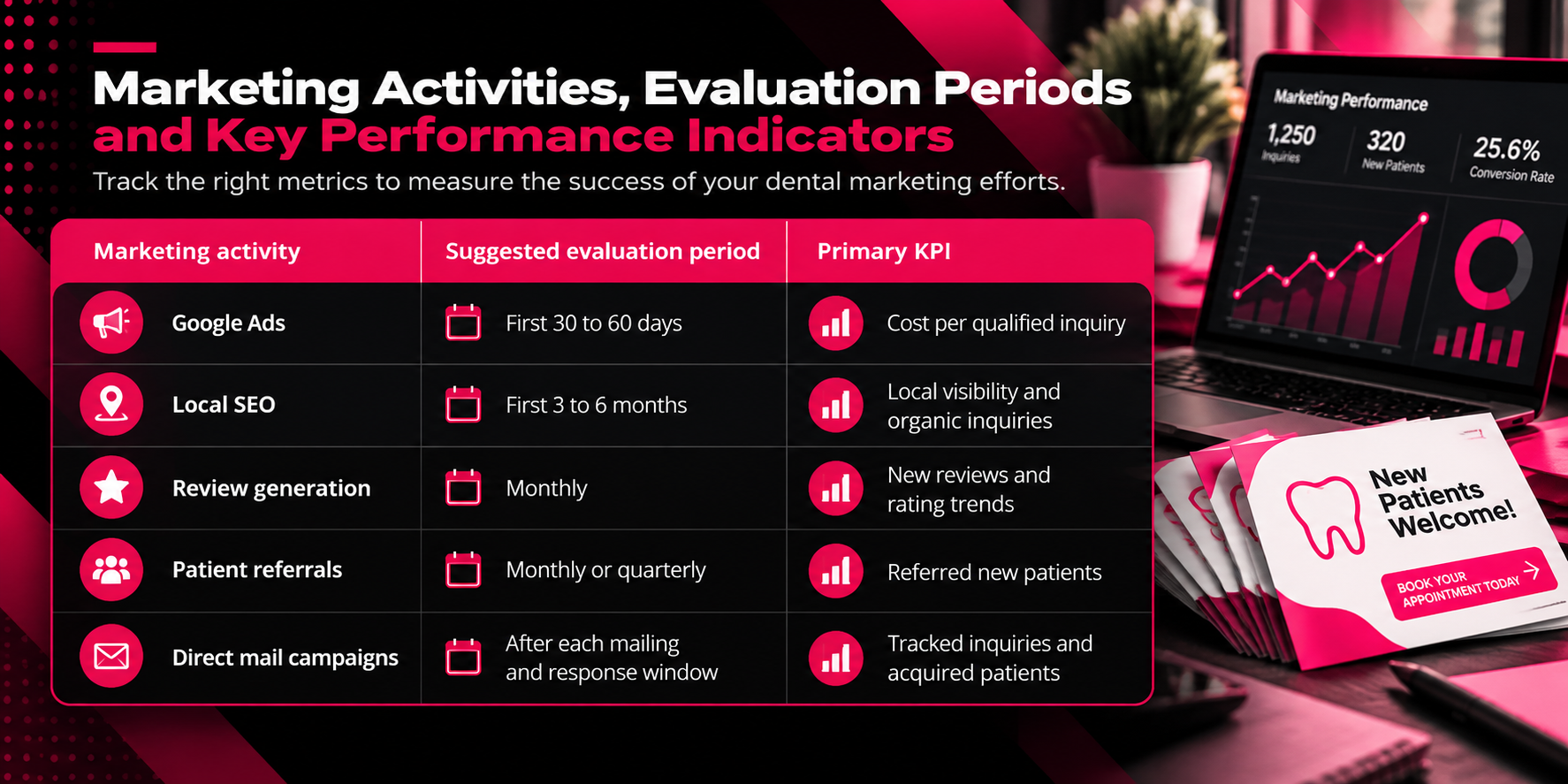
These periods are useful checkpoints rather than guaranteed timelines. Competition, budget, patient demand, and the practice's existing reputation can affect results.
Most importantly, review actual patient acquisition alongside marketing performance. A campaign that generates 50 inquiries but only three appointments needs closer attention than one producing 20 inquiries and 12 booked appointments.
2. Improve Your Google Business Profile to Attract Local Patients
For most general dental practices, local visibility deserves early attention.
People searching for a dentist often have a specific location in mind. Someone looking for a family dentist in their neighborhood is usually more valuable to a nearby practice than a visitor reading a general dental health article from another state.
That's why local marketing for dentists should start with an accurate, complete Google Business Profile.
Google explains in its official local ranking guidance that local results are primarily influenced by relevance, distance, and prominence.
You cannot control how far someone lives from your office. But you can improve how clearly Google understands your services and how well your practice presents itself to potential patients.
Make Your Google Business Profile Useful
Start with the information patients need before contacting your office.
Use your actual practice name, correct address, phone number, and business hours.
Select the most accurate primary business category and relevant secondary categories.
Add appropriate services, such as family dentistry, dental implants, or emergency dental care.
Upload authentic photos of your office, treatment rooms, and team.
Maintain an accurate website and appointment booking link.
Respond professionally to reviews without revealing patient information.
These improvements may seem basic, but they address a common issue.
A potential patient finds a practice on Google, checks its profile, and cannot tell whether the office accepts new patients or provides the treatment they need. Instead of calling to find out, they move to another result.
In practice, reducing that uncertainty can be just as important as improving rankings.
Focus on Local Search Terms That Match Patient Needs
Not every dental keyword deserves equal attention.
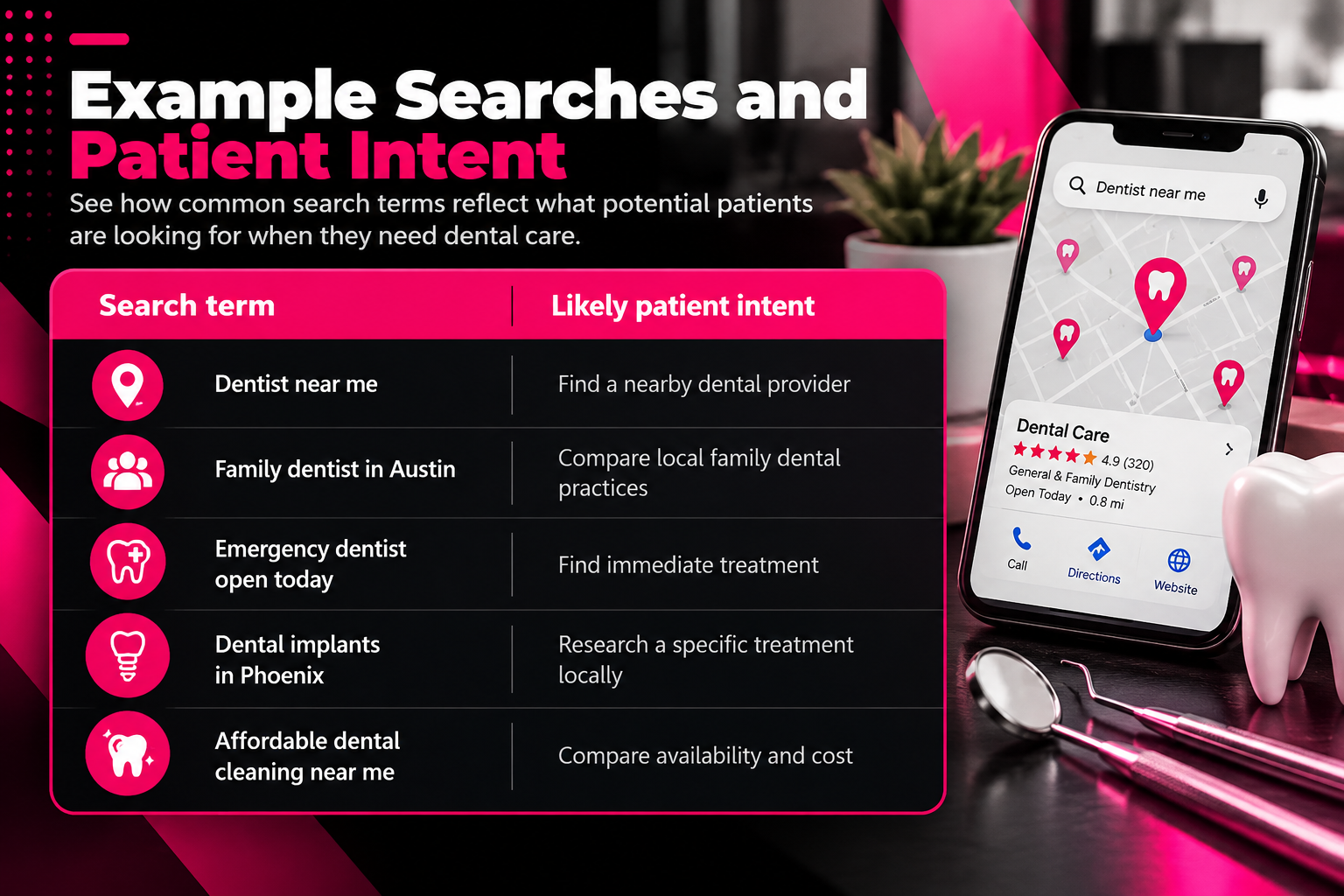
These searches represent different patient needs, but they all have local relevance.
Build useful service pages around the treatments you actually provide. Include your location naturally, explain what patients can expect, and make contacting your office easy.
Avoid creating multiple nearly identical city pages simply to target more keywords. A genuinely useful page that answers patient concerns is a better long-term investment.
For additional ideas on connecting local visibility with other marketing channels, see our guide on how to market a dental practice.
What to measure
Track Google Business Profile calls, website clicks, direction requests, and relevant organic search traffic each month. Where possible, connect inquiries to completed appointments.
For an established practice, review the first 30 days as a baseline and compare performance over the following 60 to 90 days. Local ranking improvements can take longer, especially in competitive areas.
3. Build Patient Trust Through Online Reviews
Online reviews are one of the most practical dental marketing ideas because they influence patients who are already considering your practice.
According to BrightLocal's 2026 survey, 85% of consumers say positive reviews make them more likely to use a business. The same research found that 74% consider reviews written within the previous three months important.
These findings cover local businesses generally, not dental practices exclusively. Still, they reinforce why maintaining a current, credible review profile matters.
Patients want reassurance before choosing a dentist. They may be concerned about treatment costs, discomfort, communication, or whether the office is welcoming.
A steady collection of genuine patient feedback helps them make a more informed decision.
Make Review Requests Part of Your Daily Process
Rather than occasionally launching a campaign asking for reviews, create a simple process your front desk can follow.
For example, after an appointment, your practice can send a short thank-you message with a direct link to its Google review page.
Keep the request neutral and optional. Ask patients to share honest feedback, without offering rewards or selectively requesting reviews only from people expected to leave positive ratings.
The key is consistency.
If your practice sees 200 patients per month and 10% voluntarily leave reviews after a request, that would produce approximately 20 new reviews monthly. This is a hypothetical planning example, not a guaranteed response rate.
Over time, consistent feedback can create a more current picture of the patient experience than a profile filled with reviews from several years ago.
Respond to Reviews Without Compromising Privacy
A good response does not need to be lengthy.
Thank reviewers for their feedback, acknowledge concerns professionally, and direct sensitive matters to a private communication channel.
Avoid confirming that someone is a patient or discussing appointments, diagnoses, or treatments in public responses.
Across local marketing, the strongest review strategies focus on more than increasing star ratings. They help practices understand what patients value and where the experience needs improvement.
What to measure
Review the number of new reviews, rating trends, review recency, and recurring feedback themes every month.
For the first 90 days, focus on making requests consistent and monitoring whether patients are responding. Do not treat a specific number of five-star reviews as the definition of success.
4. Make Your Dental Website Easier to Use and Book From
Your website should make it simple for patients to decide whether your practice is right for them.
This matters because local visibility doesn't automatically create appointments.
BrightLocal's 2026 research found that 54% of consumers visit a business's website after reading positive reviews. For dental practices, that visit is an opportunity to answer final questions and make booking straightforward.
A well-designed dental website doesn't need complicated features. It needs useful information, clear navigation, and a convenient way to contact the office.
Prioritize the Information Patients Actually Need
A potential patient should quickly understand what treatments you offer, where you're located, whether you're accepting new patients, and how to schedule a visit.
Your most important pages should provide straightforward answers.
For example, a dental implant service page should explain who may benefit from treatment, what the consultation involves, the general treatment process, and what can affect pricing.
An emergency dentistry page should clearly communicate the types of urgent problems your practice handles, office availability, and how patients can contact your team.
This approach supports both search visibility and patient decision-making.
It also helps reduce inquiries from people looking for treatments you don't provide.
Remove Unnecessary Steps From Appointment Booking
A common website problem is making interested patients work too hard to contact the practice.
They find a useful page, scroll through several sections, and still have to search for the phone number or booking option.
A better approach is to place a clear appointment button near the top of important pages and keep your phone number easy to find on mobile devices.
If your practice uses an online appointment form, ask only for information needed to begin the scheduling process and handle patient data securely.
For example, consider a practice receiving 500 visits per month to its main service pages.
If 2% of visitors submit an inquiry, that's 10 inquiries. Improving the inquiry rate to 3% would generate 15 inquiries from the same traffic.
That's a 50% increase in inquiries without increasing website visits. The numbers are illustrative, but they show why website improvements can be valuable even before investing in additional advertising.
What to measure
Use website analytics and appointment records to monitor inquiry conversion rates, mobile usability, booking form completions, and the number of inquiries that turn into scheduled appointments.
Start by measuring current performance over 30 days. Then test one meaningful improvement, such as making appointment booking more visible, and compare results over the next 30 to 60 days.
A better website shouldn't simply bring more traffic. It should help more qualified visitors become actual patients.
5. Use Google Ads to Reach Patients Ready to Book
Google Ads can be one of the more effective dental marketing strategies when your practice needs to reach people actively searching for treatment.
Unlike social media advertising, which often reaches people who aren't currently looking for a dentist, Google Search Ads can connect your practice with patients who already have a specific need.
According to WordStream's 2025 Google Ads Benchmarks, the Dentists & Dental Services category had an average conversion rate of 9.08% and an average cost per lead of $83.93.
These figures provide useful context, but they aren't guarantees. Actual performance depends on your location, competition, targeting, and how effectively your team handles inquiries.
Focus on High-Intent Dental Keywords
Instead of advertising every service to everyone nearby, prioritize searches that indicate someone is close to making an appointment.
For example, someone searching for "emergency dentist near me" likely needs immediate assistance. Meanwhile, a search for "what causes tooth sensitivity" is more informational and may not lead to an appointment right away.
Your advertising budget should prioritize searches that closely match your services and patient acquisition goals.
Start with a small group of relevant keywords, send visitors to dedicated service pages, and make scheduling straightforward.
For additional guidance, our article on the best dental ads that actually bring in new patients covers advertising approaches that support patient acquisition.
Measure Appointments Instead of Clicks
A common advertising mistake is celebrating traffic without checking whether those visitors become patients.
Suppose your practice spends $1,000 on Google Ads and receives 15 inquiries. Your cost per inquiry would be approximately $67.
If six inquiries turn into completed new patient appointments, your acquisition cost would be approximately $167 per patient.
That second number gives you a clearer picture of performance.
For the first 30 to 60 days, monitor search terms, qualified inquiries, appointment bookings, and acquisition costs. Adjust your targeting based on which campaigns bring in patients rather than simply generating clicks.
6. Create Helpful Dental Content That Answers Patient Questions
Content marketing helps dental practices reach people researching treatments, comparing options, or trying to understand a dental problem.
It's particularly useful for building long-term organic visibility.
But publishing articles just to target more keywords is rarely enough. Your content should address real patient concerns and help readers understand when professional dental care may be appropriate.
Google's SEO Starter Guide emphasizes creating helpful, reliable, people-first content rather than writing primarily to manipulate search rankings.
For dental practices, this means prioritizing accurate, understandable information reviewed by qualified professionals.
Write About Questions Patients Actually Ask
A useful starting point is your front desk and clinical team.
They regularly hear questions about treatment costs, insurance, recovery times, and appointment expectations. These conversations can reveal content opportunities that keyword research alone might miss.
For example, consider these topics.
- How much does a dental crown cost?
- What happens during your first dental appointment?
- Dental implants vs. bridges
- How often should children visit the dentist?
- What should you do if you chip a tooth?
Each topic addresses a specific concern that could influence a patient's decision to seek treatment.
An article comparing implants and bridges should explain the differences, limitations, and factors dentists consider when recommending treatment. It shouldn't simply promote whichever service generates more revenue.
That's what makes the content useful.
Connect Educational Content to Relevant Services
An informational article should naturally guide readers toward the next appropriate step.
For example, an article explaining common causes of tooth pain can link to your emergency dentistry page when discussing symptoms that require prompt evaluation.
This creates a logical connection between education and patient care without making every article feel like an advertisement.
Consider a blog that receives 1,000 organic visits monthly. If 1% of those visitors submit a relevant inquiry, that represents 10 potential patient conversations.
This is an illustrative scenario, not an expected industry conversion rate. Informational traffic may convert less frequently than service-specific searches.
Review content performance every 90 days using organic impressions, relevant search queries, service page visits, and patient inquiries.
For most practices, consistently improving a smaller collection of valuable pages is more practical than publishing large amounts of repetitive content.
7. Use Social Media to Build Familiarity and Trust
Social media isn't always the strongest channel for immediate appointment bookings, but it can help patients become familiar with your practice before they need treatment.
According to Pew Research Center's 2025 Social Media Use Report, 71% of U.S. adults use Facebook, while 50% use Instagram.
That makes these platforms worth considering, especially for dental practices serving families and local communities.
However, having a social media account doesn't automatically make it an effective marketing channel.
Show the People and Experience Behind Your Practice
Many dental offices publish generic oral health tips or promotional graphics without showing what makes their practice different.
A stronger approach is to share content that helps patients feel comfortable choosing your office.
Introduce your dentists and staff, explain common procedures in simple language, show your facilities, and answer frequently asked questions.
For example, a short video explaining what happens during a child's first dental appointment may be more useful to parents than another promotional post about scheduling cleanings.
You can also highlight community events, staff achievements, and practice updates.
Patient stories or treatment photos should only be shared with appropriate written authorization and careful attention to privacy requirements.
Prioritize Consistency Over Posting Volume
A dental practice doesn't need to publish every day to maintain a useful social media presence.
Start with two or three quality posts per week if your team can maintain that schedule. Use a mix of educational videos, practice updates, and content that answers common patient concerns.
The goal isn't to accumulate followers who live outside your service area.
It's to build recognition among the people most likely to visit your practice.
After 60 to 90 days, review local engagement, profile visits, website traffic, messages, and appointment inquiries attributed to social media.
If certain content consistently generates relevant questions or inquiries, use those findings to guide future posts.
8. Turn Satisfied Patients Into a Consistent Referral Source
Patient referrals remain a valuable part of dental practice growth because they introduce your office through someone the prospective patient already trusts.
A recommendation from a friend, family member, or coworker can reduce the uncertainty that comes with choosing a new dental provider.
According to Nielsen's Trust in Advertising Study, 88% of global respondents said they trust recommendations from people they know more than any other advertising channel.
The study isn't dental-specific, but it illustrates the value of personal recommendations.
Make Referrals Easy Without Pressuring Patients
The best starting point is a positive patient experience.
When appointments run smoothly, staff communicate clearly, and patients feel respected, they have stronger reasons to recommend your practice.
You can support referrals by reminding patients that your office welcomes new patients and making your contact details easy to share.
For example, after a positive visit, your front desk can mention that family members or friends are welcome to contact the practice if they need dental care.
There's no need for complicated promotions or aggressive requests.
For more practical recommendations, see our guide on how to get dental referrals.
Track Where Referred Patients Come From
Ask new patients how they heard about your practice during registration.
Suppose your office averages 50 new patients monthly, and 10 come through existing patient referrals. That means referrals account for 20% of your monthly new patient volume.
If that percentage increases over the next quarter, it may indicate that patient experience and word-of-mouth awareness are improving.
However, referral volume can fluctuate for reasons unrelated to marketing, so review trends over several months.
Track referred patients, booked appointments, completed first visits, and referral sources monthly.
More importantly, protect the patient experience that generates those recommendations in the first place.
9. Reach Nearby Households With Targeted Dental Direct Mail
Digital channels are important, but they aren't the only way to reach potential patients.
Dental direct mail marketing can help practices introduce themselves to nearby households, particularly in neighborhoods where they want to establish a stronger presence.
This approach works differently from Google Ads.
Instead of waiting for someone to search for a dentist, a targeted mailing introduces your practice before the patient begins actively comparing providers.
The 2025 Household Mail Survey reported that 14% of advertising mail pieces were rated by households as very likely to prompt a response. This measures stated likelihood across advertising mail, not actual dental campaign response rates.
The finding is useful context, but it shouldn't be treated as a forecast for dental postcards.
Target Neighborhoods With Patient Growth Potential
Successful dental postcard marketing starts with selecting the right households.
Rather than mailing every address within a fixed radius, evaluate neighborhoods based on your practice location, existing patient distribution, target demographics, and growth goals.
For example, a family dental practice might prioritize nearby residential neighborhoods with households that fit its services.
A practice introducing itself to newly developed communities could consider new mover marketing for dentists, which focuses on households that have recently relocated.
New residents may be looking for a dentist because their previous provider is no longer convenient.
The message should address that need clearly, including your location, services, contact information, and how to schedule an appointment.
Treat Direct Mail as a Patient Acquisition Campaign
One mistake we often see in dental marketing is treating a postcard as the finished product rather than part of a larger patient acquisition strategy.
The design matters, but targeting, mailing frequency, offer relevance, and appointment handling all influence the outcome.
For example, imagine a practice sends 5,000 postcards to selected households.
If 0.5% of recipients respond, that would generate 25 inquiries. If 40% of those inquiries become completed new patient appointments, the campaign would acquire 10 patients.
These percentages are hypothetical. Actual outcomes vary based on the mailing list, market, creative, timing, and patient demand.
For a campaign like this, the practice should calculate the total mailing cost against completed new patient appointments, rather than judging success by response rate alone.
Track inquiries using a dedicated phone number, campaign-specific landing page, or another reliable attribution method.
Review initial results after the mailing response window and continue monitoring delayed appointments where attribution is possible.
Direct mail generally makes more sense when it complements your other marketing activities. A household might receive a postcard, search your practice on Google, read your reviews, and then schedule an appointment.
That entire experience matters.
The strongest campaigns make it easy for patients to recognize your practice and take the next step, regardless of which channel they use.
10. Improve Patient Retention to Support Long-Term Growth
Attracting new patients is important, but keeping existing patients engaged is just as valuable for sustainable growth.
A practice that consistently gains new patients but loses contact with existing ones may struggle to maintain a full appointment schedule.
According to the American Dental Association's Dental Care Market Research, only 45% of the U.S. population had a dental visit within the previous 12 months in 2022. Among working-age adults, that figure was 40%.
While these statistics cover dental utilization rather than retention specifically, they highlight an opportunity to help patients maintain regular dental care.
Make Patient Follow-Ups Consistent
Effective dental patient retention starts with making it easy for patients to return when care is due.
Use appointment reminders, personalized recall messages, and follow-up communication to stay connected with existing patients.
For example, a patient who misses a recommended hygiene appointment may simply forget to reschedule. A timely reminder can encourage them to contact your office before too much time passes.
You can also identify patients with overdue appointments and reach out with relevant, respectful messages.
Avoid sending the same message to everyone. Communication should reflect each patient's recommended care schedule and preferences.
Our guide on how to increase patient retention in dentistry provides additional strategies for maintaining relationships with existing patients.
Track Returning Patient Appointments
Suppose 200 patients become due for a recommended recall appointment during a particular month, and 140 complete their visits within your chosen measurement window.
That represents a 70% recall completion rate for that group.
If your practice improves that figure to 80%, it would mean 20 additional completed appointments without acquiring new patients.
These are hypothetical numbers, but they demonstrate why retention deserves attention alongside acquisition.
Monitor recall completion, patient reappointment rates, overdue appointments, and inactive patient counts every month.
Review changes over 90 days to identify whether your communication efforts are helping more patients return for appropriate care.
11. Train Your Front Desk to Convert More Patient Inquiries
Marketing can generate phone calls and appointment requests, but your front desk determines what happens next.
An interested patient may find your practice through Google, social media, or advertising. If their call goes unanswered or they receive unclear information, that opportunity can disappear.
The California Dental Association's December 2025 practice management guidance recommends reviewing patient follow-ups, scheduling protocols, confirmation processes, and case acceptance when practices want to improve appointment volume.
This reinforces an important point. Patient acquisition doesn't end when someone contacts your office.
Make Every Patient Inquiry Easy to Handle
Your front desk should be prepared to explain available appointments, accepted insurance plans, general payment options, and what new patients can expect.
Staff should communicate clearly without rushing patients or making treatment promises.
For example, someone calling about dental implants may have questions about consultation fees, insurance, or treatment timelines.
Rather than immediately directing them to a website, a well-trained team member can answer appropriate administrative questions and help schedule a consultation.
Missed calls should receive timely follow-up whenever contact information is available and communication preferences allow it.
Measure Your Inquiry-to-Appointment Rate
Consider a practice receiving 100 qualified new patient inquiries each month.
If 45 result in booked appointments, the booking rate is 45%.
Improving that rate to 55% would create 10 additional bookings from the same inquiry volume.
However, booked appointments aren't the final measure. Practices should track how many patients complete their visits.
Monitor missed calls, qualified inquiries, booking rates, cancellations, and completed new patient appointments.
Start with a 30-day baseline and review performance monthly. Improvements in communication and scheduling may produce measurable results before additional advertising is necessary.
12. Set a Marketing Budget Based on Patient Acquisition Costs
A dental marketing budget should reflect your practice's financial situation, capacity, and growth objectives.
Spending more doesn't automatically produce better results.
According to the ADA Health Policy Institute's Q4 2025 State of the U.S. Dental Economy report, 41.5% of surveyed dentists identified overhead costs among their top three anticipated challenges for 2026.
With operating costs already a concern, marketing investments need to be evaluated carefully.
Calculate What You Can Afford to Spend
Start by identifying your average revenue per new patient, expected treatment costs, contribution margin, and potential future value of the patient relationship.
Then compare those figures against your acquisition costs.
For example, suppose your practice spends $3,000 monthly across its marketing channels and acquires 20 new patients.
Your average marketing cost per acquired patient would be $150.
That number alone doesn't tell you whether the investment is profitable. You also need to consider treatment revenue, operating expenses, and how many patients return for future care.
For a more detailed explanation of budgeting considerations, read our guide on how much dentists spend on marketing.
Allocate More Budget to Channels That Produce Results
Avoid dividing your marketing budget equally between channels simply because you want to maintain a presence everywhere.
If Google Ads consistently generates qualified appointments while another campaign produces expensive, low-quality inquiries, review the difference before continuing with the same spending pattern.
However, don't judge every channel by immediate bookings alone.
Local SEO, educational content, and community marketing can influence patients earlier in their decision process.
Review your budget and patient acquisition costs monthly, then consider larger allocation changes every quarter when enough performance data is available.
The goal is to build a balanced marketing strategy that supports both immediate appointments and long-term visibility.
13. Track Marketing Results and Fix What's Not Working
One of the most important dental practice marketing tips is to measure what happens after someone interacts with your marketing.
Website traffic, impressions, clicks, and social media engagement can provide useful information. But they don't show the full impact on patient growth.
Your most valuable metrics are the ones connecting marketing activity with actual appointments.
Monitor the KPIs That Matter
According to Google's official Analytics documentation, important website actions can be tracked as key events, helping businesses understand which channels contribute to meaningful user activity.
For dental practices, website inquiries are only one part of that measurement process. Appointment records and call tracking can help complete the picture.
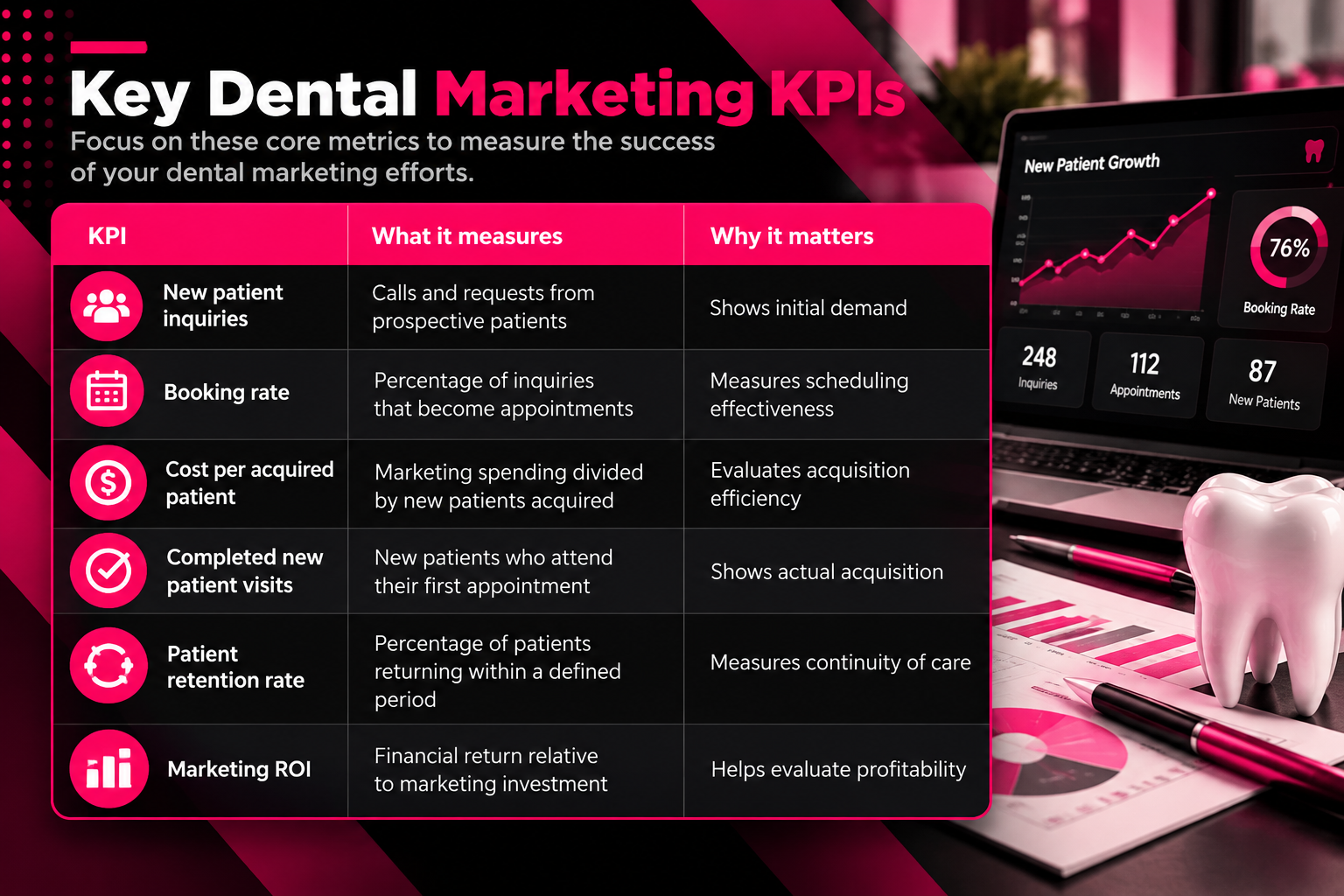
For example, a campaign generating 40 inquiries and 16 completed appointments has a 40% inquiry-to-completed-visit rate.
If another campaign produces only 25 inquiries but 18 completed appointments, the second campaign may be more valuable, depending on acquisition costs and patient value.
That's why looking at inquiry volume alone can lead to poor marketing decisions.
For a more detailed measurement framework, see our article on how to track which marketing channel brings new patients.
Review Performance Every Month
Create a simple monthly report showing spending, inquiries, appointments, and completed new patient visits for each marketing channel.
Compare results against previous months, but account for seasonality, changes in staffing, and appointment availability.
If your practice receives more inquiries but fewer completed appointments, investigate the scheduling process before increasing advertising.
Likewise, if organic traffic increases without producing relevant inquiries, review your keyword targeting and website content.
One of the most common dental marketing mistakes to avoid is continuing with campaigns because they appear active rather than because they're producing worthwhile results.
In practice, regular measurement is what turns separate marketing activities into a more reliable patient acquisition system.
Conclusion
Effective dental marketing isn't about using every available channel. It's about choosing the right strategies for your practice, understanding what your patients need, and measuring whether your efforts lead to real appointments.
Start with a strong local presence, helpful website content, and a good patient experience. Use advertising, referrals, social media, and targeted outreach to reach more potential patients. Then strengthen your front desk processes and patient retention efforts so those marketing investments translate into lasting growth.
Most importantly, give each strategy enough time to produce meaningful data before making major changes.
The goal is to build a consistent flow of new patients, not just generate more clicks, calls, or impressions.
At MVP Mailhouse, we help dental practices take a more targeted approach to patient acquisition through dental direct mail campaigns, geographic targeting, and performance tracking. Our focus is on helping practices reach the right households and understand which campaigns contribute to new patient growth.
If you're looking to reach more qualified patients in your area and build a more consistent acquisition strategy, visit MVP Mailhouse to learn how our dental marketing solutions can support your practice's growth.
Tags
Tips and Tutorials
Frequently Asked Questions
Related blog




Ready For Your Success Story?
Get 500 Free Handout cards shipped right to your doorstep!