Buffalo Creek Dental Case Study
Direct mail marketing helped Buffalo Creek Dental gain 1,140 new patients without guesswork. See the proven system and schedule a demo now.

Ashley Paige Lloyd
marketing consultant
·9 min read
·May 27, 2025



Buffalo Creek Dental Case Study: How Direct Mail Marketing Fueled Measurable, Scalable Growth
Direct mail marketing is often dismissed as “old school.” Yet here’s a stat that stops most dental owners mid-scroll: when direct mail is targeted and tracked properly, response rates can outperform many digital-only campaigns by 5–9x in local healthcare markets.
This Buffalo Creek Dental case study breaks down exactly how that happened without hype, without fluff, and without luck.
If you’re a dental practice owner or marketer wondering whether direct mail still works, this case study answers a more useful question: how direct mail works when it’s executed with discipline, data, and intent.
We’ve seen this pattern repeatedly with fast-growing practices. The ones that win aren’t chasing shiny channels. They’re doubling down on what they can measure, control, and scale. Buffalo Creek Dental is a textbook example.
The Growth Problem Most Dental Practices Don’t See Coming
Rapid growth creates its own bottlenecks. Buffalo Creek Dental wasn’t struggling to survive, they were struggling to grow without losing control.
Like most modern dental practices, they were facing three familiar challenges in 2022:
- Rising competition within tight geographic radiuses
- Digital channels becoming noisier and harder to attribute
- A need for predictable new patient acquisition, not random spikes
We’ve seen this happen time and time again. Practices rely heavily on SEO, paid search, or referrals until volume plateaus. When that happens, marketing decisions become reactive instead of strategic.
Buffalo Creek Dental made a different choice. Instead of chasing more channels, they chose one trackable channel and committed to learning it deeply.
That channel was direct mail marketing.
Why Buffalo Creek Dental Chose Direct Mail Marketing First

This wasn’t a nostalgic move. It was a practical one.
Direct mail gave Buffalo Creek Dental something most marketing channels struggle to provide: clear attribution. You can track when mail drops. You can track calls, scans, and appointments. You can match households to patients. There’s very little guesswork when the system is built correctly.
We’ve seen practices waste months debating creative tweaks while ignoring channel fit. Buffalo Creek Dental avoided that trap. They asked better questions early:
- Who exactly are we trying to reach?
- Where do our best patients actually live?
- What message would make this household act now?
With MVP Mailhouse, they launched their first campaign in 2022: not big, not flashy, just intentional.
Phase One (2022): Testing Before Scaling
Too many practices overspend before they understand what works. Buffalo Creek Dental didn’t.
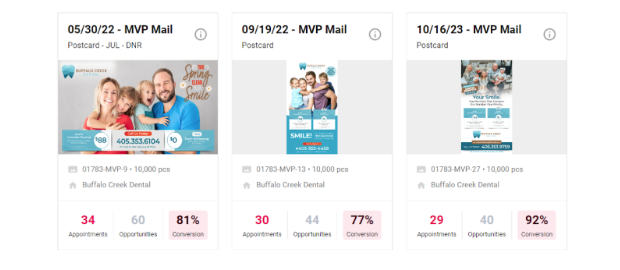
They started with our service with three direct mail campaigns, each sending 5,000 postcards. That’s it. No mass saturation. No blind expansion.
The goal wasn’t domination, it was validation.
Each campaign was designed to answer a simple KPI-driven question: Can direct mail reliably produce new patients in our market?
The answer came back quickly.
- 108 new patients acquired
- Clear call tracking and attribution
- Consistent inbound activity tied directly to mail drops
For a first-year test, that’s not just “good.” That’s signal.
We’ve seen many campaigns fail at this stage because practices expect perfection instead of insight. Buffalo Creek Dental understood that early campaigns are for learning, not bragging.
And the data told them something important: direct mail wasn’t just working, it was scalable.
What Actually Made the Early Campaigns Work
This wasn’t about “sending postcards.” That’s where most people oversimplify and then fail.
Three factors mattered early on:
Targeting over volume
Mail was sent only to households that matched real patient profiles. No random radius targeting. No wasted impressions.
Message clarity
The offers were straightforward. No clever distractions. Clear value, clear next step.
Tracking from day one
Calls, responses, and appointments were monitored in real time. This mattered later more than most people realize.
This exact setup separate practices that grow steadily from those that stall out. Once you can trust your data, scaling becomes a business decision, not a gamble.
By the end of 2022, Buffalo Creek Dental wasn’t asking if they should continue with direct mail marketing.
They were asking how fast they should grow it.
Scaling What Works: How Buffalo Creek Dental Turned Direct Mail Marketing Into a Growth Engine (2023)
By the start of 2023, Buffalo Creek Dental had something most practices never get: proof.
Not assumptions. Not “it feels busy.” Real attribution. Real patient counts. Real confidence that direct mail marketing wasn’t just viable, it was scalable.
This is the point where many practices make a costly mistake. They either scale too fast without sharpening the system, or they stay conservative and leave growth on the table. Buffalo Creek Dental did neither. They scaled but only after tightening every variable that mattered.
We’ve seen this exact inflection point before. The practices that win treat growth like an engineering problem, not a marketing gamble.
From Testing to Expansion: Doubling Volume With Purpose
In 2023, Buffalo Creek Dental doubled their mail volume from 5,000 to 10,000 postcards per campaign.
That decision wasn’t driven by optimism. It was driven by data.
They analyzed what the 2022 campaigns revealed:
- Which neighborhoods produced booked appointments, not just calls
- Which household profiles converted into long-term patients
- Which delivery timing correlated with higher response rates
Direct mail marketing only scales when targeting improves alongside volume. We’ve seen plenty of campaigns collapse when volume grows but precision doesn’t. This one did the opposite.
The result?
896 new patients acquired in 2023 alone.
That’s not incremental growth. That’s a step-change.
Why Targeting Became the Real Growth Lever
At this stage, sending more mail wasn’t the differentiator. Sending smarter mail was.
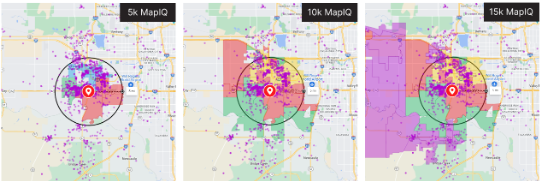
MVP Mailhouse introduced a deeper level of geographic and behavioral targeting using MapIQ, their proprietary mapping and data analysis tool. Instead of drawing arbitrary mailing radiuses, campaigns were built around:
- Proven patient density zones
- Competitive pressure from nearby practices
- Household behavior patterns tied to dental service usage
Once practices stop mailing “around the office” and start mailing where their best patients actually live, response rates stabilize and scaling becomes predictable.
This is where direct mail marketing starts behaving less like advertising and more like infrastructure.
Creative Consistency, Not Constant Reinvention
Another subtle but critical decision Buffalo Creek Dental made in 2023 was resisting the urge to constantly reinvent their messaging.
The branding stayed tight. The offer stayed clear. The call-to-action stayed simple.
Why does this matter?
Because consistency compounds. When households see similar messaging delivered reliably, trust builds faster. We’ve seen overly clever creative kill performance more often than boring clarity ever has.
Instead of chasing novelty, Buffalo Creek Dental focused on:
- Recognizable branding
- Clean, readable design
- A single, obvious next step for prospects
That discipline helped maintain conversion rates even as volume increased.
Tracking Became a Competitive Advantage
By mid-2023, tracking wasn’t just a reporting function, it was a decision-making tool.
Every campaign fed data back into the next one:
- Call tracking tied to specific mail drops
- Lead attribution matched to households
- New patient counts reconciled against campaign timing
This level of visibility changed internal confidence. We’ve seen practices hesitate to invest when marketing feels abstract. Buffalo Creek Dental didn’t hesitate because the numbers were obvious.
By the end of the year, the question wasn’t whether direct mail marketing worked.
It was how far they could responsibly push it.
What 2023 Proved for Buffalo Creek Dental
This phase answered three critical questions that most dental practices never resolve:
- Can direct mail marketing scale without losing efficiency? Yes when targeting leads the process.
- Can offline marketing be tracked as rigorously as digital? Yes when systems are built intentionally.
- Can predictable patient acquisition reduce marketing stress? Absolutely. We’ve seen it firsthand.
Buffalo Creek Dental finished 2023 with momentum, clarity, and a repeatable acquisition engine.
And then they made their boldest move yet.
From Campaigns to a System: How Buffalo Creek Dental Locked in Long-Term Growth
By late 2023, Buffalo Creek Dental wasn’t experimenting anymore. They were operating from confidence.
This is the stage most practices never reach. They’ve proven a channel works, but they hesitate to commit. Buffalo Creek Dental did the opposite. They leaned in with intention.
They launched their largest direct mail marketing initiative to date: 15,000 pieces per campaign, timed strategically to carry momentum into the new year. But volume alone wasn’t the story. What mattered was how refined the system had become.
The outcome speaks for itself:
- 1,140 new patients acquired
- 1,550 total leads generated
- Seamless syncing with MVP Mailhouse’s tracking and attribution systems
At this point, the results were so visible that formal match-back reports became unnecessary. As they put it: “No need, we already know it’s working.” Phones ringing consistently. Schedules filling weeks out. Lobbies full of new faces. When that happens, the data stops feeling theoretical.
Why This Final Push Worked When Others Stall
This wasn’t a bigger gamble, it was a more disciplined execution.
The campaigns combined everything Buffalo Creek Dental had learned:
- Precision targeting, refined over multiple years of data
- Sharp, familiar creative that built recognition instead of confusion
- Intentional timing, aligning mail delivery with patient decision windows
Many practices increase volume and watch performance drop. That didn’t happen here because every expansion was backed by proof. Direct mail marketing only becomes powerful when it’s treated as a system, not a one-off tactic.
At this stage, Buffalo Creek Dental wasn’t just acquiring patients. They were shaping predictable growth.
More Than New Patients: Building a Stronger Practice
What often gets overlooked in case studies is retention. Buffalo Creek Dental didn’t just bring in new patients, they kept them.
We’ve seen this pattern repeatedly: when acquisition is intentional, patient quality improves. The right households respond. The right expectations are set. Trust builds faster.
Their focus on excellent care, paired with consistent marketing, created a feedback loop:
- New patients felt confident choosing the practice
- Positive experiences drove repeat visits and referrals
- Growth reinforced brand presence in the community
This is what modern dental growth actually looks like, not chasing trends, but reinforcing fundamentals with smart execution.
Key Takeaways From the Buffalo Creek Dental Case Study
If there’s a playbook here, it’s this:
- Start small, test deliberately, and scale only when data proves it
- Treat direct mail marketing as a measurable system, not a guess
- Target smarter before you mail more
- Prioritize clarity and consistency over constant creative changes
This exact framework work across markets but Buffalo Creek Dental executed it exceptionally well. Their success wasn’t luck. It was built one campaign at a time.
Final Thoughts and Next Steps
Buffalo Creek Dental didn’t grow by hoping patients would find them. They built a predictable, scalable growth engine using direct mail marketing and they did it with discipline, data, and the right partner.
If you’re a dental practice looking to grow without guesswork, this case study shows what’s possible when strategy replaces assumptions.
Want to see how this could work for your practice?
Visit our website or schedule a demo with MVP Mailhouse to learn how targeted, trackable direct mail campaigns can turn your marketing into a system that actually performs.
Tags
Data and Analytics
Frequently Asked Questions
Related case study




Ready For Your Success Story?
Get 500 Free Handout cards shipped right to your doorstep!