What is the Most Effective Type of Marketing for Dentists?
What is the most effective form of marketing for dentists? Learn why direct mail, SEO, and reviews drive patient growth and long-term practice success.

James Joseph Simons
senior marketing-consultant
·13 min read
·Sep 11, 2025


The Short Answer
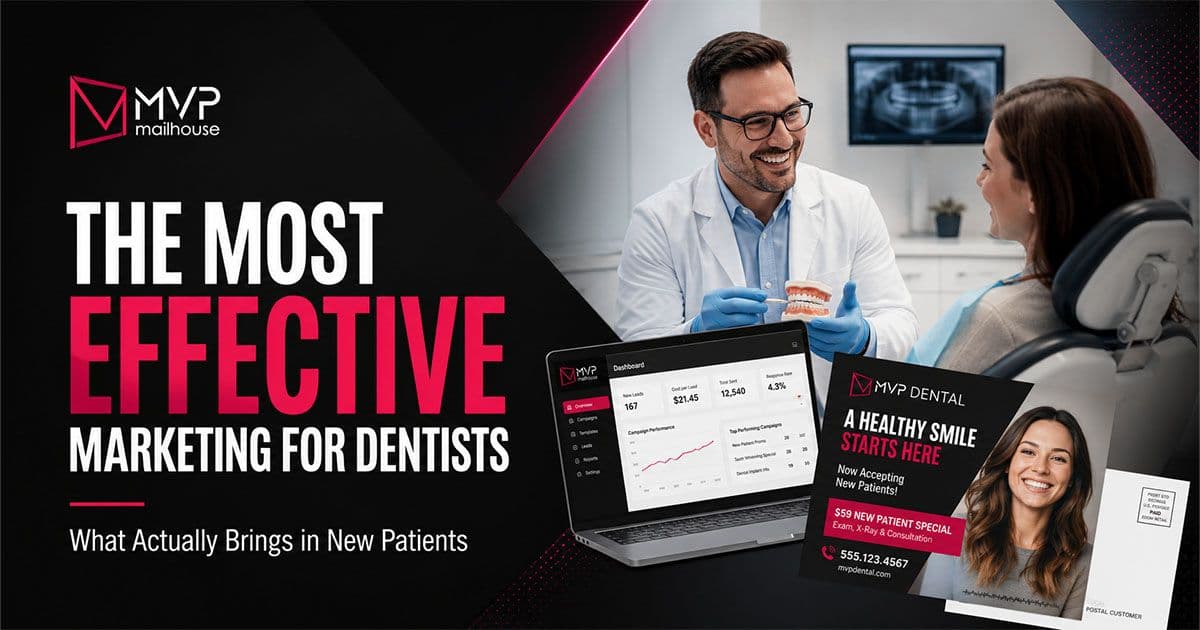
The most effective form of marketing for dentists is targeted direct mail combined with local digital visibility.
That answer surprises many practice owners because digital advertising receives most of the attention. Yet when the goal is attracting new dental patients in a specific geographic area, direct mail continues to produce some of the most measurable and predictable results.
A dental office only serves a limited radius around its location. Unlike ecommerce businesses, dentists do not need nationwide exposure. They need to consistently reach households that are likely to become patients.
This is where direct mail marketing for dentists stands out.
Across campaigns we've managed, practices often see stronger conversion rates from highly targeted postcard campaigns than from broad online advertising. The reason is simple. A postcard reaches a household whether they are actively searching for a dentist or not. Search ads only reach people already looking.
That distinction matters.
A family that recently moved into a neighborhood may not search for a dentist immediately. But a well-designed postcard offering a new patient special can put a practice on their radar before competitors have the opportunity.
For practices looking to understand the broader landscape of dental marketing, our guide on what is dental marketing explains how patient acquisition channels work together.
Why Direct Mail Remains One of the Best Marketing Channels for Dentists
Many marketing trends come and go. Direct mail has remained effective for decades because it aligns with how people choose local healthcare providers.
According to the United States Postal Service Household Diary Study, physical mail continues to receive high engagement, with consumers spending significantly more attention on mail pieces than many digital ads.
Dental practices benefit from several advantages.
Geographic Precision Creates Better Patient Quality
A dentist does not need exposure across an entire city.
Most patients choose practices within a short drive from their home or workplace. Direct mail allows clinics to target specific neighborhoods, ZIP codes, carrier routes, and demographic groups.
In practice, this often leads to higher-quality leads because every marketing dollar is focused on households that can realistically become long-term patients.
We've worked with practices that reduced wasted ad spend simply by concentrating outreach within a three-to-five-mile radius of their office.
New Movers Are More Likely to Switch Dentists
One of the strongest audiences in dental marketing is recent movers.
Research from the United States Census Bureau shows that millions of Americans relocate annually. Moving often triggers a search for new healthcare providers, including dentists.
That creates a narrow window where practices can introduce themselves before competitors establish relationships.
Targeted programs such as New Mover Mail focus specifically on these households, helping practices connect with residents during a period when they are actively building new local habits.
The data shows that new movers frequently represent some of the highest-converting prospects in dental direct mail campaigns.
Direct Mail Produces Tangible Brand Recall
Digital ads disappear quickly. A postcard often remains on a kitchen counter, refrigerator, or desk for days or weeks. That physical presence increases recall.
When a patient eventually needs a cleaning, whitening treatment, or emergency appointment, the practice that mailed them may already feel familiar.
Familiarity plays a major role in healthcare decisions. Patients tend to trust providers they recognize.
Why Digital Marketing Alone Often Falls Short
Digital marketing remains important. Every dental practice should maintain a strong online presence. But relying exclusively on digital channels creates limitations.
- Google Ads only reach people actively searching.
- Facebook ads compete with thousands of distractions.
- Organic SEO takes months or years to generate meaningful traffic.
The practices achieving the strongest growth rarely depend on a single source. Instead, they combine awareness marketing with demand-capture marketing.
Direct mail creates awareness. Search engines capture demand when prospects begin researching providers. This combination frequently generates better patient acquisition economics than either channel operating independently.
For a deeper comparison of these approaches, see our analysis of Direct Mail vs Google Ads for dental practices.
The Numbers Behind High-Performing Dental Marketing
Every marketing investment should be evaluated using measurable business outcomes.
The most successful dental practices typically track:
- Cost per new patient
- New patient volume
- Appointment conversion rate
- Production per patient
- Patient retention rate
- Return on marketing investment
Across dental campaigns, a realistic benchmark is that a new patient should generate enough lifetime value to justify acquisition costs multiple times over.
For example, if acquiring a patient costs $150 but the average patient generates $1,500 to $3,000 in lifetime revenue, the economics remain highly favorable.
This is one reason why direct mail marketing for dentists continues to perform well. Even moderate response rates can create strong returns because dental patient lifetime values are relatively high.
The most effective practices focus less on generating clicks and more on generating patients.
What Marketing Works Best for Dentists in 2026?
The best marketing for dentists is rarely one channel.
The strongest-performing practices build a system where each marketing activity supports the others. When we review campaigns that consistently produce new patients month after month, four channels typically drive the majority of results.
Direct Mail Generates Demand Before Patients Start Searching
Many dental marketing discussions focus heavily on search traffic.
But not every future patient is searching today. Someone may need a dentist in three months. A family that recently relocated may not begin researching providers until their next cleaning reminder arrives.
Direct mail reaches those households before competitors appear in search results.
According to the Data & Marketing Association's Response Rate Report, house-list direct mail campaigns can generate response rates exceeding 9%, significantly outperforming many digital advertising channels.
In practice, the most successful direct mail campaigns share several characteristics:
- Consistent monthly mailings
- Geographic targeting
- Clear offers
- Strong branding
- Easy response mechanisms
Practices that mail once often see limited results.
Practices that maintain visibility over six to twelve months frequently experience stronger patient growth because familiarity compounds over time.
For a detailed breakdown of why this channel remains effective, read our guide on why direct mail marketing still works in dentistry.
Local SEO Captures Existing Demand
While direct mail creates awareness, local SEO captures people actively searching.
Google reports that searches containing terms such as "dentist near me" and "emergency dentist" continue to show strong local intent. When someone experiences tooth pain or wants a new provider, search is often the first step.
That makes local SEO an essential component of dental marketing. Strong local SEO includes:
- Optimized Google Business Profile
- Consistent local citations
- Positive patient reviews
- Location-focused website pages
- Helpful educational content
The challenge is timing.
SEO often requires three to twelve months before substantial rankings emerge. New practices that depend entirely on organic search frequently struggle during those early growth stages.
This is one reason many clinics combine SEO with direct mail marketing. One generates immediate visibility. The other builds long-term authority.
Patient Reviews Influence More Decisions Than Most Dentists Realize
BrightLocal's Local Consumer Review Survey found that most consumers regularly read reviews before choosing local businesses, including healthcare providers.
For dentists, reviews function as social proof. Patients may never meet you before scheduling. Reviews help reduce uncertainty.
Across campaigns, practices with hundreds of positive reviews generally convert website visitors at higher rates than competitors with similar services but weaker reputations.
Review generation should not be treated as a separate marketing initiative.
It should be part of patient experience management. Simple systems such as post-appointment review requests often produce meaningful increases in review volume over time.
Referral Marketing Still Matters
Referral marketing remains one of the most cost-effective patient acquisition channels available. Satisfied patients naturally recommend providers they trust.
However, relying solely on referrals creates unpredictable growth. A practice may receive ten referrals one month and three the next. Marketing provides consistency.
Referrals work best when supported by broader outreach efforts that continuously introduce the practice to new households.
How Do Dentists Get More Patients Consistently?
The practices that grow predictably typically follow a simple framework.
First, they identify exactly who they want to attract.
Second, they focus marketing within their service area.
Third, they maintain consistent visibility instead of constantly switching tactics.
And fourth, they track performance relentlessly.
A common mistake is chasing trends.
One month it's Facebook ads.
The next month it's SEO.
Then video marketing.
Then community sponsorships.
The result is fragmented effort and inconsistent outcomes.
The data shows that consistency often beats complexity.
One dental practice we analyzed mailed targeted postcards monthly for twelve consecutive months. Response rates varied throughout the year, but overall patient acquisition increased more than 30% compared to the previous year because the campaign remained active long enough to build recognition.
Another practice generated over 100 new patients within six months by combining local SEO improvements with targeted neighborhood mail campaigns.
Neither result came from a secret tactic.
Both came from disciplined execution.
For additional patient acquisition strategies, see our guide on how to get new dental patients.
What Results Should Dentists Expect From Marketing?
One of the biggest frustrations in dental marketing is unrealistic expectations.
Some agencies promise immediate growth. That rarely reflects reality. Different channels operate on different timelines. Direct mail campaigns often begin generating leads within weeks of delivery. Google Ads can produce inquiries almost immediately if campaigns are structured correctly.
SEO usually requires several months before rankings improve significantly. Review generation programs often show meaningful impact within three to six months.
For most practices, realistic benchmarks look something like this:
- First leads from direct mail within 2 to 6 weeks
- Measurable patient growth within 3 to 6 months
- Strong campaign optimization within 6 to 12 months
- Significant brand recognition after 12 months of consistent exposure
The most successful practices evaluate marketing based on patient acquisition trends rather than short-term fluctuations.
A single month rarely tells the whole story. A full year often does.
Why Consistency Beats Marketing Tactics
Dentists often ask which postcard design works best Or which Google ad headline performs best.
Those details matter. But consistency matters more.
Patients rarely make decisions after one marketing impression. Research from marketing analytics firms consistently shows that multiple brand interactions are typically required before conversion occurs.
This principle is especially true in healthcare. Patients want familiarity and trust.
Repeated exposure through direct mail, search visibility, online reviews, and community presence creates that trust over time. The practices achieving the strongest growth are not necessarily the ones with the largest budgets.
They are usually the ones that stay visible month after month while competitors constantly restart their marketing efforts.
For practices evaluating comprehensive outreach strategies, our guide covering top dental marketing strategies that actually work explains how successful campaigns combine multiple channels into a unified growth system.
The Most Effective Dental Marketing Strategy Is a System, Not a Single Channel
Many dentists search for one perfect solution.
- One ad.
- One campaign.
- One marketing channel that will consistently bring in patients.
The reality is more practical.
The most effective form of marketing for dentists is not a single tactic. It is a coordinated system that combines proactive outreach, local visibility, reputation management, and patient retention.
Direct mail remains one of the strongest tools in that system because it allows practices to control who sees their message, where they see it, and how often they see it. Unlike many digital channels that depend on changing algorithms or increasing advertising costs, direct mail provides predictable geographic reach.
When paired with local SEO, online reviews, and a strong patient experience, it creates multiple touchpoints that increase trust and improve conversion rates.
Practices that want sustainable growth should focus less on finding shortcuts and more on building repeatable patient acquisition processes.
For a broader look at building a complete patient acquisition strategy, our guide on how to market a dental practice in 2026 outlines the key components of a modern dental marketing plan.
Why Direct Mail Continues to Deliver Strong Results for Dental Practices
Direct mail succeeds because it aligns with how local healthcare decisions are made.
Most patients are not evaluating dozens of dental providers. They are looking for a trusted option close to home.
A well-designed postcard delivered to the right household can accomplish several goals at once:
- Build awareness
- Create familiarity
- Communicate an offer
- Drive appointment inquiries
- Reinforce brand recognition
Across dental campaigns, practices often discover that direct mail generates patients who remain with the practice for years rather than months.
Patient lifetime value changes the economics significantly.
A campaign does not need massive response rates to be profitable. It only needs enough qualified patients whose long-term value exceeds acquisition costs.
That is why many growing practices continue investing in direct mail even while expanding their digital marketing efforts.
For practices exploring campaign ideas, our resource on the best dental marketing ideas for your practice highlights proven approaches used by successful dental offices.
Choosing the Right Marketing Partner Matters
Execution often determines whether marketing succeeds or fails.
The same strategy can produce dramatically different results depending on targeting, design, messaging, tracking, and consistency.
One common issue we encounter is that many practices stop marketing before campaigns have enough time to work.
The first mailing generates awareness.
The second builds recognition.
The third and fourth often begin producing stronger response rates because households have seen the practice multiple times.
This pattern appears repeatedly across successful campaigns.
Practices that commit to a long-term strategy generally outperform those that constantly switch tactics every few months.
For clinics looking for a turnkey approach, MVP Direct Mail helps dental practices manage everything from targeting and design to mailing execution and call tracking, allowing teams to focus on patient care rather than campaign logistics.
Conclusion
So, what is the most effective form of marketing for dentists?
The evidence points to targeted direct mail as one of the strongest patient acquisition channels available, especially when combined with local SEO, review generation, and a strong online presence.
Direct mail excels because it reaches potential patients before they begin searching, targets specific neighborhoods with precision, and creates lasting brand recall. Digital marketing remains important, but the highest-performing dental practices rarely rely on a single channel.
Instead, they build a marketing system that creates awareness, captures demand, and converts prospects into long-term patients.
The practices that consistently grow are not necessarily spending the most money. They are usually the ones that stay visible, track results carefully, and maintain a steady presence in their local market.
If your goal is attracting new dental patients predictably rather than hoping referrals arrive, focus on building a repeatable acquisition strategy. Start with the channels that consistently reach the right households, measure performance, and commit to the process long enough for momentum to build.
For additional guidance, explore our resources on attracting high-quality dental patients, dental ads that actually bring in new patients, and how smart marketing helps dentists get more patients.
Predictable patient growth rarely comes from a single campaign. It comes from consistently reaching the right people with the right message at the right time.
Tags
Industry Insights
Frequently Asked Questions
Related blog




Ready For Your Success Story?
Get 500 Free Handout cards shipped right to your doorstep!