Direct Mail Marketing Tips: Strategies to Boost Conversion
Learn practical direct mail marketing tips to improve response rates, boost conversions, avoid common mistakes, and build campaigns that deliver better ROI.

Aaron Boone
ceo
·15 min read
·Jul 24, 2025


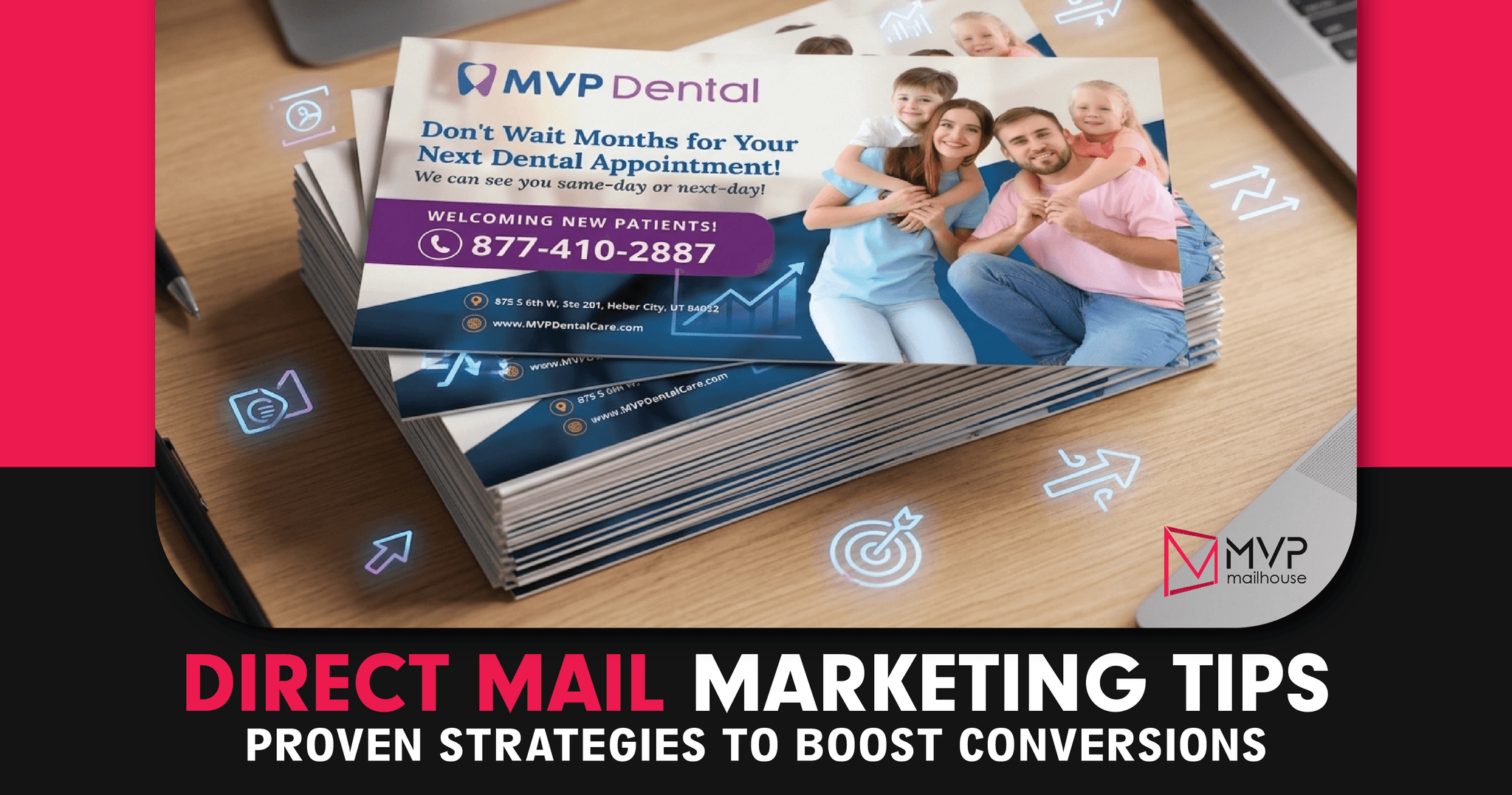
Direct mail marketing tips still matter because physical mail continues to outperform many digital channels in one critical area, attention. According to the 2024 USPS Household Diary Study, American households still interact with marketing mail for an average of 2.8 minutes, giving businesses a longer opportunity to communicate their message than most online ads receive. If your goal is to increase inquiries, appointments, or sales, the right direct mail strategy can make a measurable difference.
This guide explains practical, proven ways to improve campaign performance, increase response rates, and convert more prospects into customers. You'll learn what separates average campaigns from consistently profitable ones, why each tactic matters, and how to apply these ideas using real-world examples from dental marketing and other service-based industries.
Why Conversion Matters More Than Response Rate
Many marketers judge success by response rate alone. That only tells part of the story.
A campaign that generates a 6% response rate but converts only 10% of respondents may produce fewer customers than a campaign with a 3% response rate and a 60% appointment conversion rate.
For dental practices, this difference becomes even more important. Every new patient often represents years of recurring hygiene visits, restorative work, and referrals. Improving conversion by just a few percentage points can substantially increase long-term revenue without increasing mailing costs.
The Data & Marketing Association (DMA) has consistently reported that direct mail remains one of the highest-performing offline marketing channels because of its ability to reach targeted audiences with personalized messaging.
Across campaigns we've managed, the strongest-performing mailers rarely succeed because of a single design choice. They perform well because every stage of the customer journey works together. The audience is well targeted, the offer is relevant, the call to action is clear, and the business follows up quickly.
That is why the most valuable direct mail marketing tips focus on improving the entire conversion process instead of simply increasing responses.
1. Target the Right Audience Before Designing Anything
No design can overcome poor targeting.
In fact, mailing to the wrong households is one of the fastest ways to waste marketing budget. The Data & Marketing Association has repeatedly found that better audience targeting significantly improves campaign profitability because fewer pieces are wasted on people unlikely to convert.
For a dental practice, every neighborhood is different. One area may contain mostly young families looking for pediatric dentistry, while another may consist primarily of retirees interested in implants or dentures.
Sending identical postcards to both audiences often reduces performance.
Instead, segment recipients based on factors such as:
- Geographic location
- Household income
- Homeownership
- Age demographics
- Length of residence
- Family composition
- Previous customer activity
For example, a dental office opening a second location might prioritize homeowners who recently moved within five miles of the practice. New movers frequently search for healthcare providers within their first several months after relocating.
In practice, we've seen campaigns improve response rates simply by refining mailing lists rather than redesigning the postcard itself. Better targeting means fewer wasted impressions and higher-quality leads.
If you're building your audience, our guide on direct mail targeting explains how smarter segmentation improves campaign performance.
2. Lead With One Clear Offer Instead of Several
One of the most overlooked tips for direct mail marketing is keeping the offer simple.
Businesses often try to promote every service they offer in one mailer. A dental postcard might advertise:
- Teeth whitening
- Invisalign
- Implants
- Emergency care
- Cosmetic dentistry
- Pediatric dentistry
While that sounds comprehensive, it usually creates decision fatigue.
Research from Columbia University on consumer choice demonstrated that offering too many options can reduce purchasing decisions because people become overwhelmed.
https://academiccommons.columbia.edu/doi/10.7916/D8XS5TDB
A single, focused offer is easier to understand and remember.
Instead of listing six services, consider highlighting one compelling reason to respond.
Examples include:
- New patient comprehensive exam and cleaning
- Complimentary implant consultation
- Free Invisalign assessment
- Emergency appointment availability
- Family dental welcome package
The goal is not to explain everything your practice does.
The goal is to generate the first appointment.
Once someone visits the practice, your team has additional opportunities to educate them about other services.
Across successful dental campaigns, focused messaging consistently produces stronger conversion rates because recipients immediately understand what action they should take.
3. Personalization Goes Beyond Using Someone's Name
Variable data printing allows marketers to personalize far more than a recipient's first name.
According to McKinsey, companies that excel at personalization generate faster revenue growth than competitors because relevant communication creates stronger customer engagement.
For direct mail, personalization can include:
- Neighborhood-specific messaging
- Local office information
- Nearby landmarks
- Relevant family offers
- Age-based promotions
- Seasonal recommendations
- Personalized URLs
- Custom QR codes
For example, a family with young children may receive messaging focused on preventive care and pediatric dentistry, while older homeowners receive educational content about implants or restorative treatments.
This level of relevance helps recipients feel that the mail piece was created specifically for them rather than for thousands of households.
We've found that personalization works best when it improves usefulness instead of simply inserting a name into the headline.
People respond when the message matches their situation.
4. Make Your Headline Solve a Problem Immediately
Most recipients decide within seconds whether to continue reading.
That makes the headline one of the most valuable parts of your mail piece.
Rather than describing your business, address a problem your audience already wants to solve.
Compare these examples.
Weak
- "Trusted Family Dental Practice Since 1998"
Stronger
- "Need a New Family Dentist Close to Home?"
Or instead of:
- "Complete Cosmetic Dentistry Services"
Try:
- "Thinking About Straightening Your Smile?"
The second version focuses on the reader instead of the business.
Nielsen Norman Group research consistently shows that users pay the greatest attention to clear, benefit-focused headlines because they quickly communicate relevance.
The same principle applies to direct mail.
Recipients scan before they read.
If your headline immediately answers a need, they are far more likely to continue reading.
If you want additional guidance, our article on how to create a successful direct mail campaign covers how strong messaging supports every stage of campaign planning.
5. Use a Strong Call to Action That Removes Uncertainty
Many direct mail pieces fail because they tell people about a business but never clearly explain what to do next.
Your call to action (CTA) should be specific, easy to follow, and focused on one action. According to the Nielsen Norman Group, users are far more likely to act when interfaces and messaging reduce cognitive effort through clear instructions rather than forcing them to decide the next step themselves.
Compare these examples.
Weak
- Contact us today.
- Learn more.
- Visit our website.
Stronger
- Schedule your new patient exam before August 31.
- Call today to reserve one of this month's complimentary implant consultations.
- Scan the QR code to book online in less than two minutes.
The difference is clarity. The reader immediately understands what to do and why they should do it now.
Across dental campaigns, we've found that mailers with a single CTA consistently outperform those asking recipients to call, visit a website, follow social media, and email all at once. Multiple options often reduce action because recipients hesitate between choices.
Your CTA should also match the campaign objective. If appointment bookings are your goal, every element of the mailer should support scheduling that appointment.
For additional guidance, read our article on how to write a call to action in direct mail marketing.
6. Design for Readability Before Creativity
Creative design gets attention.
Readable design gets conversions.
Businesses sometimes prioritize elaborate graphics over communication. While an attractive mailer helps, recipients must understand the message within seconds.
Eye-tracking studies by the Nielsen Norman Group show that users naturally scan content instead of reading every word. Visual hierarchy, readable typography, and organized layouts significantly improve comprehension.
Although the research focuses on digital interfaces, the same reading behavior applies to printed marketing materials.
An effective direct mail piece usually includes:
- One dominant headline
- A clear supporting image
- Short paragraphs
- Easy-to-read fonts
- High color contrast
- Plenty of white space
- A visually prominent CTA
- Contact information that is easy to locate
For dental practices, this might mean showing a welcoming photo of the office or smiling patients instead of filling the postcard with stock graphics and lengthy descriptions.
In practice, simplifying layouts often improves performance more than redesigning them from scratch. When recipients immediately understand the message, they are more likely to respond.
7. Build Trust Before Asking for Commitment
People rarely book appointments with businesses they do not trust.
That is especially true for healthcare providers.
The 2025 Edelman Trust Barometer found that trust remains one of the strongest drivers of purchasing and decision-making behavior across industries.
Direct mail should establish credibility before asking someone to schedule an appointment.
Trust signals may include:
- Google review ratings
- Years serving the local community
- Professional certifications
- Memberships in recognized organizations
- Before-and-after treatment examples where appropriate
- Patient testimonials
- Awards or recognitions
- Satisfaction guarantees if applicable
For example, a dental postcard that mentions "Serving local families for over 20 years" alongside hundreds of five-star reviews provides reassurance before the reader considers making contact.
Across campaigns, we've observed that trust-building elements become even more important for higher-value services such as dental implants, cosmetic dentistry, or orthodontics, where patients often compare multiple providers before making a decision.
Trust does not replace a compelling offer. It reinforces it.
8. Create Urgency Without Creating Pressure
One of the most practical direct mail best practices is giving recipients a reason to act promptly.
Without urgency, many people intend to respond later but never do.
Behavioral economics research by Dr. Robert Cialdini has consistently shown that scarcity and limited availability influence decision-making when used honestly and transparently.
Examples include:
- Offer expires July 31.
- Limited number of complimentary consultations available.
- Valid for the first 100 appointments.
- Seasonal promotion ending this month.
Notice that each example explains why action should happen now.
Avoid artificial urgency that cannot be justified. Consumers recognize exaggerated claims such as "Last chance ever" or "Today only" when repeated every month. Those tactics reduce credibility over time.
We've seen stronger long-term performance from campaigns that use legitimate deadlines tied to scheduling capacity, seasonal promotions, or practice goals.
9. Make Responding as Easy as Possible
Every additional step reduces conversions.
Google's research on user experience has repeatedly shown that reducing friction improves completion rates across customer journeys.
Direct mail follows the same principle.
Your recipient should never wonder how to respond.
Include response methods that fit different preferences, such as:
- Phone number
- Online scheduling URL
- QR code
- Text messaging option
- Landing page designed specifically for the campaign
For dental practices, QR codes have become increasingly valuable because many patients immediately scan printed materials using their phones.
But convenience goes beyond technology.
When someone calls your office, the front desk experience becomes part of the campaign. If calls go unanswered or appointment scheduling is difficult, marketing performance suffers regardless of how effective the postcard was.
In practice, practices with well-trained front desk teams often convert significantly more inquiries into appointments using the same mail piece.
Improving campaign conversion rates requires both strong marketing and efficient operational follow-through.
10. Follow Up Because Most Prospects Need More Than One Touchpoint
One direct mail piece can produce results.
A well-planned series usually performs better.
According to the USPS, repeated exposure helps improve brand recall and increases the likelihood that consumers respond when they are ready to make a purchase.
For example, a dental practice might use this sequence:
- Month 1. Introduction postcard
- Month 2. Educational mailer highlighting preventive care
- Month 3. Limited-time new patient offer
Each piece builds familiarity while reinforcing the same message.
Across campaigns, businesses that maintain consistent mailing schedules generally achieve stronger long-term acquisition than those sending one isolated campaign each year.
That does not mean mailing more frequently without purpose.
Each mail piece should provide new value while maintaining consistent branding, messaging, and audience targeting.
If you're planning future campaigns, our guide on how often to send direct mail explains how mailing frequency influences campaign performance over time.
11. Measure Conversion Metrics Instead of Guessing
Many businesses know how many postcards they mailed.
Far fewer know which campaigns actually generated profitable customers.
Measurement transforms direct mail from an expense into a predictable marketing channel.
Track metrics such as:
- Response rate
- Appointment booking rate
- Conversion rate
- Cost per lead
- Cost per acquisition
- Revenue generated
- Return on investment
- Patient lifetime value
For example, imagine two dental campaigns.
Campaign A generates 120 inquiries but only 30 appointments.
Campaign B generates 80 inquiries but converts 60 appointments.
Campaign B delivers twice the conversion efficiency despite producing fewer initial responses.
The Data & Marketing Association continues to emphasize measurement because ongoing optimization consistently improves future campaign performance.
Instead of asking, "Did the campaign work?"
Ask:
- Which audience converted best?
- Which offer generated appointments?
- Which ZIP Codes produced the highest ROI?
- Which headline delivered the strongest response?
- Which response method was used most often?
Those answers shape every future campaign.
If you want to build a measurement framework, our guide on how to measure direct mail success explains the KPIs that matter most for long-term growth.
Common Direct Mail Mistakes That Reduce Conversion
Even well-designed campaigns can underperform if a few fundamental mistakes go unnoticed. The good news is that most conversion issues are preventable once you know what to look for.
Some of the most common problems include:
- Mailing to a broad, unqualified audience
- Promoting multiple offers in one mail piece
- Using a weak or generic call to action
- Failing to include a clear deadline
- Sending recipients to a generic homepage instead of a dedicated landing page
- Inconsistent branding between the mail piece and website
- Not tracking responses or appointments
- Sending a single campaign and expecting long-term results
We've audited campaigns where changing just one of these elements significantly improved performance. For example, replacing a homepage URL with a dedicated landing page that matched the postcard messaging increased appointment bookings within the first month because visitors encountered fewer distractions and a clearer path to conversion.
Mistakes often work together. A poorly targeted mailing list combined with an unclear offer and weak follow-up rarely produces strong results, even if the design looks professional.
If you want to avoid these costly errors, our guide on top direct mail marketing mistakes hurting your results explains what to watch for before launching your next campaign.
What Results Can You Realistically Expect?
One of the biggest misconceptions about direct mail is that success happens immediately after the mail arrives.
In reality, campaign performance usually follows a predictable timeline.
Week 1
- Recipients begin receiving mail. Calls, QR code scans, and website visits start to increase.
Weeks 2 to 4
- Most responses occur during this period. Businesses should closely monitor phone inquiries, appointment requests, and online bookings.
Months 2 to 3
- Follow-up campaigns reinforce awareness and generate additional responses from prospects who did not act immediately.
Months 6 to 12
- Businesses with consistent mailing schedules often begin seeing more stable lead volume and better conversion data. By this point, enough performance data has been collected to optimize audience targeting, offers, creative, and mailing frequency.
For dental practices, success should not be measured only by the number of new patients. Consider tracking metrics that reflect long-term value, including:
- Response rate
- Appointment conversion rate
- Cost per acquired patient
- Treatment acceptance rate
- Patient retention
- Average production per new patient
- Return on investment over one, three, and five years
According to the Data & Marketing Association Response Rate Report, direct mail continues to generate stronger response rates than many digital acquisition channels when campaigns are well targeted and measured consistently.
Across successful campaigns, businesses that review these KPIs after every mailing improve future performance more consistently than those relying on assumptions. Small improvements in audience selection, messaging, or follow-up often compound over multiple campaigns, leading to lower acquisition costs and more predictable growth.
Conclusion
Successful direct mail campaigns are built through a series of smart decisions rather than a single tactic. Choosing the right audience, presenting one compelling offer, personalizing the message, writing a clear call to action, designing for readability, building trust, creating genuine urgency, simplifying the response process, following up consistently, and measuring meaningful KPIs all contribute to stronger conversion rates.
The strongest direct mail marketing tips share one theme. They reduce friction for the customer while making every marketing dollar work harder. Businesses that treat direct mail as an ongoing, measurable strategy instead of a one-time promotion are better positioned to improve response quality, increase conversions, and generate a stronger return on investment over time.
If you're ready to improve your direct mail results, start by reviewing your current campaign against the strategies outlined in this guide. Even modest improvements to targeting, messaging, or follow-up can produce measurable gains over the next few mailings. And if you're looking for a more predictable way to acquire new patients or customers, a well-planned, data-driven direct mail strategy provides a practical foundation for sustainable growth.
For additional reading, explore our guides on how to improve direct mail response rates, how to improve your direct mail ROI, and how effective direct mail marketing is to continue optimizing every stage of your campaigns.
Tags
Tips and Tutorials
Frequently Asked Questions
Related blog



Ready For Your Success Story?
Get 500 Free Handout cards shipped right to your doorstep!