New Movers Direct Mail Best Practices
New Movers Direct Mail Best Practices help dentists target recent movers, time postcards, improve response rates, and track patient acquisition ROI.

Emily Duke
marketing manager
·27 min read
·Aug 20, 2025


Moving to a new neighborhood often means finding a new dentist, especially for families who have relocated too far from their previous provider. That makes recent movers a valuable audience for dental practices looking to attract patients who may not have established local healthcare relationships.
The New Movers Direct Mail Best Practices covered in this guide focus on reaching the right households, sending mail at the right time, creating offers that encourage appointments, and measuring whether campaigns produce profitable patient growth.
According to the U.S. Census Bureau, millions of Americans change residences each year. However, reaching those households does not automatically turn them into patients. A postcard delivered three months after a move may face more competition than one received while a family is still choosing local providers.
For dental practices, the difference often comes down to timing, targeting, and relevance. A well-planned new mover direct mail campaign should introduce the practice when residents are most likely to consider a new dentist, then make scheduling their first appointment simple.
This guide explains how to build that approach, avoid common mailing mistakes, and evaluate results using practical benchmarks rather than relying on postcard response rates alone.
1. Understand Why New Movers Are Valuable for Dental Marketing
New mover marketing targets households that have recently changed addresses. Unlike broad neighborhood advertising, it focuses on residents experiencing a specific life event that may create demand for new services.
For dentists, that distinction matters.
A household that has lived in the same neighborhood for ten years may already have a trusted dental provider. A family that moved into the area two weeks ago may still be comparing practices, checking insurance coverage, and deciding where to schedule routine care.
The U.S. Census Bureau's Geographical Mobility reports provide annual data on residential moves, showing the scale of this continuously changing audience.
But the real opportunity is not simply the number of people moving. It is the change in purchasing and healthcare decisions that often follows relocation.
Why Moving Creates an Opportunity to Attract New Patients
Relocation disrupts familiar routines. Residents may need to find new schools, grocery stores, pharmacies, and healthcare providers. Dental care is part of that adjustment, although it may not be their first priority.
This creates a useful window for practices that communicate early and provide a clear reason to consider an appointment.
For example, consider two dental offices targeting the same household.
One sends a generic postcard advertising teeth whitening. The other sends a welcome postcard introducing the dentist, explaining accepted insurance plans, and offering a convenient way to schedule a new-patient examination.
The second message addresses a more immediate concern. It helps the household solve the problem of finding a local dentist rather than simply promoting a treatment.
The practical lesson is that new mover campaigns should focus on establishing a patient relationship before promoting elective services.
This is particularly important for general and family dentistry, where one successful household acquisition may lead to appointments for multiple family members.
Practices unfamiliar with the process can review how to run a new mover marketing campaign for dentists before developing their mailing schedule.
2. Target Recent Movers Instead of Mailing Every Household
One of the most important direct mail best practices is selecting recipients based on their likelihood of needing the advertised service.
For new mover campaigns, mailing volume alone is a poor measure of targeting quality.
A list containing 5,000 households is not necessarily better than one containing 1,000 recently relocated households within a reasonable driving distance of the practice.
The smaller list may contain more relevant prospects, reduce wasted postage, and allow the practice to spend more on message quality or follow-up mailings.
Build a Targeted New Mover Mailing List
When determining how to target new movers with direct mail, begin with three factors.
Move recency. Prioritize households that have relocated recently, ideally using updated address data rather than older lists.
Distance from the practice. Focus on neighborhoods where visiting the dental office would be convenient.
Household suitability. Consider the practice's services, local demographics, and available patient capacity without making unsupported assumptions about individual residents.
A dental office offering pediatric care, for example, may choose neighborhoods with a strong concentration of families. A practice focused on general dentistry may prefer a broader audience of new residents.
The goal is not to exclude potential patients unnecessarily. It is to align the campaign with the services the practice can reliably deliver.
The quality of the mailing list also matters. Duplicate records, outdated addresses, and poorly matched service areas can increase costs without improving appointment volume.
For a more detailed targeting framework, see how to target new movers.
Set a Practical Geographic Targeting Radius
There is no universal distance that works for every dental practice.
A five-mile radius may cover a large population in a dense city but only a small number of households in a rural area. Traffic patterns, parking availability, competing offices, and local travel habits influence how convenient a location feels.
A useful starting point is to examine where existing patients live.
Identify the ZIP codes or neighborhoods that consistently produce patients who attend appointments and return for continuing care. Then compare those areas with neighborhoods experiencing residential turnover.
For example, a practice might test two mailing segments.
- Recent movers within 3 miles: 600 households. High mailing priority.
- Recent movers between 3 and 7 miles: 400 households. Test segment to evaluate campaign effectiveness.
- Established residents outside the service area: 1,000 households. Exclude from the new mover campaign.
Note: Illustrative segmentation example, not actual campaign data.
This approach creates a measurable comparison between nearby and more distant households.
Rather than assuming that a larger geographic area will generate more patients, the practice can evaluate which neighborhoods produce more appointments per 1,000 mailers.
A broader explanation of geographic segmentation and audience selection is available in this guide to smarter direct mail targeting.
Verify Mailing List Accuracy Before Launching
Even a carefully selected audience can underperform when its address data is outdated.
The USPS NCOALink program uses approximately 160 million permanent change-of-address records to help mailers update addresses before sending campaigns. This makes address verification an important part of reducing undeliverable mail.
However, address verification and new mover identification serve different purposes. NCOALink helps maintain accurate mailing records, while a new mover data provider identifies households that meet the campaign's targeting criteria.
Before launching, confirm when the mover records were updated, whether duplicate addresses were removed, and how recently each household relocated.
For dental practices, a verified list of 800 recent movers can be more useful than an unverified list of 2,000 addresses. The difference is not guaranteed response volume. It is having greater confidence that the marketing budget is reaching the intended audience.
3. Send New Mover Direct Mail at the Right Time
Timing is one of the most important factors in new movers direct mail strategies.
A household may need a dentist immediately after relocating, particularly when someone is due for a cleaning or has an ongoing treatment plan. Others may wait several weeks before making healthcare appointments.
That means the best mailing schedule should balance early visibility with enough time for residents to settle into their new homes.
When to Send Direct Mail to New Movers
A practical starting point is to deliver the first postcard within 2 to 4 weeks after the household's recorded move date, where reliable data and mailing schedules permit.
This is a recommended testing window, not an industry-proven optimum. The ideal timing will depend on how quickly mover data becomes available and how soon households begin seeking dental care.
A simple three-touch campaign might follow this schedule.
- First Postcard (Weeks 2–4): Introduce the dental practice and welcome the household to the neighborhood.
- Second Postcard (Weeks 6–8): Reinforce convenience, build trust, and highlight new-patient services.
- Third Postcard (Weeks 10–12): Provide a final reminder with a clear and convenient appointment option.
The follow-up mailings should not repeat the same message word for word.
The first postcard can introduce the dentist and office location. The second might explain insurance acceptance, available appointment times, or family dental services. The third can focus on making it easy to schedule a first visit.
This creates a natural progression from awareness to consideration without overwhelming residents with identical advertisements.
Why Consistent Monthly Mailing Matters
A single mailing only reaches households at one point in their decision-making process.
Some residents may already be looking for a dentist. Others may keep the postcard for later, overlook it while unpacking, or wait until their next routine examination is due.
For practices using new mover direct mail, monthly list updates help maintain a steady flow of newly relocated households entering the campaign.
This is different from sending the same postcard to every address each month. A well-managed campaign should track which households have already received mail, which are eligible for follow-up, and which have booked appointments.
In practice, the goal is to build a repeatable patient acquisition process rather than depend on one successful mailing.
For example, a practice mailing 500 newly identified households each month would reach up to 1,500 household records over three months before accounting for duplicates or repeat contacts. That creates a larger pool of potential patients while keeping monthly spending more predictable.
The most useful performance measure at this stage is not simply how many postcards were delivered. It is how many qualified appointments each monthly group generates.
The key takeaway from these first three practices is simple. Identify households that have genuinely relocated, concentrate on neighborhoods the practice can serve conveniently, and establish a consistent mailing schedule while residents are forming new healthcare relationships.
These decisions create the foundation for the next stage, where postcard design, offers, response tracking, and campaign profitability determine whether new mover marketing becomes a reliable source of new patients.
4. Design New Mover Mailers That Encourage Appointments
A postcard can reach the right household at the right time and still fail to generate a response. Often, the problem is the message.
New residents are busy adjusting to their surroundings. They may be comparing healthcare providers, managing moving expenses, or arranging school schedules. A dental postcard needs to communicate its value quickly without requiring the recipient to read several paragraphs.
The most effective new mover mailers make three things clear. Who the practice is, why it is relevant to the household, and how to schedule an appointment.
Use a Welcome Message Instead of Generic Advertising
New mover direct mail should feel different from a standard promotional postcard.
A message such as "Welcome to the Neighborhood! Looking for a Family Dentist?" immediately connects the advertisement to the recipient's recent move.
Compare that with "We Offer Professional Dental Services." The second statement describes the business but gives residents little reason to pay attention.
A strong welcome postcard can include a brief introduction to the dentist, a photograph of the practice, nearby landmarks, and information about services commonly needed by new patients.
For example, a family dental practice might use this message.
"Welcome to your new neighborhood! Finding a dentist shouldn't be another stressful part of moving. Our team provides preventive and family dental care just minutes from your new home."
This approach addresses a practical concern rather than relying on promotional claims.
The USPS 2024 Household Diary Study provides research on household mail use and how Americans interact with mail. It offers useful context for understanding physical mail as a communication channel, although it does not establish a specific response rate for dental welcome postcards.
For dentists, the practical lesson is to make the message recognizable and relevant from the first glance.
Keep the Postcard Design Simple and Easy to Read
A new mover postcard should not attempt to explain every treatment the dental practice offers.
Too many service descriptions, competing offers, or calls to action can make the message difficult to understand.
Instead, prioritize a clear visual hierarchy.
Headline. Welcome the household and identify the practice as a local dental provider.
Main benefit. Explain why the office is a convenient choice for new residents.
Trust signals. Include genuine patient reviews, dentist credentials, or relevant practice information.
Offer. Present one clear incentive when appropriate.
Call to action. Make the phone number, booking link, and office location easy to find.
For example, a 6 × 11-inch postcard provides more room for a photograph, welcome message, and appointment information than a smaller format. However, larger dimensions do not automatically improve results. They can increase printing or postage costs, depending on the mailpiece specifications.
A practice should compare the additional cost against the number of appointments generated.
The design should also work for someone who spends only a few seconds reviewing the postcard. If the recipient cannot identify the business and next step immediately, the layout needs improvement.
For additional examples, see new mover mailers designed to attract patients who recently relocated.
5. Create a New Patient Offer That Protects Profitability
An offer can encourage new residents to schedule their first appointment, but aggressive discounts are not always the best approach.
For dental practices, acquiring a patient at any cost is not the goal. The campaign should attract people who are likely to receive appropriate care, have a positive experience, and return for future appointments.
A heavily discounted promotion may generate inquiries without producing enough revenue to justify the marketing expense.
Choose Offers That Reduce the Barrier to Booking
The strongest new mover offers address common reasons people delay their first dental visit.
These may include uncertainty about treatment costs, insurance acceptance, appointment availability, or what happens during an initial examination.
Depending on the practice's services and applicable regulations, possible approaches include a clearly priced new-patient examination, a transparent self-pay package, or assistance verifying insurance benefits before an appointment.
A welcome offer should be specific. Residents need to understand what is included, who qualifies, and whether additional charges may apply.
For example, advertising a $99 new-patient examination without explaining whether X-rays or cleaning are included can create confusion.
A more transparent message identifies the included services and explains any important restrictions.
For dental marketing, clarity often matters more than the size of the discount. A resident who understands the offer is better prepared to book and less likely to feel misled when contacting the office.
Practices should also review state dental board rules, payer contracts, and applicable laws before advertising discounted or complimentary services.
Calculate Whether the Offer Makes Financial Sense
Consider a hypothetical campaign sent to 2,000 recent mover households.
- Postcards Delivered: 2,000
- Total Campaign Cost: $1,600
- Inquiries Generated: 30
- Appointments Booked: 18
- New Patients Who Attended: 15
- Cost per Acquired Patient: $106.67
Note: These figures are hypothetical examples for planning purposes, not actual MVP Mailhouse campaign results or industry benchmarks.
In this scenario, the campaign produces a 1.5% inquiry rate and a 0.75% attended-patient acquisition rate.
The cost per acquired patient is calculated by dividing the $1,600 campaign expense by the 15 patients who attended.
That cost must then be compared with the contribution margin from the patients' actual treatment and any subsequent visits.
If the average initial appointment generates $180 in collected revenue, the 15 visits produce $2,700 in gross collections. But that does not mean the campaign generated $1,100 in profit. Clinical costs, promotional discounts, staffing, and other expenses still need to be considered.
The distinction matters because response rates for new mover direct mail do not tell the full financial story.
A campaign with fewer responses may be more profitable if it attracts patients who complete appointments and continue receiving care.
6. Personalize New Mover Direct Mail Without Making It Intrusive
Personalization can make a postcard feel more relevant, but it should not rely on assumptions about the recipient's health, family situation, or financial circumstances.
For new mover campaigns, useful personalization usually comes from location and the moving event itself.
A postcard that welcomes someone to a specific neighborhood can feel more relevant than a generic advertisement mailed across an entire city.
However, personalization should remain accurate and respectful.
Use Location-Based Messaging
Targeting new homeowners with direct mail marketing can involve mentioning the neighborhood, nearby landmarks, or the convenience of reaching the practice.
For example, a dental office located near a residential development might use a headline such as "New to Oakwood? Your Neighborhood Dental Office Is Just Around the Corner."
This message is useful because it connects the practice to the resident's surroundings.
A postcard could also include a simple map showing the office's location, particularly when the practice is not immediately visible from major roads.
Travel convenience can influence provider selection, especially for families managing school, work, and multiple appointments.
A location-based message should be based on the practice's actual service area rather than making unsupported claims about being the closest or most convenient dentist.
For more detail on selecting and reaching this audience, see how dentists can target new movers with direct mail.
Segment Messages Based on the Practice's Services
Not every dental office should use the same postcard.
A pediatric practice may emphasize children's preventive care and a welcoming environment. A general dentist may focus on routine examinations, family appointments, and insurance acceptance.
A practice providing emergency dental services could mention availability for urgent dental concerns, provided it can reliably deliver those services.
The goal is to match the message to the services the office actually provides.
For example, a practice could test two postcard versions across comparable groups of 500 recent mover households.
One version highlights family dentistry. The other emphasizes convenient scheduling and insurance acceptance.
After the campaign, compare attended appointments per 1,000 delivered postcards rather than selecting a winner based only on inquiries.
With small samples, apparent differences may be random. Treat the first mailing as directional evidence and repeat the test before making major budget decisions.
7. Make It Easy for New Movers to Schedule an Appointment
A postcard can generate interest without generating a patient.
This often happens when the next step is inconvenient. The recipient may want to schedule an appointment but cannot find the phone number, reaches voicemail, or encounters a complicated online booking process.
Improving the response process is one of the most practical ways to increase response rates for new mover mailers.
Give Recipients More Than One Way to Respond
A new mover postcard should provide at least two convenient contact options, such as a prominent phone number and an online appointment page.
A QR code can provide a shortcut to the booking page, but it should not be the only digital option. Some recipients prefer typing a short URL, while others want to speak directly with the office.
The destination page should match the postcard's promise.
If the mailer advertises a new-patient examination, the linked page should explain that service and provide a clear booking option. Sending residents to a general homepage can create unnecessary steps.
The USPS Informed Delivery program also provides participating consumers with digital previews of incoming mail. Eligible business mailings may have opportunities for additional digital engagement through related USPS campaign features.
However, Informed Delivery should be treated as a supporting channel rather than a substitute for clear postcard messaging.
Prepare the Front Desk Before the Campaign Arrives
The office's scheduling process is part of the campaign.
Consider a hypothetical mailing that generates 25 inquiries. If the practice books 40% of those inquiries, it receives 10 appointments. Improving the booking rate to 60% would produce 15 appointments from the same number of inquiries.
That represents five additional bookings without increasing printing or postage expenses.
- 40% Inquiry-to-Booking Rate: 25 inquiries resulting in 10 booked appointments.
- 50% Inquiry-to-Booking Rate: 25 inquiries resulting in 12–13 booked appointments.
- 60% Inquiry-to-Booking Rate: 25 inquiries resulting in 15 booked appointments.
To support this process, reception staff should know which postcards were mailed, what the advertised offer includes, and how to identify inquiries generated by the campaign.
They should also have a clear process for handling missed calls and following up with prospective patients who request additional information.
In practice, this is where a campaign can lose potential patients despite successful targeting and postcard delivery. The marketing generates interest, but the office must convert that interest into an attended appointment.
The most useful lesson is that new mover direct mail performance depends on both the mailing and the patient experience that follows it.
Practices looking to improve their overall campaign structure can review these direct mail best practices for successful campaigns.
8. Track New Mover Direct Mail Campaign Performance
Sending postcards is only the beginning. Dental practices need to know whether those mailers generate inquiries, scheduled appointments, and patients who actually visit the office.
Without proper tracking, it is difficult to identify which neighborhoods, messages, or mailing schedules deserve more investment.
One of the most important new movers direct mail best practices is measuring performance beyond the initial response.
A campaign that generates 40 inquiries but only five attended appointments may be less valuable than one that produces 20 inquiries and 12 new patients.
The difference comes down to conversion quality.
Track the Right KPIs From the First Mailing
Direct mail campaigns should have clear performance indicators before postcards are delivered.
For dental practices, the most useful metrics include response rate, appointment booking rate, patient acquisition cost, and campaign return on investment.
- Response Rate: Calculated as (Inquiries ÷ Delivered Mailers) × 100. Measures initial interest in the campaign.
- Booking Rate: Calculated as (Appointments Booked ÷ Inquiries) × 100. Shows how effectively inquiries convert into scheduled appointments.
- Attendance Rate: Calculated as (Attended Appointments ÷ Booked Appointments) × 100. Identifies scheduling and attendance issues.
- Cost per Acquired Patient: Calculated as Campaign Cost ÷ New Patients Acquired. Measures patient acquisition efficiency.
- Campaign ROI: Calculated as [(Attributable Contribution Profit − Campaign Cost) ÷ Campaign Cost] × 100. Evaluates campaign profitability.
For example, consider a campaign that delivers 3,000 postcards and generates 45 inquiries.
The response rate is 1.5%. If 27 recipients book appointments and 21 attend, the campaign achieves a 60% booking rate and approximately 77.8% attendance rate.
These figures provide a clearer picture than response rate alone.
They also reveal where improvements are needed. A low inquiry rate may suggest problems with targeting, timing, or messaging. A strong response rate paired with weak appointment conversion may indicate scheduling friction.
For additional guidance, see how to measure direct mail success for dental practices.
Use Campaign-Specific Tracking Methods
Practices should establish a consistent way to identify patients acquired through new mover marketing.
A dedicated tracking phone number can help attribute incoming calls. A unique landing page or QR code can identify online visits and appointment requests.
The front desk should also ask new patients how they heard about the practice and record their answers in the practice management system.
No single attribution method is perfect.
A recipient might receive a postcard, search for the dental office on Google, and schedule through the website several days later. Without multiple tracking methods, that appointment could be attributed entirely to organic search.
For this reason, combining call tracking, website analytics, booking records, and patient-reported sources provides a more complete view of campaign performance.
The goal is not to claim that every new patient came from direct mail. It is to build enough reliable evidence to make better marketing decisions.
9. Calculate the ROI of New Mover Marketing Campaigns
The ROI of new mover marketing campaigns depends on more than the number of appointments generated.
Dental practices must consider campaign expenses, collected revenue, the cost of providing treatment, and whether acquired patients return for future care.
A campaign can produce positive initial revenue while still taking several months to recover its acquisition costs.
Calculate Patient Acquisition Costs and Profitability
Consider a hypothetical dental practice running a three-month campaign.
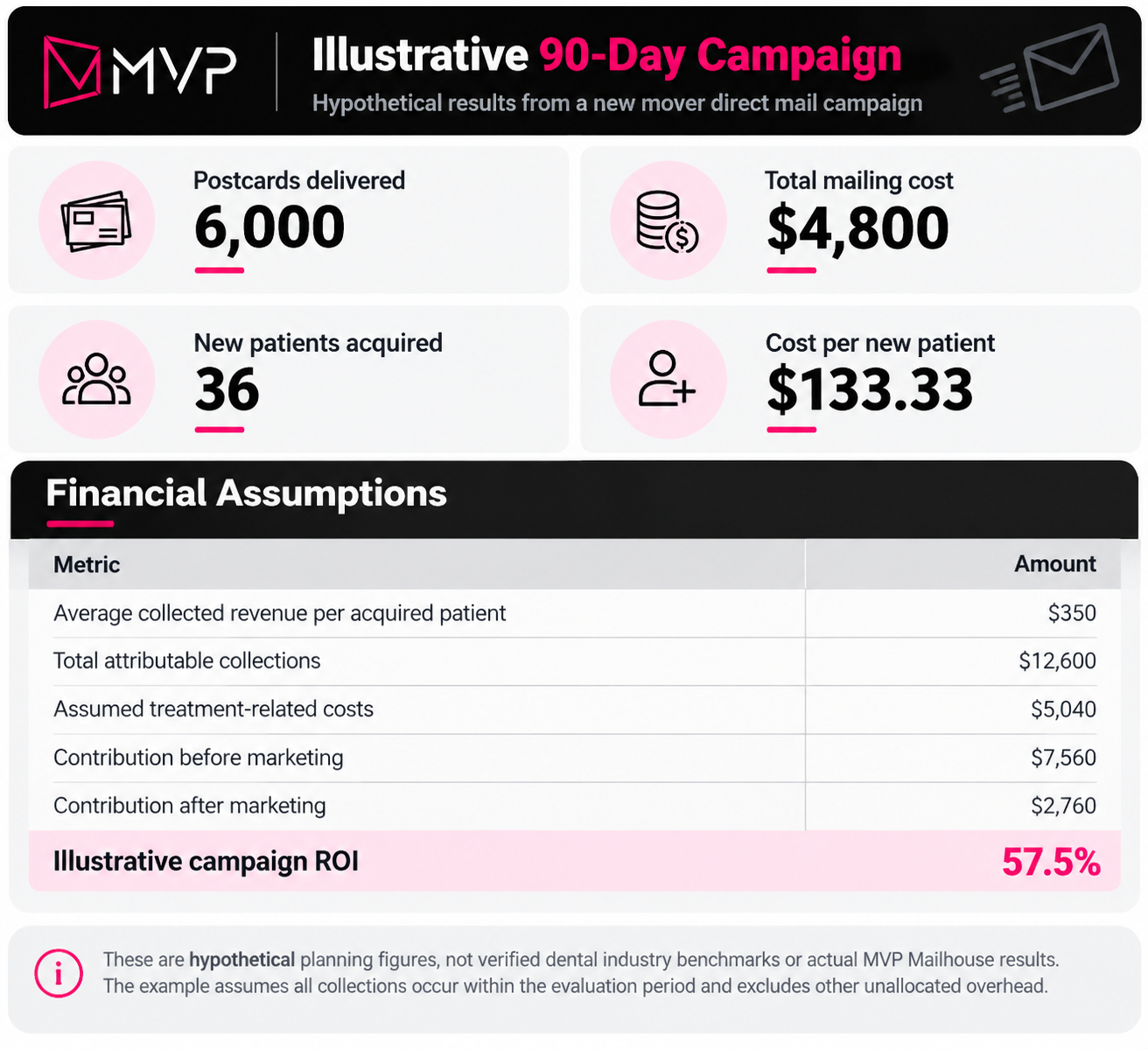
Under these assumptions, the practice earns $7,560 in contribution before marketing expenses. After subtracting the $4,800 campaign cost, the remaining contribution is $2,760.
The resulting ROI is 57.5%.
However, the result would change if fewer patients attended, treatment costs increased, or collections occurred later than expected.
This is why practices should calculate ROI using actual financial records rather than projected lifetime patient value alone.
Consider Long-Term Patient Value
Dental care often involves continuing relationships.
A patient who initially visits for an examination may return for preventive appointments, restorative procedures, or other clinically appropriate services.
But future revenue should never be treated as guaranteed.
A useful approach is to measure actual patient retention at six and twelve months. Practices can then compare the contribution generated by acquired patients against their original acquisition costs.
For example, if a patient costs $130 to acquire and generates $90 in contribution from the first appointment, the practice has not yet recovered the acquisition expense.
If that patient later returns and generates another $120 in contribution, the combined contribution becomes $210, exceeding the original marketing cost by $80.
This does not mean every new patient will follow the same pattern. It demonstrates why evaluating a dental marketing campaign only through first-visit revenue may understate or overstate its eventual value.
10. Improve New Mover Direct Mail Response Rates Through Testing
Successful new mover marketing requires ongoing adjustments.
Even when a campaign generates appointments, there may be opportunities to improve targeting, messaging, or scheduling.
The most reliable approach is to change one important variable at a time and compare results using consistent metrics.
Test Offers, Headlines, and Mailing Timing
A dental practice might begin by testing two postcard headlines.
Version A emphasizes convenience with "Your New Neighborhood Dentist."
Version B emphasizes family care with "A Dental Home for Your Whole Family."
Both postcards should use the same offer, format, mailing schedule, and comparable audience segments.
This makes it easier to determine whether the headline influenced response.
The same principle applies to offers and mailing frequency.
For example, a practice could compare an initial mailing sent during weeks 2–4 after a recorded move against one sent during weeks 5–7. The results may help determine when to send direct mail to new movers in that particular market.
However, small differences between test groups do not necessarily indicate a meaningful improvement.
A campaign with 500 recipients in each group may produce only a handful of responses. Results from such a small sample should be treated as preliminary rather than conclusive.
Focus on Appointments Instead of Response Rate Alone
Consider two hypothetical postcard designs sent to 2,000 households each.
Comparing postcard test outcomes
Hypothetical results from two equally sized mailing groups
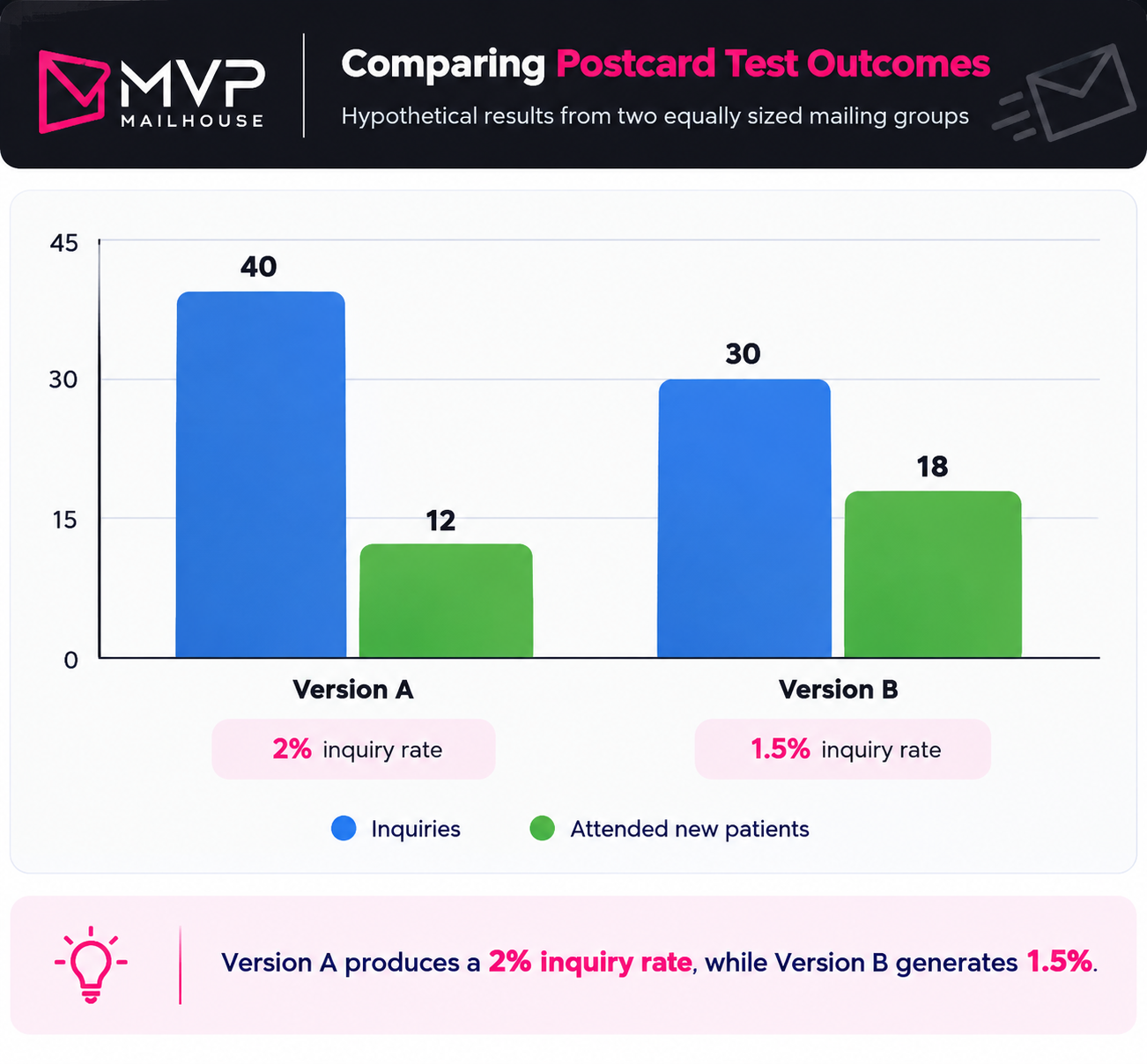
Version A produces a 2% inquiry rate, while Version B generates 1.5%.
If the practice evaluates only inquiries, Version A appears stronger.
But Version B produces 18 attended new patients compared with 12 from Version A. Assuming comparable acquisition costs and patient value, Version B delivers the more useful outcome.
This distinction should guide decisions about which postcard design to continue using.
For more practical optimization methods, review how to increase direct mail response rates.
11. Avoid Common New Mover Direct Mail Mistakes
Many underperforming campaigns share similar problems. They reach households too late, use broad mailing lists, or focus on promotional offers without considering the patient's actual needs.
Avoiding these mistakes can improve efficiency before additional marketing dollars are spent.
Sending Mail to Outdated Addresses
A household that moved several months ago may already have selected a dentist.
That does not make the household an unsuitable prospect, but it changes the opportunity. Use frequently updated mover records and track the time between the recorded move and postcard delivery.
For practices using monthly mailing programs, list freshness should be reviewed before every campaign.
Using Generic Messages for Every Household
A postcard that could be sent to any resident may fail to communicate why it matters to someone who recently relocated. Welcome messaging, neighborhood references, and relevant new-patient information can make the communication more useful.
Personalization should remain factual and respectful rather than relying on assumptions about the household.
Promoting Discounts Without Explaining the Offer
An unclear offer may generate inquiries that never become appointments. Patients should understand what services are included, what restrictions apply, and how to schedule.
Transparent pricing and accurate descriptions help prevent confusion during the first interaction.
Stopping After One Mailing
A single mailing provides limited information about campaign effectiveness. One group of residents may be ready to book immediately, while another may respond several weeks later.
A planned sequence can create additional opportunities for engagement, provided follow-up frequency remains reasonable and suppression lists are maintained.
Failing to Measure Actual Patient Acquisition
Postcards delivered, website visits, and phone calls are useful indicators, but they are not the final objective. For most dental practices, the meaningful outcome is an acquired patient who attends an appointment and receives appropriate care.
A campaign should therefore be evaluated using both marketing and practice management data.
12. Set Realistic Expectations for New Mover Marketing Results
New mover marketing is not an immediate guarantee of new patients.
Performance depends on the quality of the mailing list, local competition, service availability, the strength of the offer, and how effectively the practice handles inquiries.
Practices should establish a realistic evaluation period rather than judging a campaign solely by its first few days.
Use a 90-Day Evaluation Framework
A three-month test can provide an initial view of campaign performance.
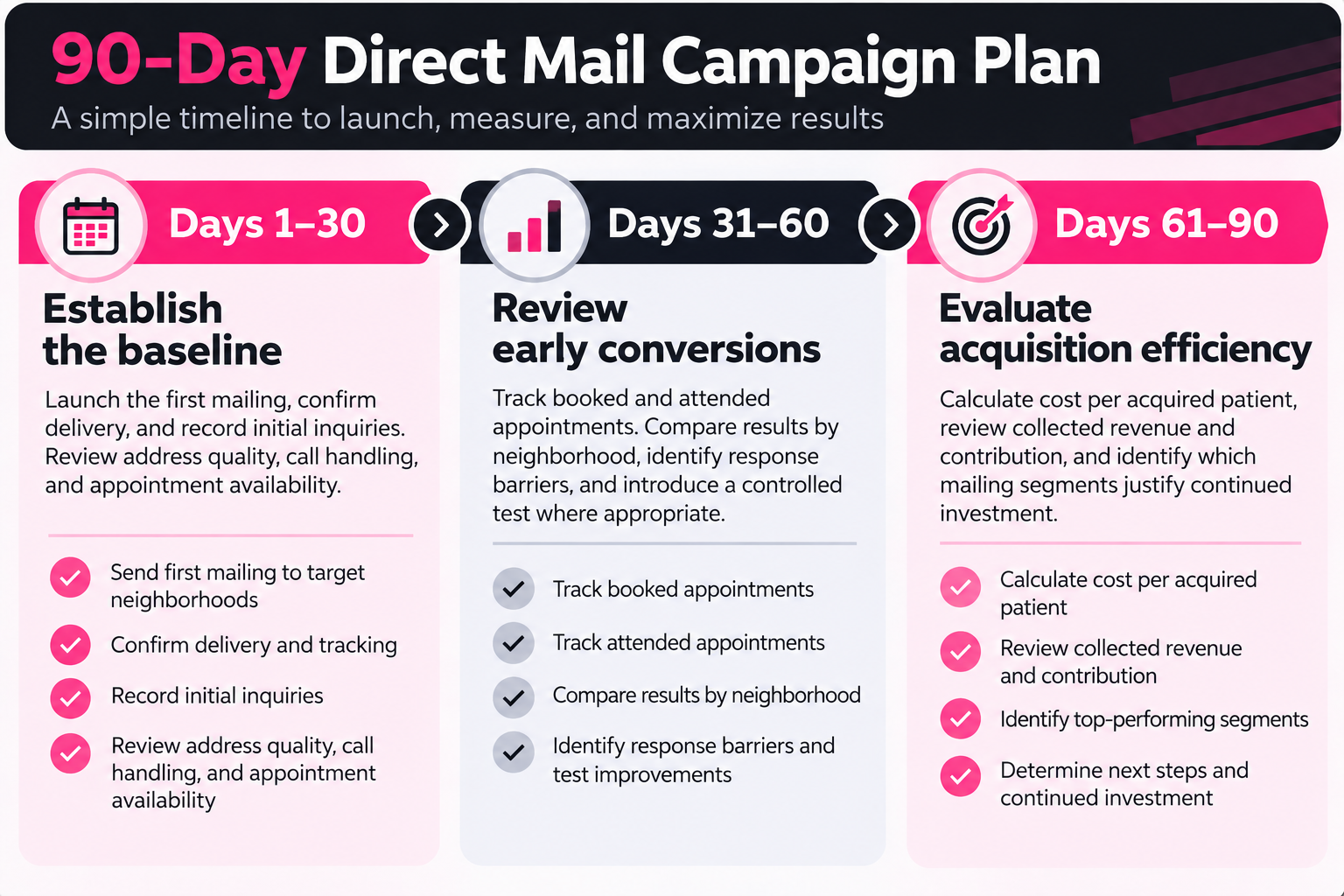
A 90-day review is a useful starting point, not a definitive measurement period. Practices with lower mailing volumes or longer booking delays may need more time to gather reliable data.
Establish Targets Based on Actual Practice Performance
Instead of assuming a universal response rate, practices should use their own historical results to establish benchmarks.
For a new campaign without previous data, a scenario model can help with budgeting.
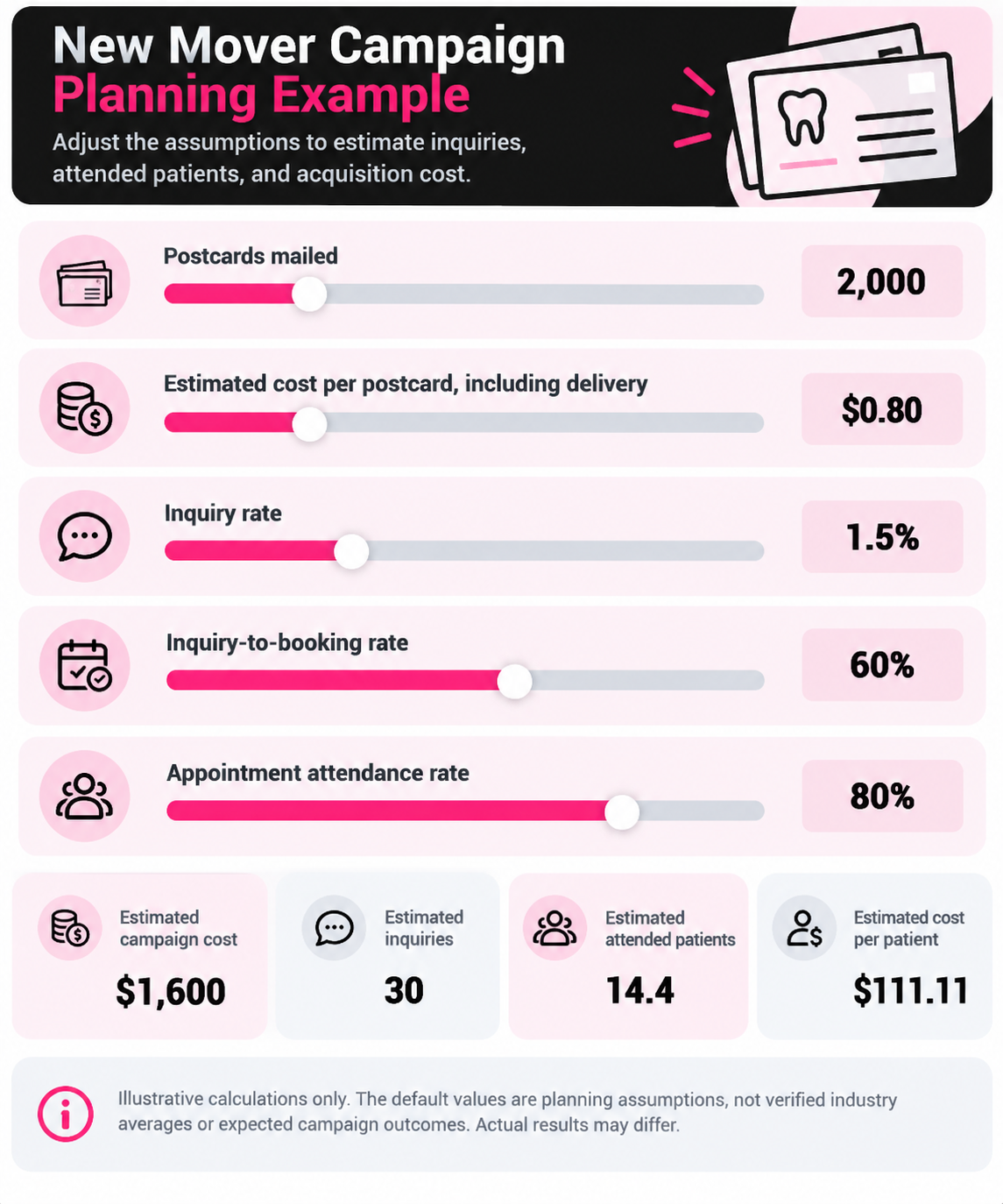
A model like this helps practices understand how response rates and appointment conversion influence acquisition costs.
It also highlights an important point. Increasing the number of postcards is not always the most cost-effective way to attract patients. Improving list accuracy, appointment booking, and attendance can sometimes produce better results without increasing mailing volume.
Conclusion
Successful new movers direct mail best practices begin with reaching the right households while they are establishing new routines.
For dental practices, that means using accurate mover lists, selecting convenient neighborhoods, sending timely welcome postcards, and communicating a clear reason to schedule an appointment.
But targeting and design are only part of the process.
A strong new mover marketing campaign also requires transparent offers, convenient booking options, reliable follow-up, and consistent performance tracking. Measuring attended appointments, patient acquisition costs, and actual financial returns helps practices identify which strategies deserve continued investment.
The goal is not simply to send more mail. It is to create a repeatable process that introduces the practice to new residents and turns qualified interest into lasting patient relationships.
Build a More Predictable Source of New Dental Patients With MVP Mailhouse
MVP Mailhouse helps dental practices reach recently relocated households through its New Mover Mail direct mail service. The program includes custom-designed postcards, targeted neighborhood mailing, monthly mover list updates, delivery management, and performance tracking.
Rather than managing every part of the mailing process separately, practices can focus on welcoming new patients while maintaining a consistent outreach schedule.
Visit the MVP Mailhouse website to learn how a targeted new mover campaign can support more consistent patient acquisition, improve marketing visibility, and help your dental practice grow.
Tags
Tips and Tutorials
Frequently Asked Questions
Related blog



Ready For Your Success Story?
Get 500 Free Handout cards shipped right to your doorstep!