How To Market A Small Business Using Direct Mail?
Learn how to market a small business using direct mail with practical tips on targeting, postcard design, budgeting, and tracking ROI to attract more customers.

Emily Duke
marketing manager
·31 min read
·Mar 18, 2025


Learning how to market a small business using direct mail starts with one simple principle. Send the right message to the right households at the right time. A well-planned postcard campaign can introduce your business to nearby customers, bring back past buyers, and generate inquiries without relying entirely on digital advertising.
According to the Data & Marketing Association's 2018 Response Rate Report, direct mail sent to house lists achieved a 9% response rate, compared with 4.9% for prospect lists. These historical benchmarks show the potential of targeted mailing, although actual results vary by industry, offer, audience, and campaign quality.
For a local dental practice, that might mean reaching families who recently moved into the neighborhood. A landscaping company could promote seasonal services to homeowners, while a restaurant could mail an introductory offer to nearby households.
The advantage is control. You choose where your marketing goes, who receives it, what you offer, and how you measure the response.
This guide explains how to build a direct mail marketing strategy for a small business, from selecting your audience and creating effective mailpieces to managing costs, tracking results, and improving future campaigns.
1. Is Direct Mail Good for Small Businesses?
Yes. Direct mail can be an effective marketing channel for small businesses, particularly those serving a defined geographic area or a specific type of customer.
Unlike online advertisements that compete for attention on crowded screens, physical mail reaches households through their mailboxes. It gives local businesses a tangible way to introduce their services and encourage customers to take action.
However, receiving a postcard does not guarantee someone will read it, remember the business, or make a purchase. The campaign must give recipients a relevant reason to respond.
Why Direct Mail Works for Local Businesses
Direct mail marketing is especially useful when a business knows where its ideal customers live.
A dental practice, for example, may serve patients within a 5-mile radius. Mailing to households outside that area could increase costs without improving patient acquisition.
The same principle applies to other industries. A neighborhood restaurant may benefit from targeting nearby residents, while a home improvement contractor could focus on homeowners in communities where its services are most relevant.
The USPS Household Diary Study provides useful context about how mail fits into household communication. Its research examines household mail volume, advertising mail, and consumer behavior, helping businesses understand the role of physical mail in reaching customers.
Source: USPS Household Diary Study
Three advantages make direct mail worth considering.
- Geographic precision: Businesses can concentrate spending on neighborhoods, postal routes, or selected household segments.
- Message control: Every recipient receives the intended offer, contact information, and next step.
- Measurable responses: Dedicated phone numbers, landing pages, promotional codes, and customer records can connect inquiries to specific campaigns.
The strongest advantage is not simply that direct mail is physical. It is the ability to concentrate a limited budget on households with a reasonable chance of becoming customers.
When Direct Mail Makes the Most Sense
Direct mail is particularly suitable for businesses that depend on local visibility, repeat purchases, appointments, or high-value services.
Consider a dental practice with an average contribution margin of $300 from a new patient's initial treatment. If a campaign costs $1,500, it needs five incremental patients to cover that marketing expense at that contribution level.
A coffee shop faces a different calculation. Its first-visit contribution may be relatively small, so repeat purchases and customer retention become more important.
This distinction matters because the same mailing strategy will not deliver equal financial results across different industries.
Our recommendation is to evaluate direct mail based on customer value, not response rate alone. A campaign that produces 10 profitable customers can outperform one that generates 50 low-value inquiries.
For a closer examination of cost concerns, read Is Direct Mail Too Expensive for Small Business?.
2. Define Your Direct Mail Marketing Goals Before Spending Money
A successful direct mail campaign begins with a measurable business objective.
Sending 2,000 postcards is an activity. Generating 20 qualified inquiries or acquiring 10 new customers is an outcome.
That difference determines how you design the campaign, select recipients, and evaluate performance.
Choose One Primary Campaign Goal
Small businesses often try to accomplish too much with a single postcard. They introduce the company, promote several services, announce discounts, and ask recipients to visit multiple online pages.
The result can be an unclear message.
Instead, select one primary objective and build the campaign around it.
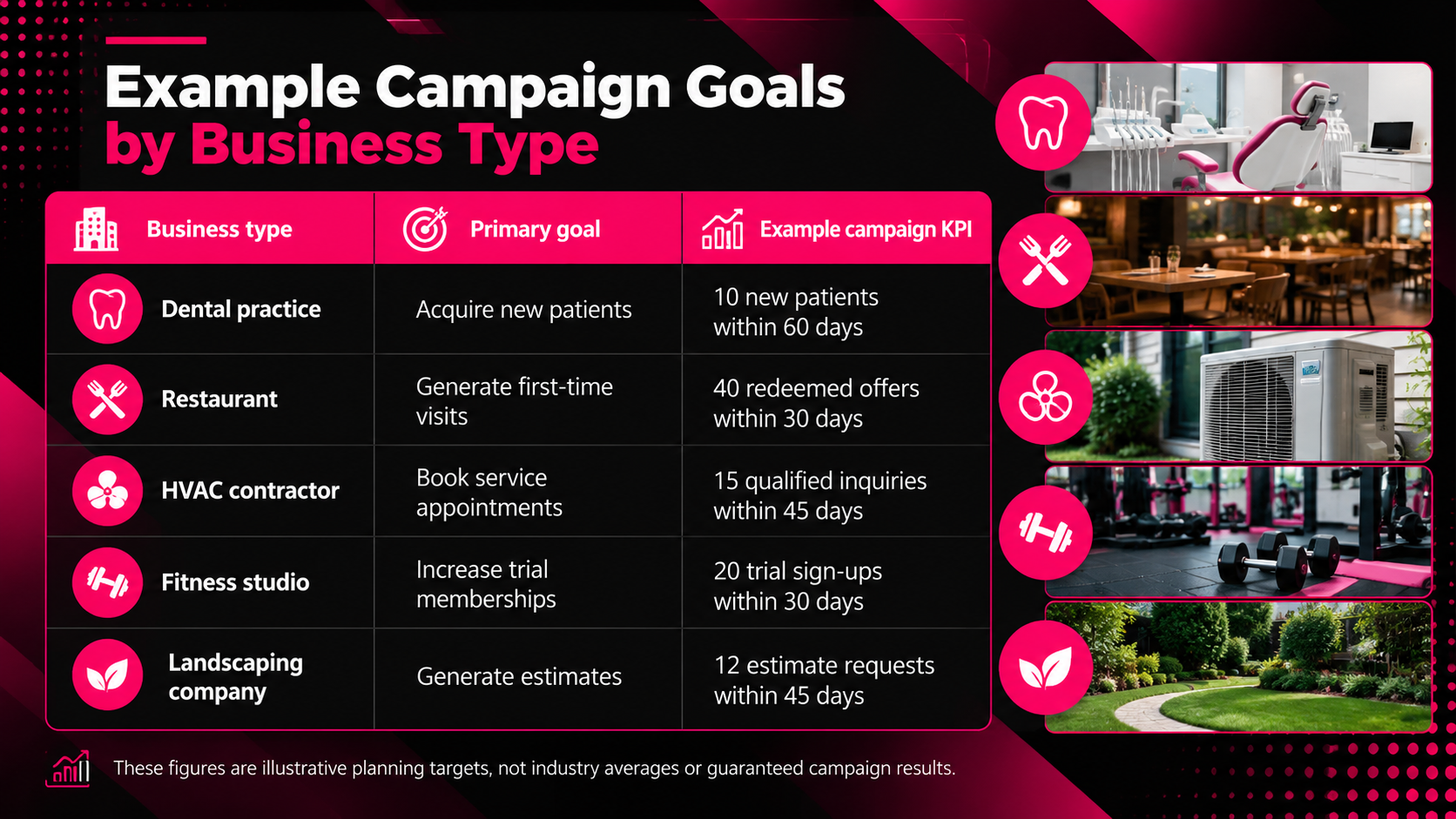
The right target depends on the mailing volume, market, available budget, and value of each customer.
Establish a Realistic Campaign Timeline
Direct mail takes planning. Lists need preparation, designs require approval, and printed materials must enter the postal system before customers can respond.
For a straightforward small-business campaign, a practical planning schedule might look like this.
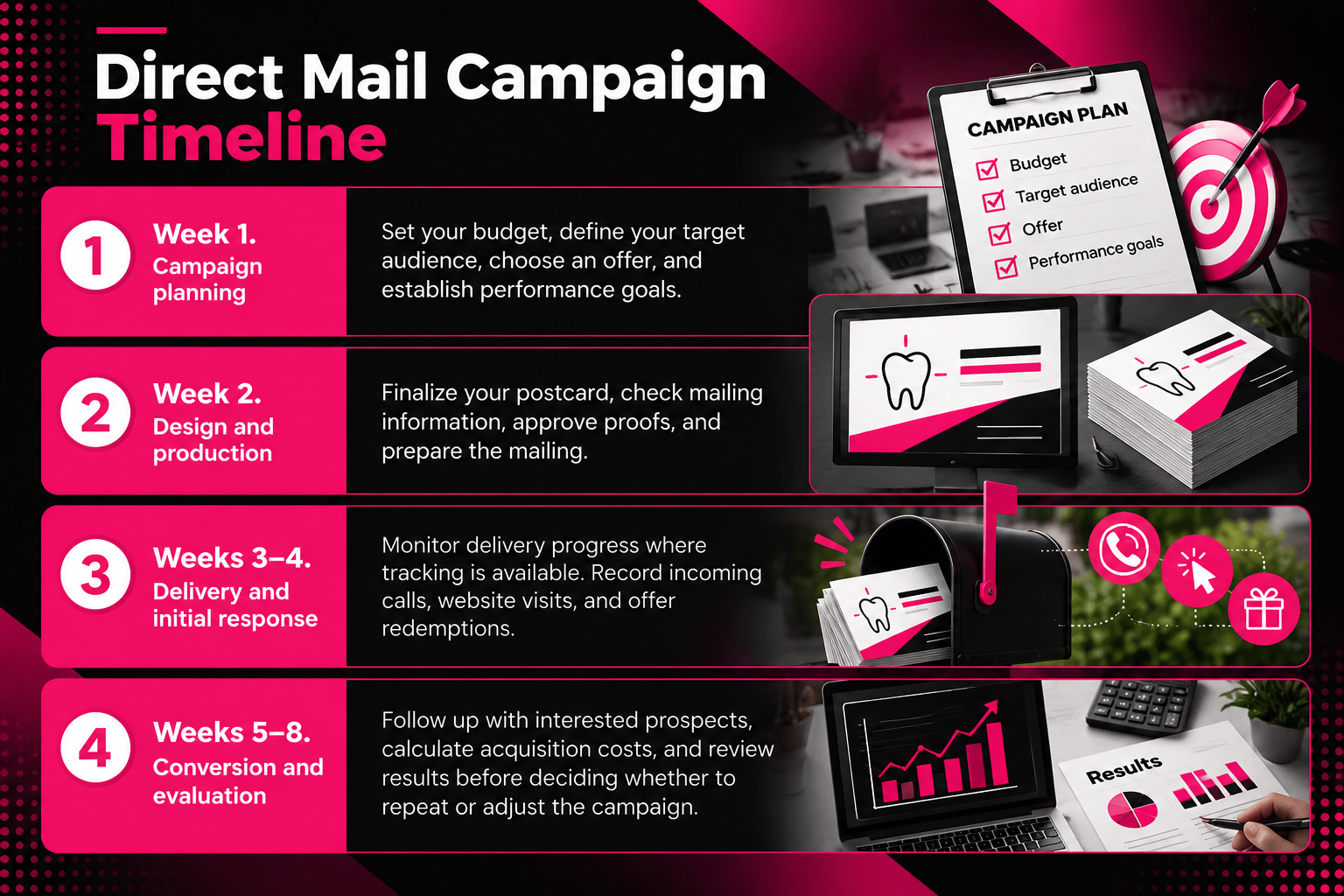
These periods are planning estimates. Actual delivery and response windows depend on mailing preparation, postal service, location, and customer decision cycles.
A restaurant coupon might generate visits shortly after delivery. A dental implant consultation or major home renovation may take several weeks to convert into a paying customer.
In practice, evaluating every business using the same 30-day window can produce misleading conclusions.
Calculate the Results Your Budget Needs to Generate
Consider a hypothetical dental postcard campaign with the following assumptions.
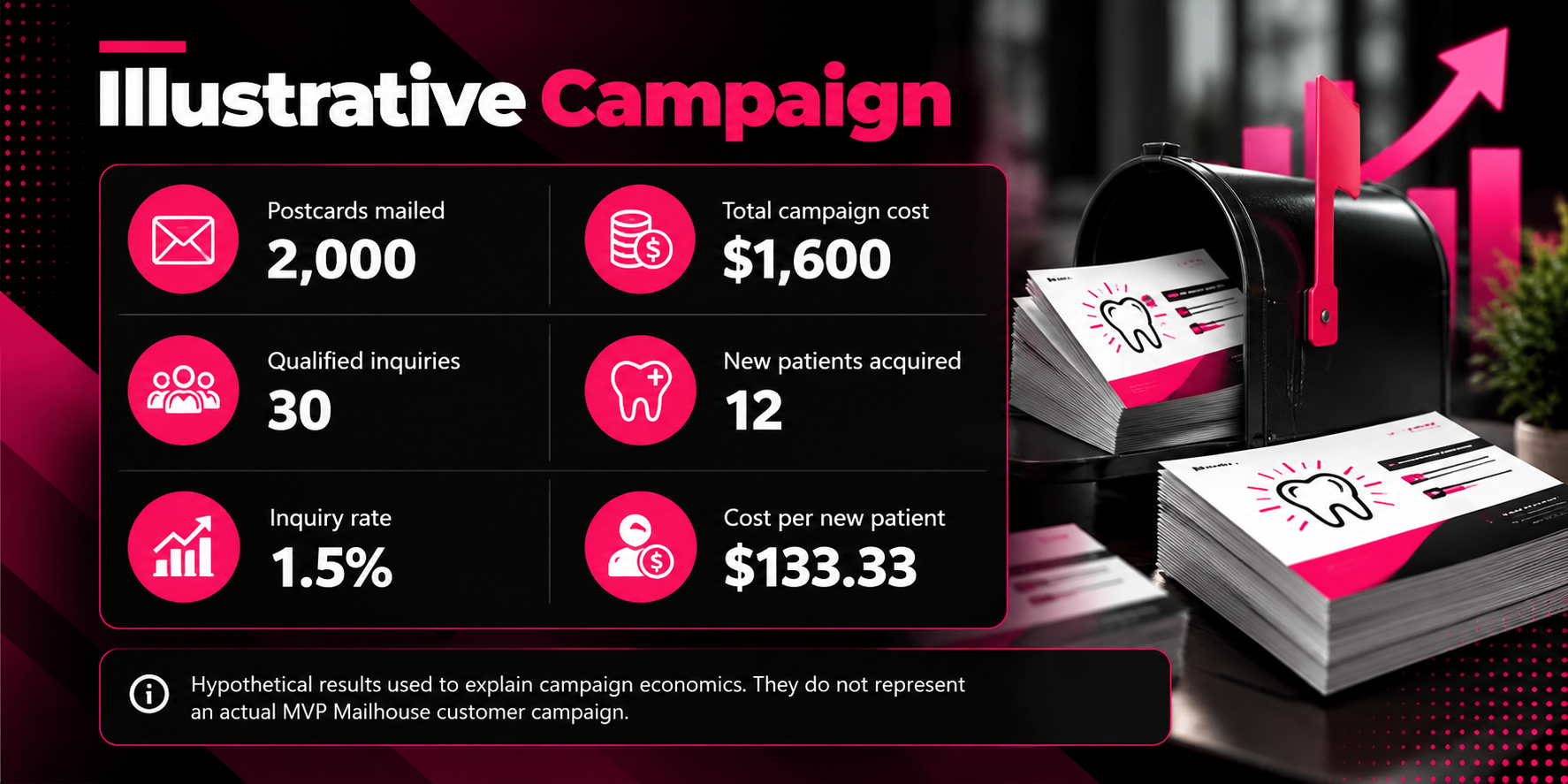
If each acquired patient produces $250 in contribution after service-related costs, the 12 patients generate $3,000 in contribution before marketing expenses. Subtracting the $1,600 mailing cost leaves $1,400.
This example shows why cost per acquired customer and contribution after marketing are more useful than counting responses alone.
Businesses planning their first mailing can use How Much Should You Budget for Direct Mail? to develop a realistic spending plan.
3. Identify the Right Customers for Your Direct Mail Campaign
The success of direct mail for small business depends heavily on audience selection.
A beautifully designed postcard sent to the wrong households is still wasted spending. A simpler message delivered to people who genuinely need the service can produce better results.
The ANA/DMA 2018 Response Rate Report reported response rates of 9% for existing customer lists and 4.9% for prospect lists. These are historical figures, not current performance guarantees, but they demonstrate why an existing customer relationship can influence campaign response.
More recent USPS research reinforces the importance of relevance. The FY 2023 Household Diary Study reported that recipients read 59% of advertising mail from businesses with which they had an existing relationship, compared with 23% from businesses without one. These are reading rates, not actual purchase or response rates.
The lesson for small businesses is straightforward. Targeting should come before design, printing, and mailing volume.
Start With Your Most Valuable Customer Segments
Rather than mailing every address within a ZIP code, identify groups most likely to need your products or services.
For example, a dental practice may prioritize families living near its office, households that recently relocated, or existing patients due for appointments.
A roofing contractor could concentrate on established residential neighborhoods. A fitness studio might target households within a short driving distance.
Three audience groups deserve consideration.
Existing customers. People who have previously purchased, booked, or interacted with your business. These contacts may be suitable for reminders, repeat purchases, and relevant service promotions.
New prospects. Households that match your ideal customer profile but have not purchased from you.
New movers. People who recently relocated and may need local services, including dentists, restaurants, home maintenance providers, and fitness facilities.
Each segment needs a different message. Existing customers may respond to a timely reminder, while unfamiliar households need a clear introduction and a compelling reason to choose your business.
Use Geographic Targeting to Reduce Wasted Spending
For many local businesses, proximity is one of the most useful targeting criteria.
Start by reviewing where your current customers live. Identify neighborhoods that produce repeat purchases, valuable appointments, or profitable projects.
Then evaluate surrounding areas using relevant criteria such as distance, household characteristics, service availability, and local competition.
Consider a dental practice with a $2,000 mailing budget.
Illustrative targeting comparison
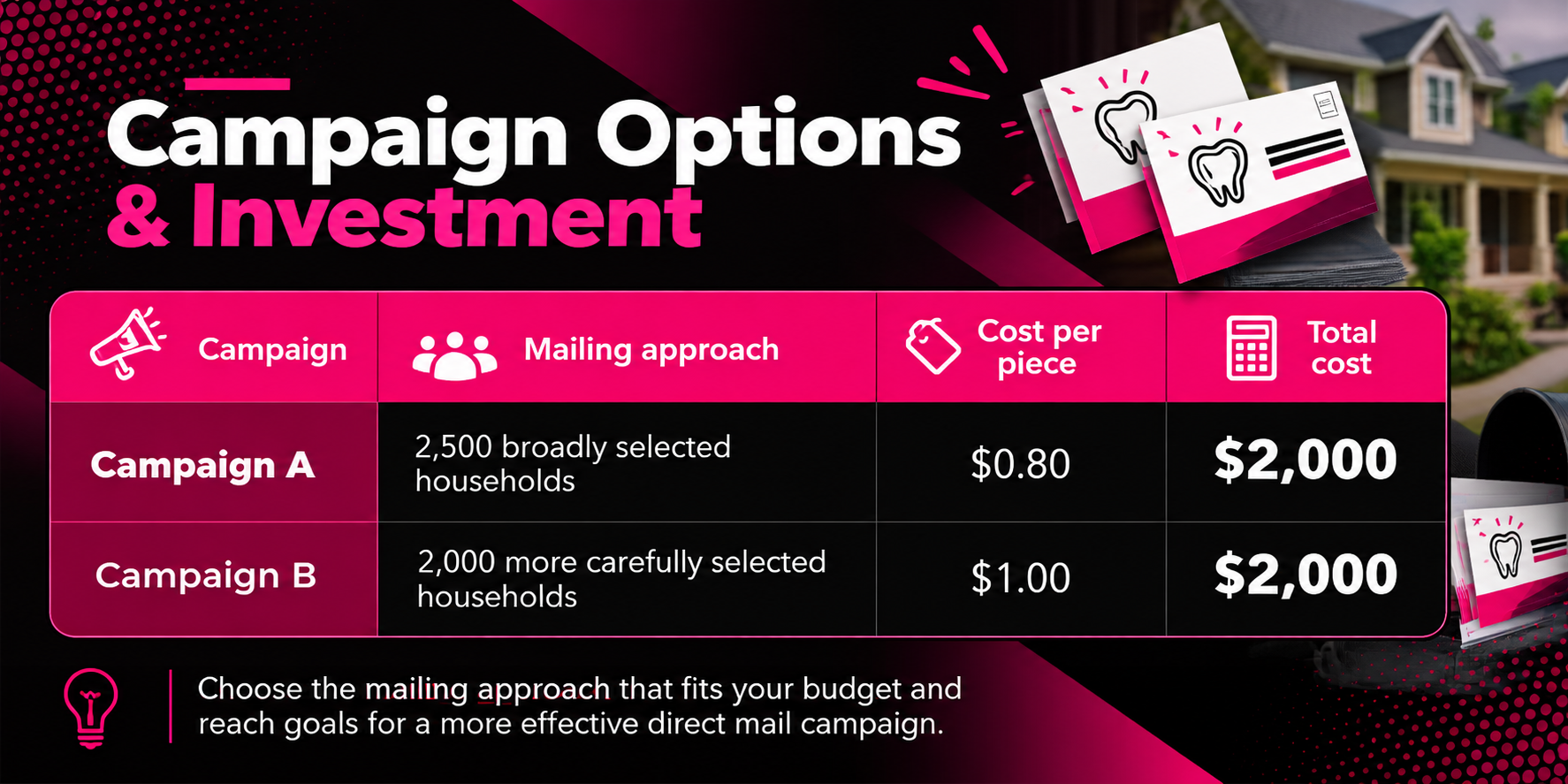
Campaign B reaches fewer people, but the additional cost per household may be worthwhile if better targeting produces more qualified inquiries.
For example, if Campaign A acquires 8 customers and Campaign B acquires 14, the respective acquisition costs are $250 and approximately $143.
These are hypothetical outcomes, not measured campaign results. They illustrate why the cheapest mailing cost does not necessarily produce the best financial return.
For a deeper explanation of selecting neighborhoods and customer segments, see How to Target Customers With Direct Mail for Better ROI.
Consider New Mover Marketing for Customer Acquisition
New mover marketing is a direct mail strategy that targets households after they relocate to a new address.
It can be particularly useful for small businesses because moving creates immediate purchasing needs.
A family settling into a new neighborhood may need a dentist, veterinarian, hair salon, grocery store, or home maintenance provider. These decisions often happen before the household develops strong relationships with local businesses.
A welcome postcard from a nearby dental practice, for instance, could introduce the office, explain the services available, and provide a convenient way to schedule an appointment.
The timing matters. A mailing that arrives while a household is actively researching local providers may be more relevant than one delivered months later.
For a first test, businesses can compare a new-mover mailing against a similar campaign targeting established residents. Measure qualified inquiries, appointments, customer acquisition costs, and subsequent purchases.
The practical takeaway is to prioritize households with a reason to act, rather than assuming every nearby address has equal value.
4. Choose the Right Direct Mail Format for Your Small Business
The format of your mailpiece affects how much you spend, how quickly customers understand your message, and what action they take.
For most small businesses launching their first direct mail marketing campaign, postcards are a practical starting point. They provide enough space to introduce a service, present an offer, and explain the next step without requiring recipients to open an envelope.
However, postcards are not always the best choice. A business promoting a high-value service may need additional space to explain its benefits, while an existing customer might respond better to a personalized letter.
According to the Data & Marketing Association's 2018 Response Rate Report, oversized envelopes achieved a 5% response rate among prospect lists, while postcards achieved 4.25%. These historical benchmarks show that format can influence response, although audience quality, offers, and campaign execution also affect results.
Source: ANA/DMA 2018 Response Rate Report
Compare Common Direct Mail Formats
Different formats serve different marketing goals. The right choice depends on how much information customers need before deciding to respond.
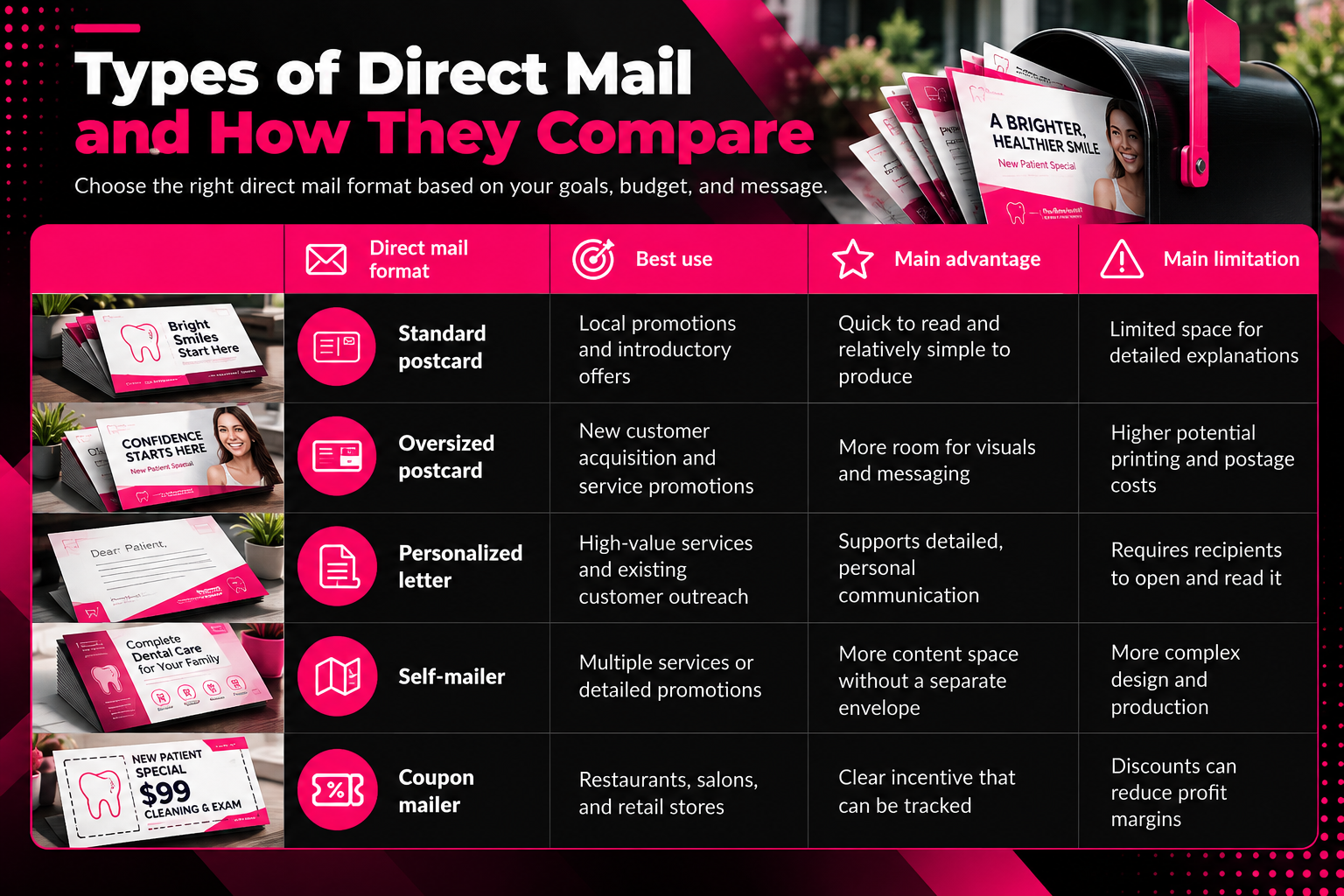
For a dental practice introducing itself to nearby households, an oversized postcard may provide enough space for a welcoming message, office photography, key services, and appointment information.
A restaurant promoting a weekday lunch special could use a smaller postcard with a clear offer and expiration date.
A home improvement company advertising a major renovation service may benefit from a letter that explains its process, qualifications, and consultation options.
Our recommendation is to choose the simplest format that communicates your offer clearly. Paying for additional space makes little sense unless that space helps customers understand the service or take action.
Should Small Businesses Use Postcards or Letters?
Postcards generally work well when the offer is easy to understand. Letters are more suitable when customers need context, reassurance, or detailed information before responding.
Consider two hypothetical campaigns.
A neighborhood car wash sends 2,000 postcards advertising a first-visit discount. Customers can understand the offer within seconds.
Meanwhile, a financial planning firm sends 500 personalized letters inviting selected prospects to an introductory consultation. The longer format gives the firm room to explain its services and establish credibility.
Neither format is automatically better.
The car wash needs an affordable way to generate visits. The financial planning firm needs qualified appointments from a smaller audience.
When comparing formats, calculate the total cost per acquired customer rather than focusing only on printing expenses.
5. Create a Direct Mail Offer That Gives Customers a Reason to Respond
An attractive design can help your mailpiece get noticed, but the offer determines whether customers have a compelling reason to act.
Small businesses sometimes spend too much time choosing colors, images, and layouts while giving little attention to the actual promotion.
A postcard that simply announces a business exists may increase awareness. But if the goal is to generate appointments, inquiries, or purchases, the message needs a stronger reason for recipients to respond.
An effective offer connects a specific customer need with a clear benefit.
Match Your Offer to the Customer's Needs
Not every direct mail campaign requires a discount.
For businesses offering professional services, convenience, reassurance, or a useful consultation may be more persuasive than a reduced price.
Consider these examples.
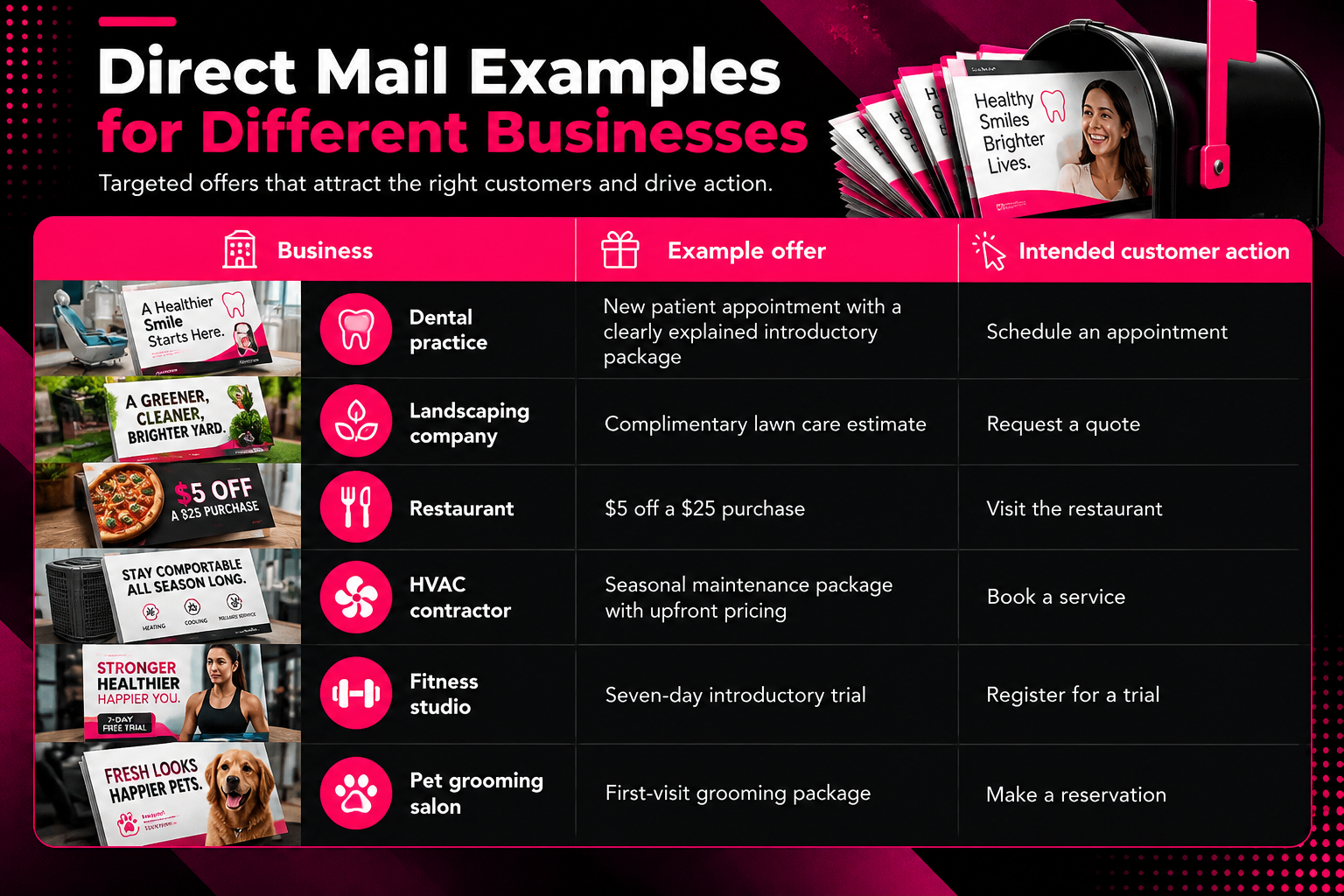
These offers are examples, not proven conversion winners. Businesses should verify that discounts, complimentary services, and promotional claims are financially sustainable and comply with applicable rules.
For dental practices, marketing offers should be especially clear about eligibility, included services, limitations, and any applicable professional advertising requirements.
Make the Offer Specific and Easy to Understand
Compare two hypothetical messages for a local landscaping company.
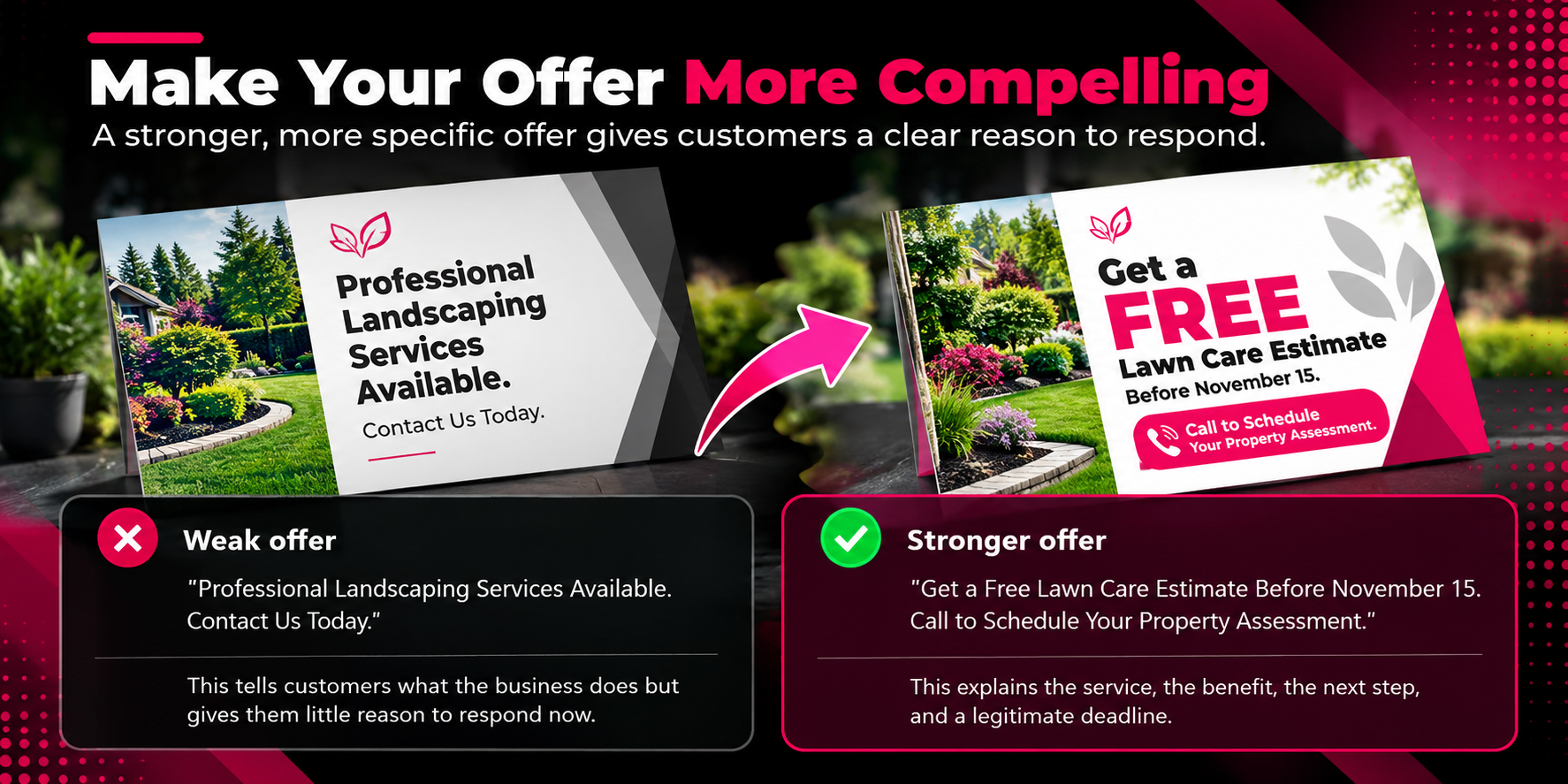
The second message reduces uncertainty. Recipients know what they receive and what they need to do.
A deadline can encourage action, but it should reflect a genuine promotion or scheduling limitation. Artificial urgency can damage trust.
Protect Profitability When Offering Discounts
A discount can increase responses while reducing the profit earned from each sale.
Suppose a restaurant normally sells a meal for $25, with $10 in variable costs. Its contribution before fixed expenses is $15.
If it offers a $5 discount, the contribution falls to $10 per redeemed meal, assuming costs remain unchanged.
That is a 33.3% reduction in contribution per meal.
The promotion may still make sense if it brings in new customers who return, purchase additional items, or refer others. But the business should not assume that every redemption represents profitable growth.
This is why the best direct mail offer is not necessarily the biggest discount. It is the one that attracts customers at an acceptable acquisition cost.
When refining an offer, consider how its perceived value, clarity, and timing affect response. Our guide to direct mail marketing tips for better conversions explores additional ways to improve campaign effectiveness.
6. Design a Direct Mail Postcard That Customers Can Understand Quickly
A postcard has only a few seconds to communicate its purpose. If recipients cannot identify the business, understand the offer, or find the next step, the design is working against the campaign.
The USPS 2024 Household Diary Study found that household members read 44% of advertising mailpieces, looked at another 22% without fully reading them, and set aside 4% for later. In total, 70% received some form of attention.
prc.arkcase.com
That finding has a practical implication. Your mailpiece should communicate its most important information even when someone only glances at it.
Use a Clear Visual Hierarchy
Visual hierarchy refers to the order in which people notice information on a page.
For a small-business postcard, the message should follow a natural sequence.
Headline. Identify the main service or customer benefit.
Offer. Explain why the recipient should consider responding.
Supporting information. Include relevant details, qualifications, or reasons to trust the business.
Call to action. Tell the recipient exactly what to do next.
Contact information. Make the phone number, website, or booking method easy to find.
Consider a dental practice mailing postcards to new residents.
A headline such as "Looking for a Dentist Near Your New Home?" immediately connects the message to the recipient's situation.
Below that, the postcard could introduce the practice, explain its new-patient appointment process, and provide a scheduling link.
A photograph of the actual dental team may be more useful than a generic stock image because it helps prospective patients recognize the people behind the business.
The same principle applies to restaurants, fitness studios, and home service providers. Use visuals that help customers understand what they can expect.
Keep the Message Focused on One Service or Offer
A common mistake in direct mail marketing for small business is trying to fit an entire website onto a postcard.
A roofing company might offer inspections, repairs, replacements, gutter cleaning, and emergency services. Listing every service in equal detail makes the postcard harder to scan.
If the campaign's primary goal is to generate roof inspection appointments, that service should dominate the message.
Additional services can appear in smaller supporting text when necessary.
As a practical starting point, aim for one primary headline, one main offer, and one clear call to action. This is a design guideline, not a statistically established rule.
Write a Call to Action That Removes Uncertainty
A call to action, or CTA, tells recipients what to do after reading the mailpiece.
"Contact Us" is technically a CTA, but it leaves important details unanswered.
"Call to Schedule Your Free Lawn Care Estimate" communicates the action and what the customer receives.
Likewise, "Book Your New Patient Appointment Online" is more specific than "Learn More" when the goal is to generate dental appointments.
A strong CTA should match the campaign's primary KPI.
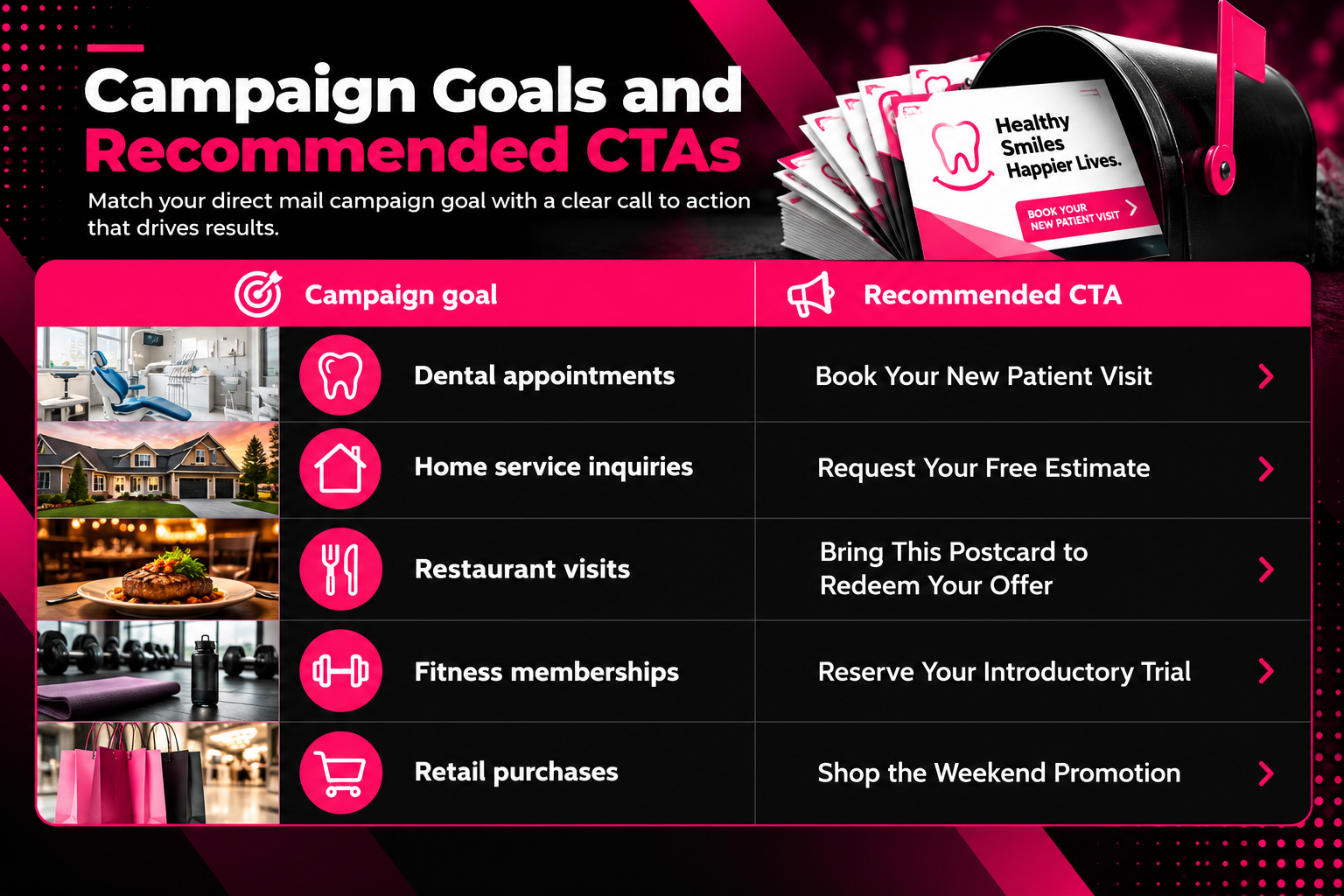
The wording should accurately describe the offer. Avoid suggesting that services are free, guaranteed, or available to everyone unless those claims are true.
For more examples, read How to Write a Call to Action in Direct Mail Marketing.
7. Prepare and Send Your First Direct Mail Campaign
Once the audience, offer, and design are ready, the next step is preparing the mailing for production and delivery.
This stage requires careful attention because errors can become expensive after printing begins.
A wrong phone number, outdated mailing list, or unclear offer can affect every postcard in the campaign.
For a mailing of 2,000 postcards at an illustrative all-in cost of $0.80 each, a significant production error could put $1,600 of marketing spending at risk before the business receives a single inquiry.
Review Your Mailing List Before Production
Start by checking whether the mailing data matches your intended audience.
Remove duplicate records where appropriate, verify address formatting, and exclude households that should not receive the promotion.
If using a purchased or third-party list, confirm its source, permitted uses, and relevant privacy requirements.
For campaigns targeting existing customers, verify that contact information is current and that any applicable marketing preferences or restrictions are respected.
A dental practice should avoid using sensitive patient information or revealing treatment details in a way that compromises privacy.
List preparation may not be the most visible part of the campaign, but it directly affects delivery efficiency and audience relevance.
Proofread Every Detail Before Printing
Before approving a mailpiece, verify the following.
Business name, address, phone number, and website
Offer details, eligibility, expiration date, and restrictions
QR code destination and landing page functionality
Readability of headlines and smaller text
Image quality, printing margins, and postal layout requirements
Tracking codes or dedicated contact methods
One practical approach is to have someone unfamiliar with the campaign review the proof.
Ask that person to identify the offer and explain how to respond without additional instructions.
If they struggle, simplify the message before printing.
Choose a Mailing Method That Fits Your Budget
Small businesses generally have two options. They can manage mailing preparation themselves or work with a direct mail service provider.
Handling the campaign internally may be practical for very small, simple mailings. However, printing, address preparation, postage requirements, and delivery coordination can become time-consuming as volume increases.
A full-service provider can coordinate list preparation, design, production, mailing, and tracking, depending on the services offered.
For businesses considering USPS Every Door Direct Mail, or EDDM, the program allows qualifying mailpieces to reach selected postal carrier routes without requiring individual recipient names and addresses.
EDDM can be useful for restaurants, salons, and other businesses targeting broad neighborhoods. More selective customer acquisition campaigns may require a targeted mailing list instead.
Businesses can review eligibility and requirements through the USPS Every Door Direct Mail program.
For a complete execution walkthrough, see How to Send Direct Mail: A Step-by-Step Guide for Beginners.
Coordinate Mailing Dates With Business Capacity
Mailing at the wrong time can create operational problems.
A landscaping company should avoid launching a major appointment campaign when its schedule is already full. A restaurant should confirm that staff can handle the promotion before sending thousands of coupons.
Dental practices need to consider appointment availability, front-desk capacity, and follow-up procedures.
A practical timeline might allow one to two weeks for preparation and production, followed by delivery and a response-monitoring period. Actual schedules depend on the mailing method, postal service, and production requirements.
We recommend confirming operational readiness before committing to a mailing date.
For more detail on coordinating each stage, read How To Do A Direct Mail Campaign Successfully?.
8. Combine Direct Mail With Your Digital Marketing Channels
Direct mail works best when customers can move easily from a physical postcard to the next step in their buying journey.
A recipient might notice an offer, search for the business online, read customer reviews, and then book an appointment.
That process may involve several interactions before a conversion occurs.
The USPS Office of Inspector General's 2024 report on historical mail volume trends explains how digital advertising and improved data analytics have changed the marketing environment. It also notes that digital channels can be less expensive and easier to measure, depending on the campaign.
|
For small businesses, the practical approach is not to choose between physical and digital marketing. It is to make the channels support the same customer journey.
Connect Postcards to a Dedicated Landing Page
A landing page is a website page created around a specific campaign or offer.
Instead of directing recipients to a general homepage, a dental practice could send them to a page explaining its new-patient appointment process.
That page might include office information, available services, appointment options, and a simple booking form.
A landscaping company could use a landing page where homeowners request estimates.
Dedicated pages make the next step clearer and allow businesses to measure visits and conversions associated with a particular mailing.
Use QR Codes Without Making Them the Only Response Option
QR codes can help recipients access a booking page or promotion using their smartphones.
However, not everyone wants to scan a code.
A postcard should still provide a readable website address or phone number.
For example, a dental postcard might include a QR code leading to an appointment page, alongside a phone number for recipients who prefer to call.
Test the code on multiple devices before printing.
Keep Your Online Information Consistent
A direct mail campaign may encourage customers to research your business before responding.
Make sure the website, Google Business Profile, and other relevant online listings display accurate contact details, operating hours, and service information.
The postcard's offer should match the information customers find online.
If the mailpiece advertises an introductory appointment but the linked page does not mention it, recipients may become confused or abandon the process.
Consistency reduces friction between receiving the postcard and taking action.
9. Track Your Direct Mail Marketing Results
Sending postcards is only the beginning. To understand whether direct mail marketing is helping your small business grow, you need to measure what happens after delivery.
A campaign that generates 50 inquiries may look successful. But if only two people become paying customers, the results could be disappointing. Meanwhile, another campaign might produce 15 inquiries and convert 10 into profitable customers.
The real measure of success is not how many people respond. It is how many valuable customers your campaign acquires at a sustainable cost.
The Data & Marketing Association's 2018 Response Rate Report recorded response rates of 9% for house lists and 4.9% for prospect lists. These figures provide historical context, but they should not be treated as guaranteed results for modern campaigns.
Source: ANA/DMA 2018 Response Rate Report
Measure the KPIs That Matter
Key performance indicators, or KPIs, help determine whether a mailing campaign is achieving its objectives.
For small businesses, the most useful metrics connect marketing spending to inquiries, sales, appointments, and customer acquisition.
These metrics answer different questions.
Response rate indicates whether the campaign attracted attention. Conversion rate reveals whether those responses became meaningful business opportunities. Customer acquisition cost shows how much the business spent to gain each customer.
For dental practices, new patient appointments and completed visits may be more useful than website traffic alone.
A restaurant might prioritize redeemed offers, first-time visits, and repeat purchases.
The important point is to choose KPIs that reflect the campaign's original objective.
Calculate Your Direct Mail Response Rate
The direct mail response rate measures the percentage of recipients who take a trackable action after receiving your mailpiece.
The formula is straightforward.
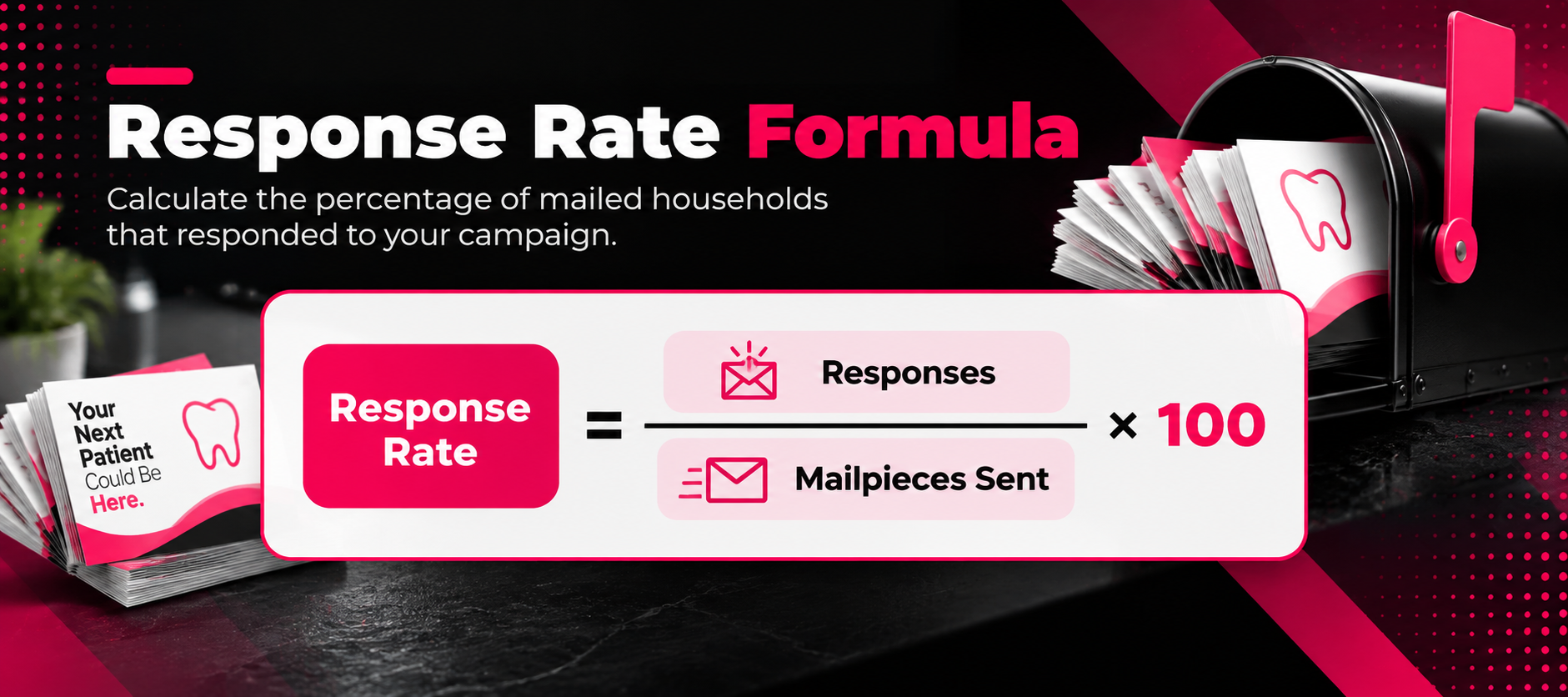
Suppose a local dental practice mails 3,000 postcards and receives 45 identifiable inquiries.
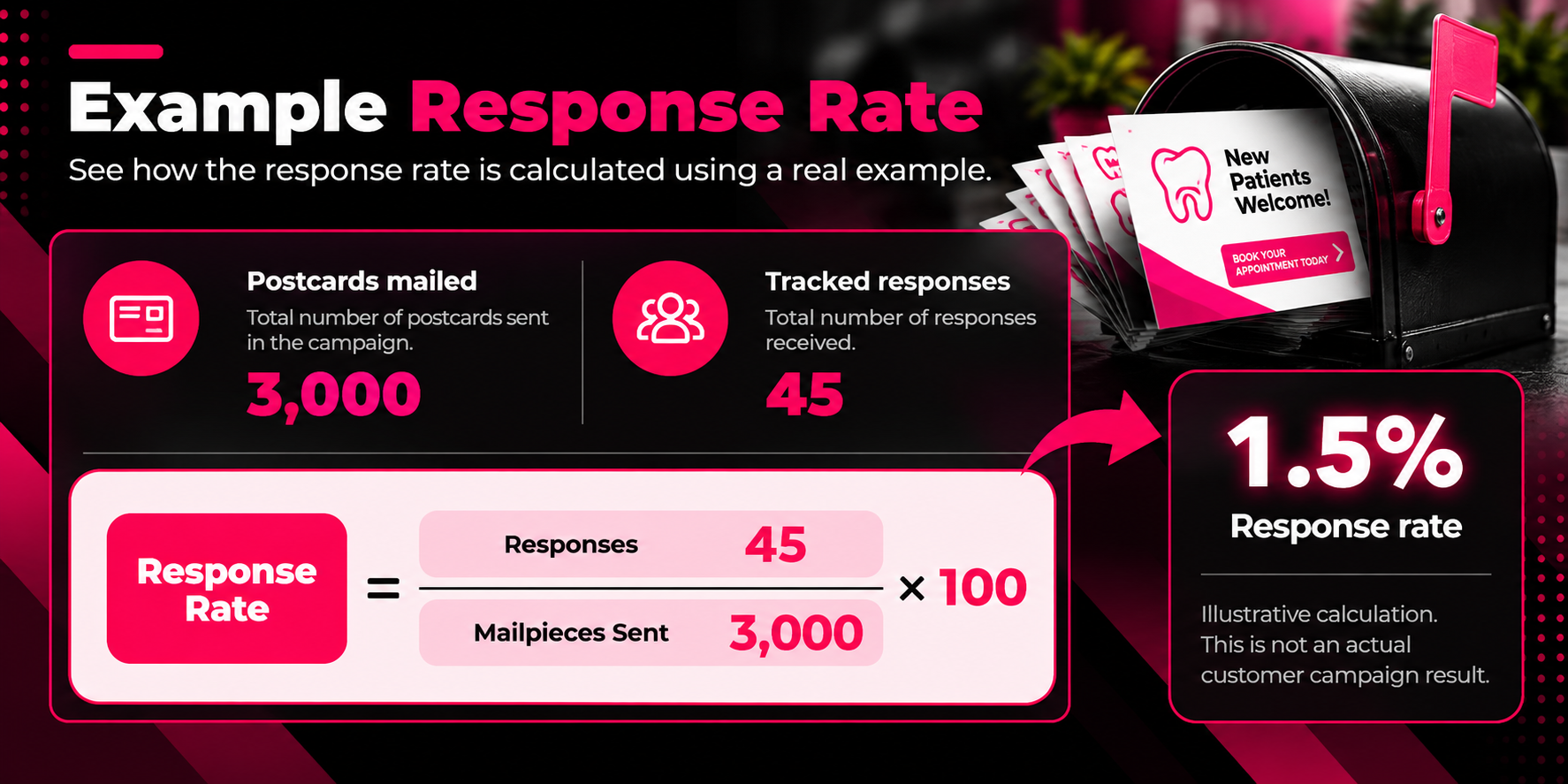
A 1.5% response rate means approximately 15 responses per 1,000 postcards mailed.
Whether that is financially successful depends on how many inquiries convert into customers and the value of those customers.
For practical ways to improve this metric, read How to Increase Direct Mail Response Rates.
Track Where Your Customers Come From
One challenge with direct mail is attribution, which means identifying which marketing activity contributed to a customer's response.
Someone may receive a postcard, search for the business on Google, and call several days later.
Without a tracking process, that customer might be incorrectly attributed entirely to organic search.
To improve accuracy, businesses can use dedicated campaign phone numbers, unique promotional codes, QR codes, and campaign-specific landing pages.
Staff can also ask new customers how they heard about the business.
No single method captures every interaction perfectly. Combining several tracking methods provides a more complete picture.
For a dental practice, connecting campaign responses with appointment records can help identify how many inquiries became scheduled appointments, completed visits, and new patients.
10. Calculate Direct Mail ROI and Customer Acquisition Costs
Return on investment, or ROI, helps determine whether a direct mail campaign generated enough financial value to justify its cost.
Small businesses should calculate ROI using profit contribution rather than revenue alone.
A campaign may generate $8,000 in sales, but that does not mean the business earned $8,000 in profit. Product costs, labor, service delivery, and other variable expenses must be considered.
Calculate Your Campaign's Financial Return
For a simplified campaign-level calculation, use the contribution generated by acquired customers after direct service or product costs, but before marketing expenses.
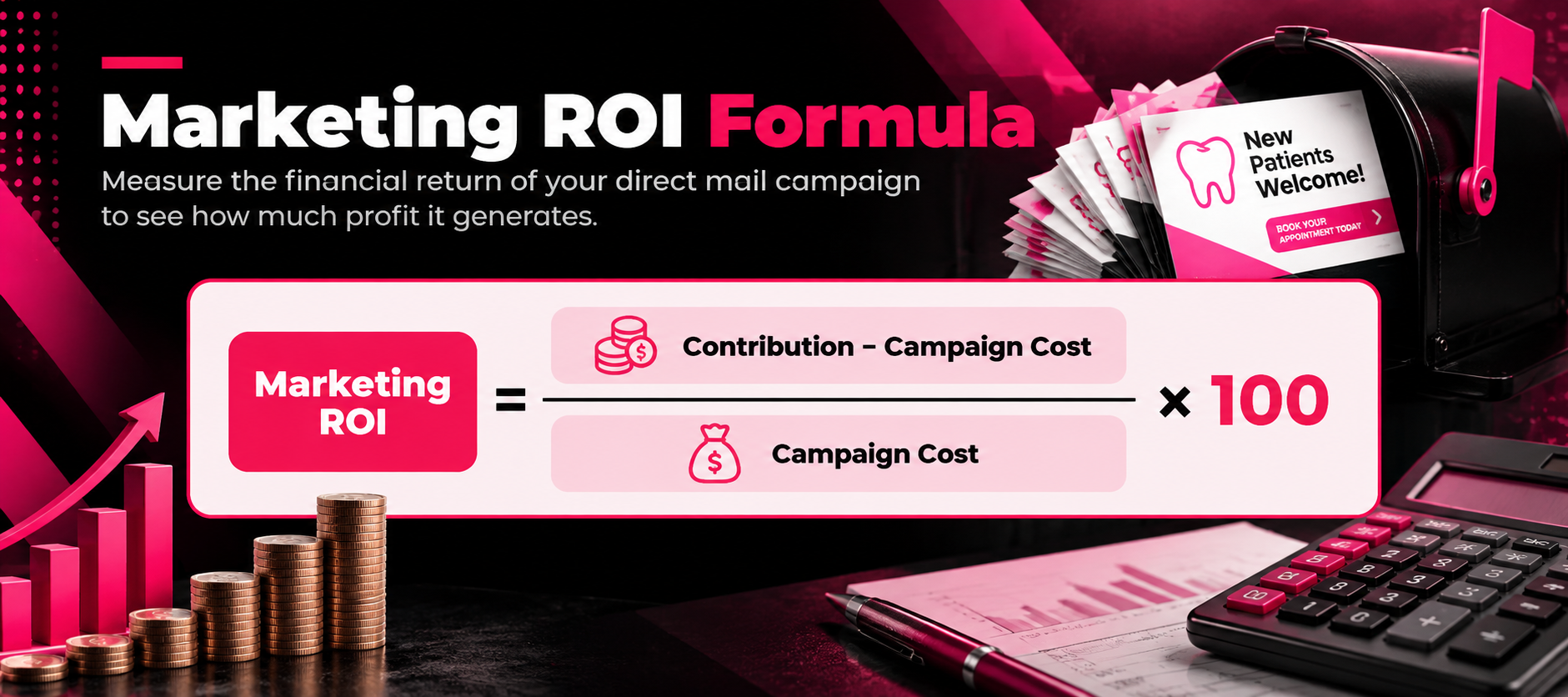
Consider this hypothetical campaign for a local home service company.
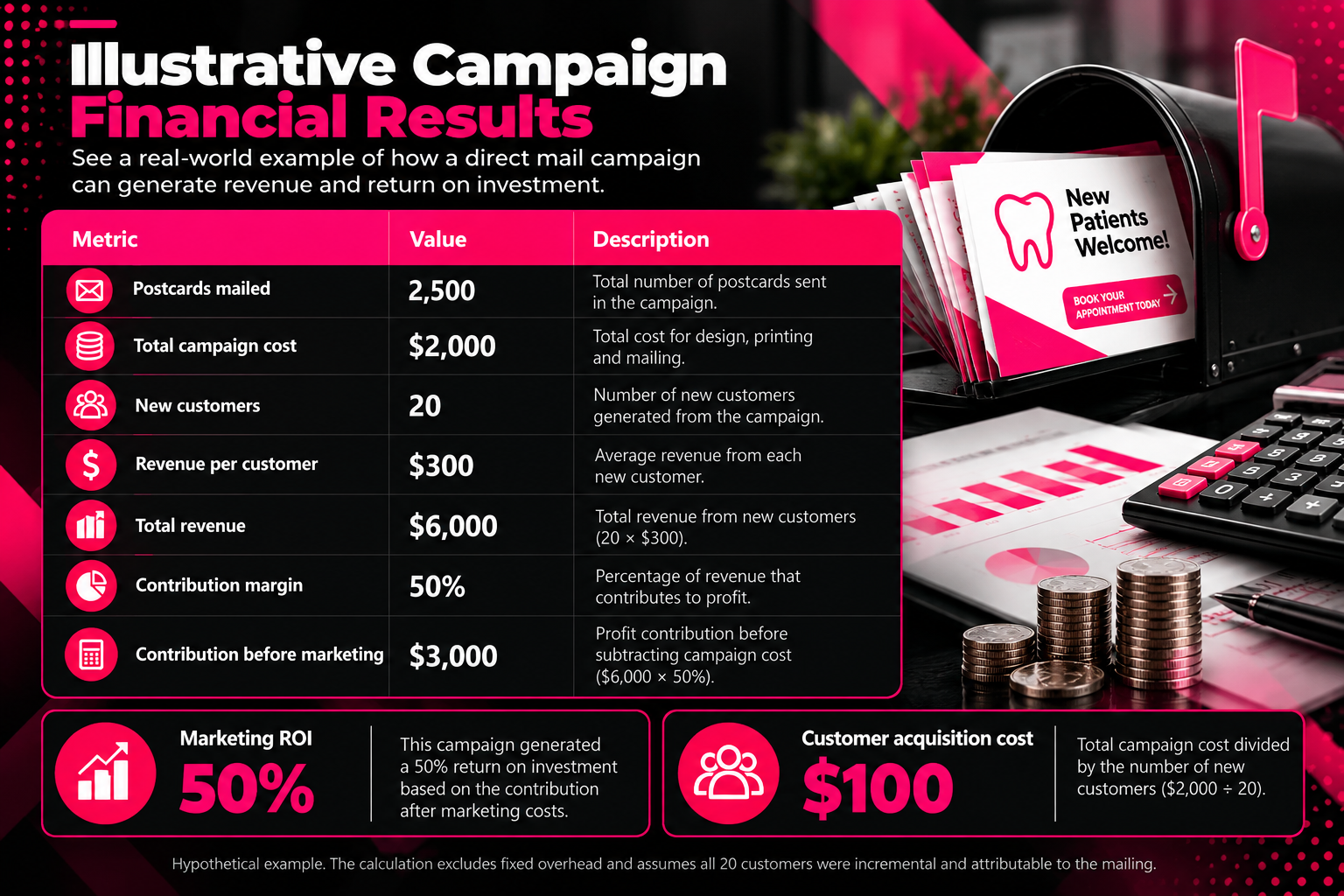
In this example, the campaign generates $3,000 in contribution before marketing expenses. After subtracting the $2,000 campaign cost, the remaining contribution is $1,000.
That represents a 50% marketing ROI.
The business also spends $100 to acquire each new customer.
If those customers return for additional profitable services, their long-term value may increase. However, future purchases should only be included in ROI calculations when supported by actual customer retention data or clearly identified forecasts.
Determine Your Break-Even Customer Acquisition Cost
A useful planning exercise is calculating how many customers a campaign must acquire to cover its marketing expenses.
Suppose a dental practice spends $2,400 on a postcard campaign and expects an average contribution of $300 per new patient from the initial treatment period.
The campaign would need eight incremental new patients to recover its marketing cost at that contribution level.
This does not guarantee profitability after fixed overhead, but it gives the practice a measurable acquisition target.
For small businesses, knowing the break-even point before mailing is far more useful than judging results solely by how many people called.
Our guide on How To Improve Your Direct Mail ROI explains additional ways to evaluate and improve campaign profitability.
11. Improve Your Direct Mail Campaign After the First Mailing
Your first mailing should provide information that makes the next campaign more effective.
Rather than immediately increasing the number of postcards, review which audiences responded, which offers generated profitable customers, and where potential customers stopped moving forward.
In practice, a low response rate does not always mean direct mail is unsuitable for the business. It may indicate that the audience, offer, timing, or message needs adjustment.
However, campaigns that consistently fail to cover their acquisition costs should not continue unchanged.
Test One Major Variable at a Time
Testing allows businesses to compare different approaches without relying entirely on assumptions.
For example, a landscaping company could send two postcard versions to comparable household groups.
Version A promotes a complimentary lawn care estimate.
Version B promotes a seasonal maintenance package with transparent pricing.
If both groups receive the same number of postcards during the same period, the business can compare inquiry rates, appointment bookings, and acquisition costs.
A simple comparison might look like this.
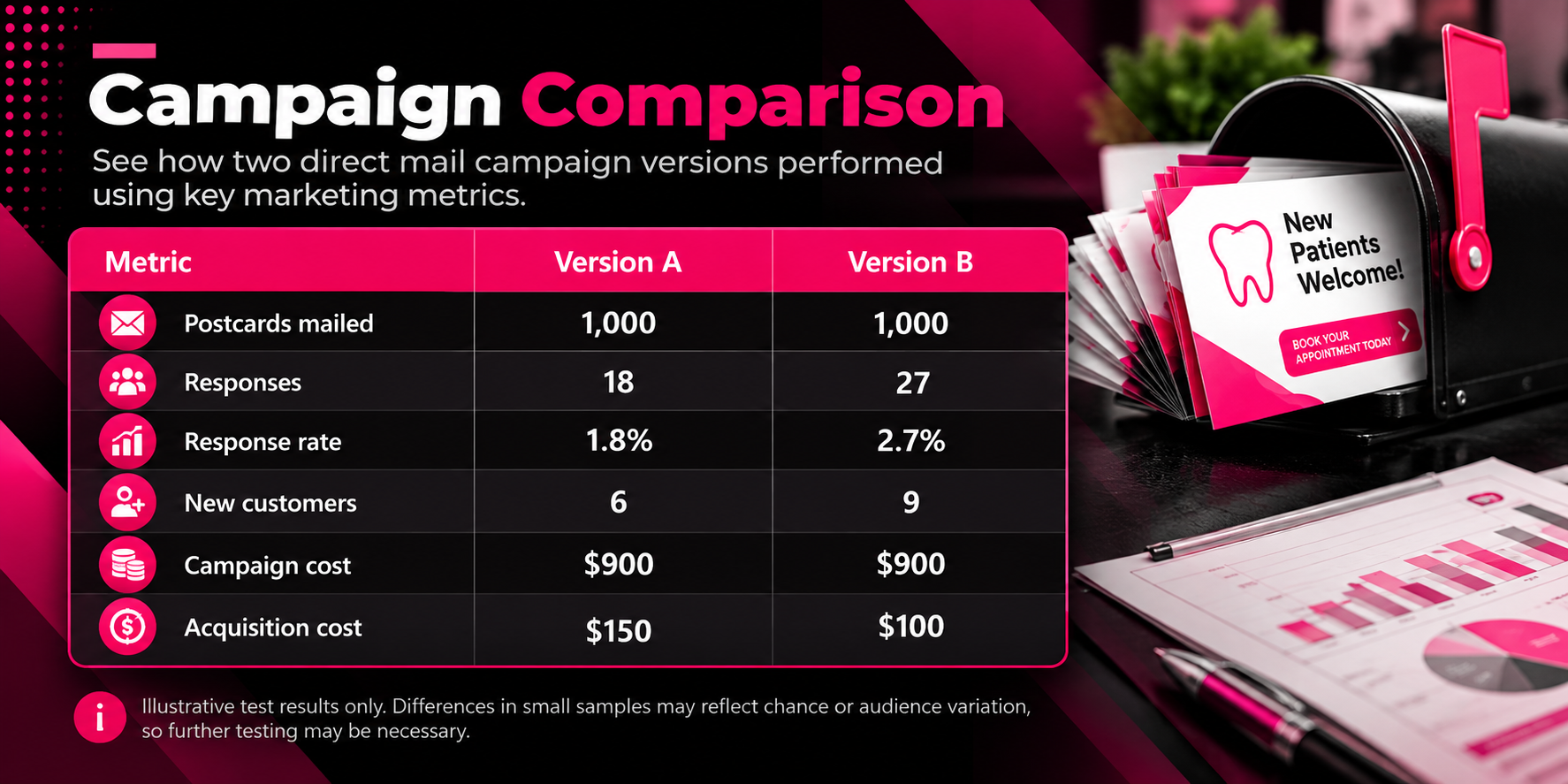
Version B performs better in this hypothetical example, but one small test is not enough to establish that its offer will consistently outperform the alternative.
For more reliable comparisons, businesses should keep audience characteristics, timing, mailing format, and other major factors as similar as possible.
Use Campaign Data to Refine Geographic Targeting
Campaign performance can also reveal which neighborhoods produce valuable customers.
A dental practice might discover that households within three miles of its office generate more completed appointments than those farther away.
A landscaping company may find that certain neighborhoods produce more estimate requests but fewer confirmed jobs.
These differences matter.
Instead of mailing repeatedly to the largest possible audience, businesses can concentrate future spending on areas with stronger acquisition economics.
Mapping campaign responses and customer locations can make these patterns easier to identify.
For a small business with a limited budget, this approach can be more sustainable than increasing mailing volume without improving targeting.
Decide When to Repeat a Campaign
There is no universal mailing frequency that works for every business.
A restaurant might benefit from periodic promotions tied to seasonal menus or local events. A dental practice may use recurring new-patient campaigns in selected neighborhoods.
A home service company could align mailings with seasonal demand.
The right frequency depends on customer needs, marketing costs, and whether additional mailings generate enough incremental business.
For an initial test, consider evaluating responses over 30 to 60 days, with longer periods for services that involve extended purchasing decisions.
Compare results before repeating the campaign. Do not assume that mailing more frequently will automatically improve performance.
12. Avoid Common Direct Mail Marketing Mistakes
Direct mail can waste money when businesses focus on printing and distribution without considering targeting, conversion, or follow-up.
The USPS Office of Inspector General reported that direct mail accounted for approximately 4% of total advertising spending in 2023, compared with more than 8% in 2013. This reflects a changing marketing environment in which businesses have more channels competing for their budgets.
Source: USPS OIG, Analysis of Historical Mail Volume Trends, 2024.
|
With more ways to reach customers, small businesses should expect every marketing investment to justify its cost.
Mailing to Too Many Unqualified Households
Sending 10,000 postcards may seem more impressive than sending 2,000. But larger volume does not guarantee more profitable customers.
A dental practice that serves a small geographic area may waste money targeting households far outside its typical patient service area.
Start with a defined audience and expand only when campaign results support doing so.
Using a Weak or Confusing Offer
A postcard filled with general claims about excellent service may not give recipients enough reason to respond.
Instead, communicate a specific benefit, explain what customers can expect, and provide a clear next step.
Avoid excessive discounts that attract inquiries without generating adequate profit.
Ignoring Customer Follow-Up
An inquiry is not the same as a sale.
Suppose a dental campaign produces 40 inquiries, but the practice only schedules 12 appointments. Before blaming the postcard, examine how quickly staff respond, whether appointments are available, and whether interested patients receive appropriate follow-up.
For service businesses, lead handling can have a substantial effect on the number of customers acquired.
Failing to Measure Results
Without tracking, businesses cannot confidently determine whether direct mail is working.
Use campaign-specific contact methods and customer records to identify responses and completed purchases.
Then compare acquisition costs with the financial value of new customers.
For a more detailed breakdown, read Top Direct Mail Marketing Mistakes Hurting Your Results.
13. Build a Repeatable Direct Mail Marketing Strategy
A single mailing can generate useful results, but a repeatable process gives businesses a better opportunity to improve customer acquisition over time.
The goal is not to send postcards indefinitely. It is to develop a marketing system that consistently identifies promising customers, delivers relevant offers, measures performance, and adjusts spending based on results.
For small businesses with limited resources, a simple 90-day testing plan can provide structure.
A Practical 90-Day Direct Mail Marketing Plan
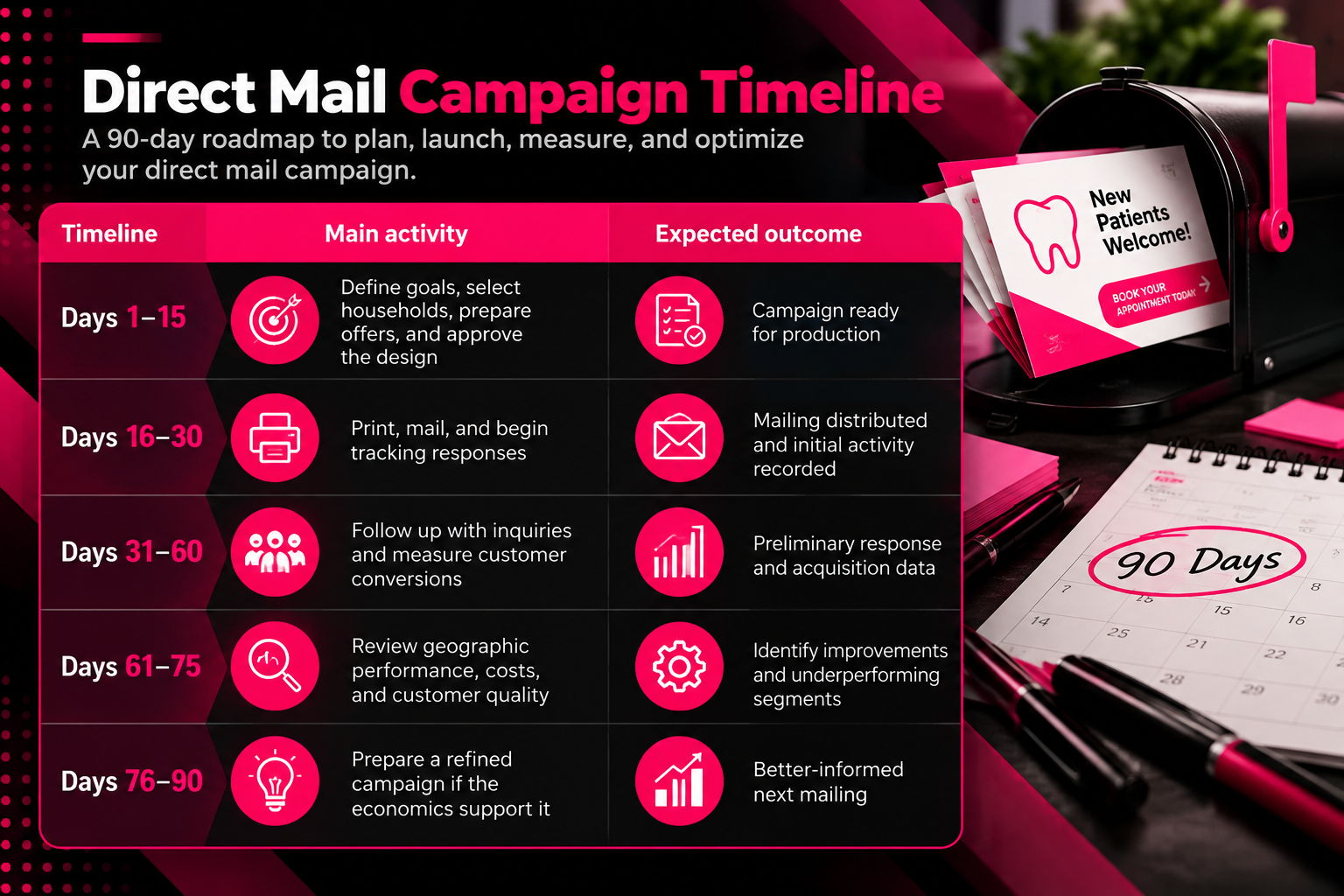
These are suggested planning milestones, not promised delivery or customer acquisition timelines.
For businesses offering high-value services, meaningful sales data may take longer than 90 days to develop.
Scale Based on Profitability, Not Mailing Volume
Suppose a small business spends $1,500 on its first mailing and acquires 10 customers at $150 each.
If those customers generate sufficient contribution to justify the acquisition expense, the business may consider increasing its budget.
However, doubling the mailing volume does not guarantee twice as many customers.
Additional neighborhoods may have different demographics, competitive conditions, and purchasing behavior.
Expand gradually, compare performance by audience, and continue tracking acquisition costs.
This approach helps businesses avoid committing larger budgets before understanding what works.
Conclusion: Turn Direct Mail Into a Measurable Customer Acquisition Strategy
Learning how to market a small business using direct mail is not about sending the most postcards or creating the most elaborate design. It is about reaching people who are likely to need your services, giving them a clear reason to respond, and measuring whether those responses become profitable customers.
Start with a defined audience and a realistic budget. Choose a mailing format that fits your message, develop a relevant offer, and make the next step easy. Once the campaign reaches households, track inquiries, conversions, customer acquisition costs, and financial returns.
The most useful results often come from what businesses learn after the first mailing. Geographic response patterns, customer feedback, and conversion data can help refine future campaigns and reduce unnecessary spending.
For dental practices, direct mail can support a more consistent approach to attracting new patients. For restaurants, home service providers, and other local businesses, it can help introduce services to nearby households and encourage new customer relationships.
The objective is not simply to generate attention. It is to build a repeatable process for acquiring customers at a cost your business can sustain.
Start Building a More Predictable Direct Mail Strategy With MVP Mailhouse
A successful campaign requires more than printing and postage. It needs the right targeting, a clear message, reliable execution, and a way to measure results.
At MVP Mailhouse, we focus on helping businesses turn direct mail into a measurable customer acquisition strategy, with particular expertise in dental marketing.
Our approach brings together audience targeting, geographic mapping technology, campaign design, printing, mailing, and performance tracking to help businesses make informed marketing decisions.
Whether your goal is to attract new dental patients, reach recently relocated households, or generate more local customer inquiries, a carefully planned campaign can provide a practical starting point.
Visit our website at MVP Mailhouse to explore our direct mail marketing solutions and learn how a targeted campaign can support more consistent customer acquisition and sustainable business growth.
Tags
Direct Mail Strategies
Frequently Asked Questions
Related blog




Ready For Your Success Story?
Get 500 Free Handout cards shipped right to your doorstep!