How Does Call Tracking Work in Direct Mail?
How does call tracking work in direct mail? Boost ROI 2–5x, track every call, fix leaks fast, see the system and schedule your demo today.

Aaron Boone
ceo
·12 min read
·Jun 17, 2025


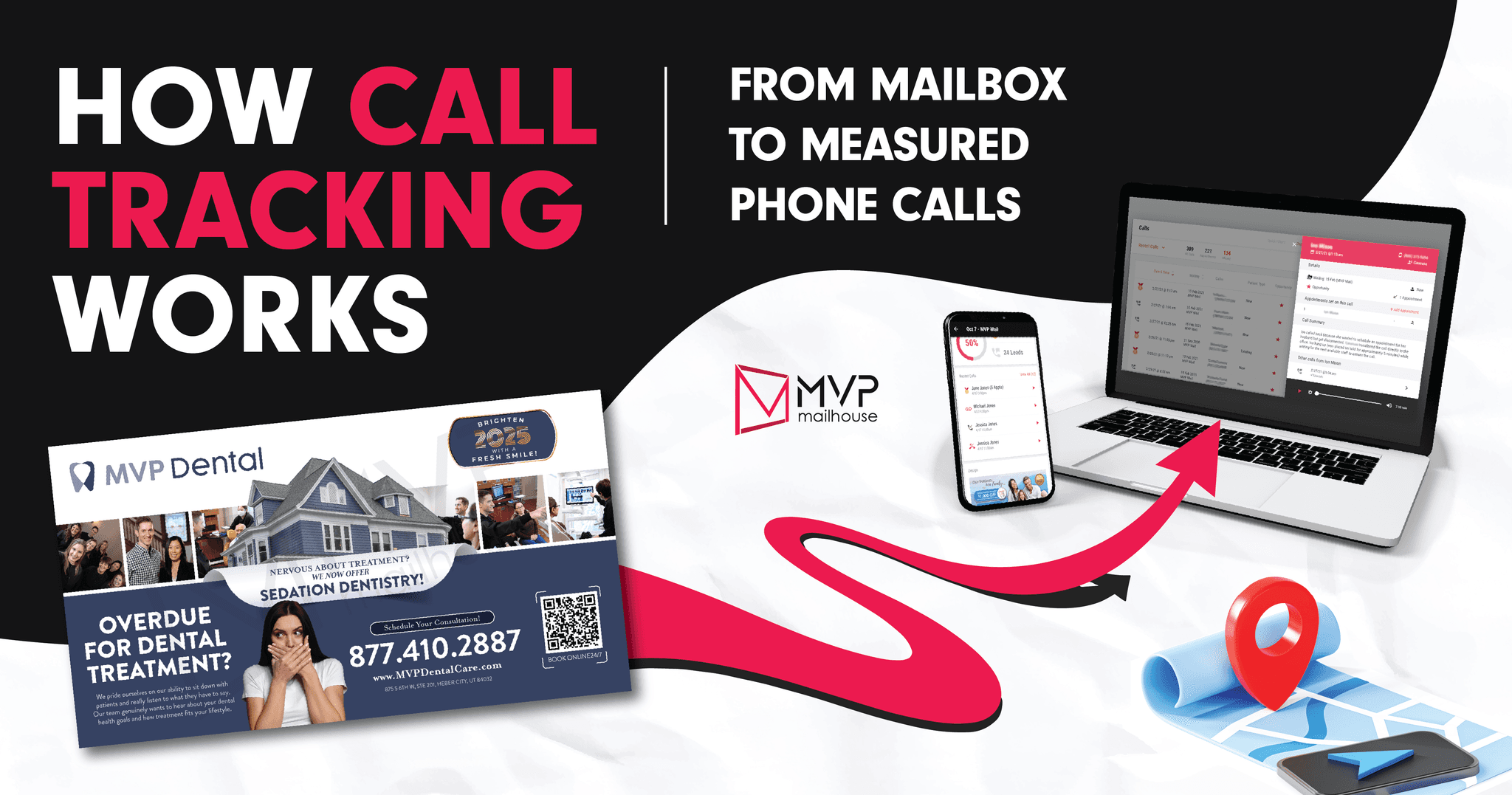
How does call tracking work and why do practices that use it often see 20–40% clearer attribution on their marketing within the first 90 days?
In 2025, direct mail campaigns achieved an average response rate of about 3.63%, significantly higher than many digital channels, making offline calls a high-value action worth tracking with unique numbers.
That’s not hype. It’s the difference between guessing which mail piece worked and knowing exactly which postcard, list, or offer drove a high-value phone call.
Direct mail still drives response. In healthcare and dental marketing especially, phone calls remain the primary conversion action. But if you can’t connect that ringing phone to a specific campaign, your ROI is blurred at best and completely misjudged at worst.
In this article, we’ll break down exactly how call tracking works in direct mail, why it matters, what software actually does behind the scenes, and what results you should realistically expect when it’s implemented correctly.
How Does Call Tracking Work in Direct Mail?
Call tracking works by assigning unique phone numbers to specific campaigns, then logging and analyzing the calls that come through those numbers.
In direct mail, that typically means:
- A different phone number for each mail drop
- Or a unique number per audience segment (e.g., new movers vs. reactivation patients)
- Or even per creative variation (Offer A vs. Offer B)
When someone calls the number printed on the postcard, the tracking software:
- Captures the call data (caller ID, time, duration)
- Routes the call to your real office number
- Logs and records the conversation (if enabled)
- Attributes that call to the exact campaign tied to that tracking number
The patient never knows anything is different. To them, it’s just your office phone.
But to you? It’s visibility.
We’ve seen this happen repeatedly in dental campaigns: two nearly identical mailers go out. One drives 38 calls. The other drives 11. Without call tracking, both would have been credited equally. With tracking, the winning creative becomes obvious and scalable.
If you want a broader foundation before diving deeper, our guide on What is Call Tracking? A Complete Guide for Dental Practices breaks down the fundamentals.
How Does Call Tracking Software Work Behind the Scenes?
Understanding how call tracking software works helps you trust the data—and use it correctly.
Here’s what happens technically:
1. Dynamic Number Provisioning
The software provides local or toll-free tracking numbers. These are real, carrier-grade phone numbers assigned to your account. Each number maps to a specific campaign.
For example:
- Campaign: New Mover Mail – January
- Tracking Number: (801) 555-0198
When someone dials that number, it instantly forwards to your main office line.
2. Real-Time Call Forwarding
The system uses call routing protocols to forward the call in milliseconds. There’s no lag, no app required, and no change to your front desk workflow.
From a patient perspective, nothing feels different.
3. Data Capture and Attribution
This is where the real value lives.
The software logs:
- Call source (which campaign number)
- Date and time
- Call duration
- Caller phone number
- Call recording (if enabled)
- Outcome tagging (appointment booked, missed opportunity, etc.)
If your front desk books an appointment from that call, you can directly connect revenue back to that specific mail piece.
In industries like dentistry where one new patient can represent $1,000 to $3,000 in lifetime value, that level of clarity changes budgeting decisions fast.
4. Call Recording and Performance Scoring
Advanced systems go further. They don’t just track the call. They evaluate it.
With tools like CallPro by MVP Mailhouse, practices can monitor, record, and score incoming calls to improve front desk performance. This matters more than most realize.
We’ve seen offices generate strong mail response, but only convert 50–60% of inbound calls into appointments. After implementing call monitoring and coaching, conversion rates improved to 75% or higher within 60–120 days.
Call tracking isn’t just attribution. It’s optimization.
Why Do I Need Call Tracking in Direct Mail?
The short answer: because direct mail without attribution is expensive guesswork. The longer answer involves three key realities.
1. Phone Calls Are the Primary Conversion in Healthcare
In dental marketing especially, over 70% of new patient responses from direct mail come via phone. If you aren’t tracking calls, you’re not tracking the majority of your results.
Online clicks are easy to measure. Offline response isn’t, unless you build the measurement in from the start.
If you’re actively investing in mail, you should also understand How to Measure Direct Mail Success for Dental Practices. Call tracking is one of the foundational pillars.
2. Front Desk Performance Directly Impacts ROI
This is the uncomfortable truth.
A mail campaign might generate 40 calls. But if 15 of those calls are mishandled, rushed, or improperly quoted, the marketing appears weak when the real issue is call handling.
We’ve audited campaigns where response rates were strong but 30% of callers never received a clear next step. Once we implemented structured call coaching and reviewed Front Desk Strategies for Efficient Call Handling, booked appointments increased without increasing mail volume.
Call tracking exposes both marketing performance and operational gaps.
3. It Turns Direct Mail into a Measurable Channel
When practices ask, “Why do I need call tracking?” the answer is simple:
Because you can’t scale what you can’t measure.
With tracking in place, you can calculate:
- Cost per call
- Cost per booked appointment
- Revenue per campaign
- True return on investment
And once you know that, scaling becomes math, not emotion.
We’ve seen practices confidently increase monthly mail budgets by 25–50% after seeing verified ROI from tracked calls. The uncertainty disappears.
Benefits of Call Tracking in Direct Mail (With Real KPIs That Matter)
If you’re asking how does call tracking work, you’re really asking something deeper:
Does it actually improve results or just improve reporting?
When implemented correctly, it does both.
We’ve seen dental practices move from vague “the phones were busy” feedback to precise, campaign-level ROI tracking within 60–90 days. That shift changes how marketing decisions get made.
Let’s break down the measurable benefits of call tracking in direct mail and the numbers you should be watching.
1. Clear Attribution: Know Exactly What’s Working
Most practices measure direct mail success by feel:
- “We had a decent week.”
- “New patients mentioned the postcard.”
- “I think that campaign did well.”
That’s not measurement. That’s memory.
With call tracking in direct mail, every incoming call tied to a unique number gets attributed to a specific campaign. This allows you to calculate:
- Calls per mail drop
- Cost per call
- Appointment conversion rate
- Revenue per campaign
For example:
- 5,000 postcards mailed
- 42 calls tracked
- 28 appointments booked
- 21 patients showed
- $18,900 in collected production
Without call tracking, you might only see 21 new patients and never know which list, offer, or design drove them.
If you’re serious about metrics, understanding What Are Direct Mail KPIs is essential. Call tracking feeds directly into those numbers.
Expected outcome: Within one full campaign cycle (typically 4–6 weeks), you should be able to identify your cost per call and cost per booked appointment with confidence.
2. Improved Conversion Rates Through Call Analysis
Here’s where things get interesting. Most practices focus on response rate. But response rate isn’t revenue. Conversion rate is.
Call tracking software doesn’t just log calls, it allows you to review them. That means you can answer questions like:
- Are calls being answered consistently?
- Are team members confident discussing offers?
- Are insurance questions being handled smoothly?
- Are callers being asked for the appointment?
We’ve seen this happen repeatedly:
A practice generates 50 calls from a mail campaign. Only 30 turn into appointments. After reviewing recordings and coaching the front desk, booking rates climb to 40 out of 50 on the next campaign.
That’s a 33% improvement without increasing marketing spend.
The benefits of call tracking extend beyond marketing attribution. They directly impact operational performance.
If you want a broader overview of performance gains, this breakdown of the Key Benefits of Call Tracking in Your Business
expands on the strategic side.
Expected outcome: Practices that actively review call recordings and coach staff often see booking rate improvements within 30–60 days.
3. Accurate ROI Calculation (Not Inflated Guesswork)
This is where many practices miscalculate.
They assume: “We mailed 5,000 pieces and got 25 new patients. That’s success.”
But what was the cost per patient? What was the revenue generated? How many callers didn’t book?
Call tracking gives you clean data to calculate:
- Total calls generated
- Booked appointments
- Show rate
- Production value
- Campaign ROI
If you want to do this properly, you need a structured method. Our guide on How to Calculate ROI from Your Direct Mail Campaign walks through the formula step by step.
Here’s a simplified example:
- Campaign cost: $8,000
- Revenue collected: $24,000
- ROI: 3:1 return
Without tracking, that $24,000 might never be tied directly to the mail campaign especially if patients don’t verbally mention it.
Expected outcome: Within 90 days of implementing call tracking, you should have enough campaign data to calculate ROI per mail drop with accuracy.
4. Smarter Budget Allocation and Scaling
Once you understand how call tracking software works and you trust the numbers, decision-making becomes straightforward.
You can answer:
- Which ZIP codes generate the highest-value calls?
- Does Offer A outperform Offer B?
- Are new mover lists outperforming saturation mail?
- Is January outperforming September?
We’ve seen practices discover that one list segment produces 2x higher case value than another. That insight alone can reshape the entire annual marketing plan.
Call tracking turns direct mail from a static channel into a performance-driven system.
And when you combine it with broader evaluation tools like a match-back analysis (covered in our guide on How to Maximize ROI with Match-Back Audit ), you get even more precision.
Expected outcome: After 2–3 campaign cycles, you should be able to confidently increase budget toward top-performing segments and eliminate underperformers.
5. Accountability Across Marketing and Operations
This is often overlooked.
When you implement call tracking, marketing and front desk performance become measurable in the same system.
Marketing can no longer be blamed for weak results if calls are mishandled.
The front desk can no longer be blamed if the phone simply isn’t ringing.
The data clarifies responsibility.
We’ve seen this create healthier conversations inside practices. Instead of debating opinions, teams review recordings and numbers together.
The result? Faster improvement.
How to Implement Call Tracking in Direct Mail (Without Overcomplicating It)
Understanding how does call tracking work is one thing. Implementing it correctly is another.
We’ve seen practices over-engineer this process and others skip key setup steps that distort their data. The goal isn’t complexity. It’s clarity.
Here’s a practical framework that works.
Step 1: Assign Unique Numbers Per Campaign (Not Per Practice)
The biggest mistake we see? Using one tracking number across multiple campaigns. If you mail:
- New mover campaign
- Reactivation campaign
- Insurance-specific campaign
Each one should have its own dedicated number.
Why? Because attribution collapses without separation.
If 60 calls come in and they all hit the same tracking line, you won’t know which campaign drove them. That makes optimization impossible.
Timeline expectation: This setup can be completed before your next mail drop. It’s a same-week implementation process.
Step 2: Define What Success Actually Means
Call volume alone is not success. You should define and track:
- Cost per call
- Booking rate (calls → appointments)
- Show rate
- Revenue per patient
- ROI per campaign
If you don’t define these upfront, you’ll default back to surface-level metrics.
We recommend aligning your tracking metrics with structured direct mail measurement standards like those outlined in How to Measure Direct Mail Success for Dental Practices.
Realistic benchmark:
- 0.5%–1.5% response rate for dental direct mail
- 60%–80% booking rate on qualified calls
- 2:1 to 5:1 ROI within the first 90–120 days
These ranges vary by market but if you’re far outside them, call tracking will help you identify why.
Step 3: Review Calls Weekly (Not Quarterly)
This is where most practices fall short. They install tracking. They look at call counts. And then… nothing.
We’ve seen this happen over and over. The software is there, but no one listens to calls or evaluates performance.
If you want the real benefits of call tracking, you need a rhythm:
- Weekly call review
- Monthly campaign performance review
- Quarterly budget adjustments
When teams consistently review calls, we typically see booking rates improve within 30–60 days. When they don’t, conversion rates stagnate even if mail performance is strong.
Call tracking is a performance tool, not just a reporting tool.
Step 4: Optimize Campaigns Based on Data, Not Emotion
Once you have two to three campaign cycles tracked, patterns emerge.
You may discover:
- One ZIP code consistently produces higher lifetime value patients.
- One offer attracts price shoppers who don’t convert.
- Certain mail designs generate longer call durations (a good signal).
At that point, scaling becomes strategic, not hopeful.
We’ve seen practices double down on high-performing segments and increase patient acquisition predictably month after month. That only happens when attribution is clean.
Common Mistakes to Avoid
Even strong practices misstep here. Watch for these:
1. Not training the front desk.
Tracking exposes performance gaps. If your team isn’t coached, you’ll see the data but not fix the issue.
2. Ignoring missed calls.
A missed call from a direct mail lead is often a missed $1,000+ opportunity.
3. Measuring too early.
Direct mail response can extend 30–60 days beyond drop date. Don’t evaluate performance in week one.
4. Not calculating full ROI.
Revenue matters more than response rate. Always track production tied to new patients.
If you want a deeper foundational understanding of call tracking strategy overall, revisit What is Call Tracking? A Complete Guide for Dental Practices for broader context.
Conclusion: Call Tracking Turns Direct Mail Into a Measurable Growth Engine
So, how does call tracking work?
It works by assigning unique numbers to your direct mail campaigns, capturing every inbound call, recording performance data, and connecting phone conversations directly to revenue.
But more importantly, it works because it removes uncertainty.
Without call tracking, you’re guessing which campaign performed.
With call tracking, you know:
- Which mail drop generated calls
- Which calls turned into appointments
- Which appointments produced revenue
- Where your front desk can improve
- Whether your ROI justifies scaling
We’ve seen practices go from “We think it’s working” to “We know it’s working and here’s the data to prove it” in under 90 days.
Direct mail is powerful. But when combined with structured call tracking in direct mail, it becomes accountable, optimizable, and scalable.
If you’re ready to stop guessing and start measuring, explore how CallPro by MVP Mailhouse helps dental practices track, monitor, and optimize inbound calls for real growth.
Visit our website to learn more or schedule a demo to see exactly how call tracking can transform your next direct mail campaign.
Tags
Tips and Tutorials
Frequently Asked Questions
Related blog




Ready For Your Success Story?
Get 500 Free Handout cards shipped right to your doorstep!