Does Direct Mail Still Work for Dentists? The Real Answer
Does direct mail still work for dentists? See 1–3% response rates, real ROI math, and proven tactics. Get the facts and grow your practice now.

Aaron Boone
ceo
·12 min read
·Apr 14, 2025


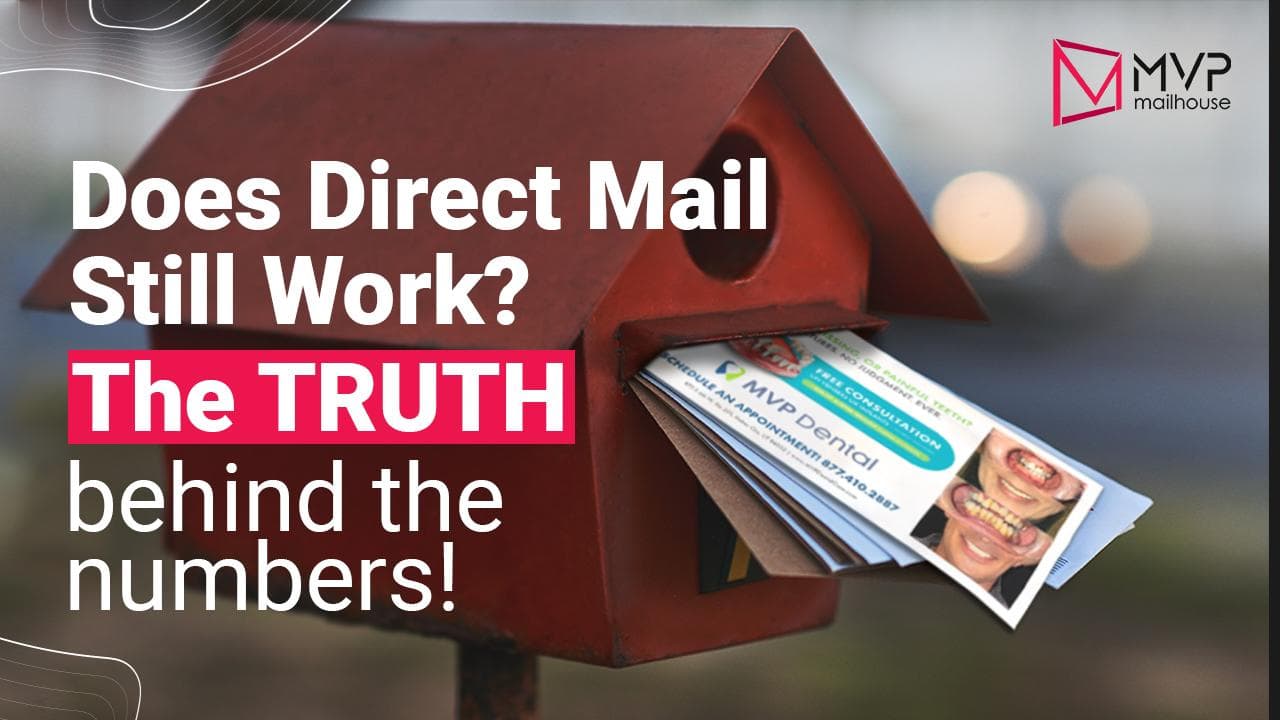
Does direct mail still work in 2025 or has it been replaced entirely by Google Ads, SEO, and social media?
It’s a fair question. Dentists today are flooded with digital marketing pitches promising instant leads and automated growth. But here’s the reality: response rates for direct mail consistently outperform email by a wide margin, and in local healthcare markets, physical mail often drives more first-time appointments than paid social campaigns.
So, does direct mail still work for dentists? Yes and in many cases, it works better than practices expect.
In this article, we’ll break down what’s actually happening in dental marketing today, what the numbers say, and what we’ve seen firsthand running campaigns for practices nationwide. If you’re trying to decide whether direct mail marketing for dentists is outdated or a hidden advantage, you’ll get a clear answer.
The Short Answer: Yes, Direct Mail Still Works, If It’s Done Correctly
Let’s start with clarity.
Direct mail is not dead. Generic, poorly targeted mail is.
When dental direct mail campaigns are built with the right audience, offer, and frequency, they produce consistent patient acquisition at predictable costs. In fact, industry averages show direct mail response rates ranging from 2% to 5% for house lists and 1% to 2% for prospect lists. Compare that to the average email marketing response rate hovering under 1%, and the gap becomes obvious.
According to recent industry benchmarks, direct mail campaigns deliver an average 4.4% response rate, dramatically outperforming email’s typical 0.12% response rate, showing that physical mail still drives action when done well.
But numbers alone don’t tell the full story.
We’ve seen this happen repeatedly: a dental practice spends months running Google Ads, battling competitors, watching cost-per-click rise. Leads come in but inconsistently. Then they launch a targeted direct mail campaign into 5,000 nearby households with a clear new-patient offer. Within 30–60 days, appointment requests spike. Phones ring more. Front desks feel the difference.
The key isn’t the channel alone. It’s control.
With direct mail for dentists, you control:
- Exactly which ZIP codes or carrier routes you hit
- Household income ranges
- Homeownership status
- Family demographics
Digital platforms promise targeting but local dental markets are often saturated and competitive. Mail, on the other hand, physically enters the home. It’s tangible. It sits on the kitchen counter. It gets seen by multiple family members.
If you want deeper context on how the channel performs across industries, our breakdown on how effective direct mail marketing to explore broader response trends and ROI benchmarks.
Why Dental Marketing Is Different From Other Industries
Dental marketing isn’t like e-commerce. It isn’t like SaaS and it definitely isn’t impulse-driven retail.
Dentistry is local, trust-based, and household-driven.
Most patients choose a dentist within 5–10 miles of their home. They rarely switch unless they move, have a bad experience, or need a specific service. That makes visibility inside residential neighborhoods incredibly powerful.
Data consistently shows that over 70% of dental patients come from within a tight geographic radius. This matters because direct mail marketing for dentists allows hyper-local saturation in ways digital ads simply can’t replicate without enormous spend.
Think about it this way:
- Google Ads targets intent but only when someone is actively searching.
- Social ads interrupt but compete with entertainment and endless scrolling.
- Direct mail lands physically inside the decision-making environment.
We’ve seen households schedule multiple family members after receiving one postcard. Why? Because dentistry is often a family decision, not an individual one.
And here’s something most practices underestimate: older homeowners, often the highest-value dental patients are statistically more responsive to physical mail than digital ads. They read it. They keep it. They respond to it.
If you’re weighing channels, our comparison on why direct mail outperforms digital ads for dental practices goes deeper into how these differences play out in real acquisition costs.
Is Direct Mail Effective for Dental Practices in 2025?
Let’s address the skepticism directly.
Many dentists assume direct mail peaked in the early 2000s. But recent data tells a different story. As digital ad costs have increased especially in competitive metro areas, direct mail has regained strategic value.
Consider these trends:
- Cost-per-click for dental keywords often ranges between $5 and $20+, depending on competition.
- Direct mail cost per household can range from $0.40 to $0.70 per piece in volume.
- Average response rates between 1%–3% can generate dozens of new patient inquiries from a 5,000-home drop.
Let’s run simple math.
Mail 5,000 households. At a 2% response rate, that’s 100 inquiries. If 40% convert to booked appointments, that’s 40 new patients.
Even at a conservative $800 lifetime value per patient (many practices exceed this significantly), that’s $32,000 in long-term revenue potential from a single drop.
And here’s what we’ve seen firsthand: consistency compounds. Practices that mail the same routes 3–4 times per year often see response rates increase over time because recognition builds.
Direct mail works best when it’s strategic, not sporadic.
If you want to understand broader trends shaping the channel, our article on the top direct mail facts in 2025 that outlines key statistics every dental practice should know before making decisions.
Why Many Dentists Think Direct Mail Doesn’t Work
Usually, it’s because they tried it once and stopped too soon.
We’ve seen campaigns fail for three predictable reasons:
- The offer wasn’t compelling.
- The targeting was too broad.
- The mailing was one-and-done.
Dental direct mail isn’t magic. It’s math plus repetition.
A single drop builds awareness. The second builds familiarity. The third builds trust. When a household finally needs a cleaning, whitening, or emergency appointment, guess whose card is still on the fridge?
If you’re curious how this compares against other acquisition channels, our guide on what is the most effective type of marketing for dentists that breaks down performance expectations by channel.
What Makes Direct Mail Marketing for Dentists Actually Work
If you’re asking, does direct mail still work, the more important question is this: what separates campaigns that quietly fail from those that reliably add 20–50 new patients per month?
We’ve seen this happen over and over again. Two practices in the same city launch dental direct mail campaigns. One gets minimal traction. The other sees phones light up within weeks.
The difference isn’t luck. It’s structure.
Let’s break down the mechanics that matter.
1. Targeting: Saturation Beats Scattershot Mailing
In dental marketing, geography is everything.
Roughly 70–80% of patients choose a dentist within a short driving distance from their home. That means mailing random ZIP codes across an entire metro area is wasteful. You’re paying for reach when what you need is density.
Effective direct mail for dentists follows a simple rule: Own the neighborhood closest to your practice.
We typically recommend:
- Carrier route targeting within 3–5 miles
- Household income filters aligned with your fee structure
- Homeowner-heavy routes (higher lifetime value, higher retention)
- Family demographics if you focus on pediatric or family dentistry
We’ve seen campaigns where dentists mailed 15,000 homes once and got mediocre results. Then they switched to mailing 5,000 homes consistently every 6–8 weeks and response rates nearly doubled over time.
Why? Familiarity compounds. Repetition builds trust.
If you’re evaluating patient acquisition strategy more broadly, our breakdown on how to get new dental patients that covers how direct mail fits into a sustainable growth plan.
2. The Offer: Make It Clear, Measurable, and Low Friction
One of the biggest mistakes in direct mail marketing for dentists is being too vague.
“Now accepting new patients” is not an offer.
Patients respond to clarity. They want to know exactly what they’re getting and why they should act now.
High-performing offers often include:
- $99 new patient exam, X-rays, and cleaning
- Free whitening with new patient visit
- Emergency exam specials
- Family bundle incentives
The offer must remove hesitation. Dentistry carries anxiety and cost concerns. A transparent, packaged offer reduces both.
We’ve seen response rates jump from 0.8% to 2.4% simply by restructuring the offer and making pricing unmistakably clear.
And here’s the part most practices underestimate: urgency matters. Limited-time framing (30–45 days) dramatically improves call volume compared to open-ended promotions.
If you want to understand realistic benchmarks, our guide on what is a good response rate for direct mail marketing outlines what healthy performance looks like by industry.
3. Design and Messaging: Authority Over Flash
Dental direct mail doesn’t need to look flashy. It needs to look trustworthy.
Patients aren’t choosing a nightclub. They’re choosing someone to work on their teeth.
We’ve tested oversized postcards, standard 6x9 cards, folded mailers, and letter-style formats. What consistently wins?
- A professional headshot of the dentist
- A short credibility statement (years in practice, affiliations, community involvement)
- Real patient testimonials
- A clear call-to-action with phone number front and center
Less clutter. More confidence.
We’ve seen this firsthand: overly busy designs reduce response. Clean layouts with one strong offer outperform “coupon book” formats nearly every time.
And contrary to popular belief, direct mail is not outdated. If anything, mailbox competition has decreased as brands shifted heavily toward digital. That creates opportunity.
Our article on what top direct mail myths busted explains why many assumptions about mail performance are simply wrong.
4. Frequency: The Real Multiplier
Here’s where most dentists misjudge is direct mail effective for dental practices.
They try it once. Direct mail is not a one-touch channel. It’s a visibility channel.
We typically recommend:
- Minimum 3 consecutive drops
- 4–6 campaigns annually for sustained growth
- 6–12 month testing windows
The first drop builds awareness. The second builds recognition. The third builds action.
We’ve seen practices go from 18 new patients per month to 42 within six months simply by staying consistent. Same routes. Same branding. Improved tracking.
The timeline matters.
- Expect early traction within 30 days.
- Expect meaningful compounding within 90 days.
- Expect predictable performance by month six.
Our deeper analysis in why direct mail works for dentists in 2025 breaks down why repetition drives ROI in today’s competitive market.
5. Tracking KPIs: Treat It Like a System, Not a Guess
If you can’t measure it, you can’t scale it.
Every dental direct mail campaign should track:
Calls generated
Appointments booked
Show-up rate
Cost per acquisition (CPA)
Lifetime value (LTV) of new patients
We’ve seen this happen too often: a dentist says “mail didn’t work,” but they never tracked booked appointments separately from inquiries. Or they didn’t attribute patients correctly at the front desk.
Use unique phone numbers or promotional codes. Train staff to ask, “Did you receive our mailer?”
From there, performance becomes predictable.
If you’re comparing channels, our guide on direct mail vs Google Ads for dentists shows how CPA and long-term ROI typically stack up.
What Results Should Dentists Realistically Expect?
Let’s ground this in practical expectations.
For a 5,000-home mailing:
- 1–3% response rate
- 50–150 inquiries
- 30–60 booked appointments (depending on staff performance)
At even a modest $1,000 lifetime value per patient, that can translate into $30,000–$60,000 in long-term revenue from a single campaign cycle.
But the real strength of direct mail for dentists isn’t a single drop.
It’s sustained presence in your local market.
We’ve seen practices build steady pipelines where new patient flow becomes predictable month over month. Not viral. Not explosive. Just consistent.
And in dentistry, consistency wins.
When Should Dentists Prioritize Direct Mail Over Digital?
By now, the question isn’t just does direct mail still work, it’s when does it make the most sense?
Here’s the honest answer: direct mail works best when you need predictable, local patient growth. Not vanity metrics. Not impressions. Actual booked appointments.
We’ve seen direct mail outperform digital in three specific scenarios:
1. New Practice Launches
A startup dental office needs awareness fast. SEO takes months. Google Ads can be expensive and volatile. Direct mail can saturate 5,000–10,000 nearby households within weeks and immediately introduce the dentist to the community.
2. Plateaued Growth
When a practice is stuck at 20–25 new patients per month and digital ads are maxed out, adding consistent direct mail marketing for dentists often breaks the ceiling. It adds a second acquisition engine that doesn’t rely on search behavior.
3. Competitive Metro Markets
In cities where cost-per-click keeps rising, direct mail offers stable acquisition costs. Instead of competing in auctions, you’re competing for attention inside the mailbox.
That doesn’t mean digital marketing has no place. In fact, the strongest dental marketing strategies combine both.
- Direct mail drives awareness and first-time visits.
SEO builds long-term organic visibility.
Google Ads captures high-intent searchers.
But here’s what we’ve observed repeatedly: practices that rely only on digital are more vulnerable to algorithm changes, ad cost spikes, and inconsistent lead flow.
Practices that integrate direct mail create stability.
If you want a broader breakdown of multi-channel strategy, our guide on what are the top dental marketing strategies that actually work walks through how these pieces fit together.
So, Does Direct Mail Still Work?
Yes. Unequivocally when it’s executed strategically.
- It works because dentistry is local.
- It works because households still check their mail daily.
- It works because tangible marketing builds familiarity faster than digital noise.
And it works because most of your competitors are underutilizing it or doing it inconsistently.
- We’ve seen practices add 30–50 new patients per month within 90 days.
- We’ve seen consistent 1–3% response rates when targeting and offers are dialed in.
- We’ve seen patient acquisition costs remain stable while digital channels fluctuate.
Direct mail isn’t flashy. It isn’t trendy.
But it’s measurable. Repeatable. Scalable.
And in dentistry, predictable growth beats hype every time.
If you’re still questioning whether direct mail is effective for dental practices, our in-depth breakdown on why direct mail marketing still works in dentistry dives deeper into performance data and real-world examples.
Final Thoughts
Dental growth isn’t about chasing the newest tactic. It’s about building reliable patient acquisition systems.
Direct mail for dentists remains one of the most controllable, local, and scalable marketing channels available today. When you combine smart targeting, compelling offers, consistent frequency, and proper tracking, it becomes a predictable growth engine, not a gamble.
If you’re serious about adding new patients consistently, not occasionally, it’s worth evaluating how direct mail fits into your strategy.
Ready to see what it could look like for your practice?
Visit our website to explore proven dental direct mail strategies, or schedule a demo with our team to map out a campaign tailored to your market. Let’s build something predictable.
Tags
Direct Mail Strategies
Frequently Asked Questions
Related blog




Ready For Your Success Story?
Get 500 Free Handout cards shipped right to your doorstep!